ADC Sound Shaper SS-415X (1980s)
A 12-band EQ that remembers your favorite sound—and lights up like a synth in a dark room.
Overview
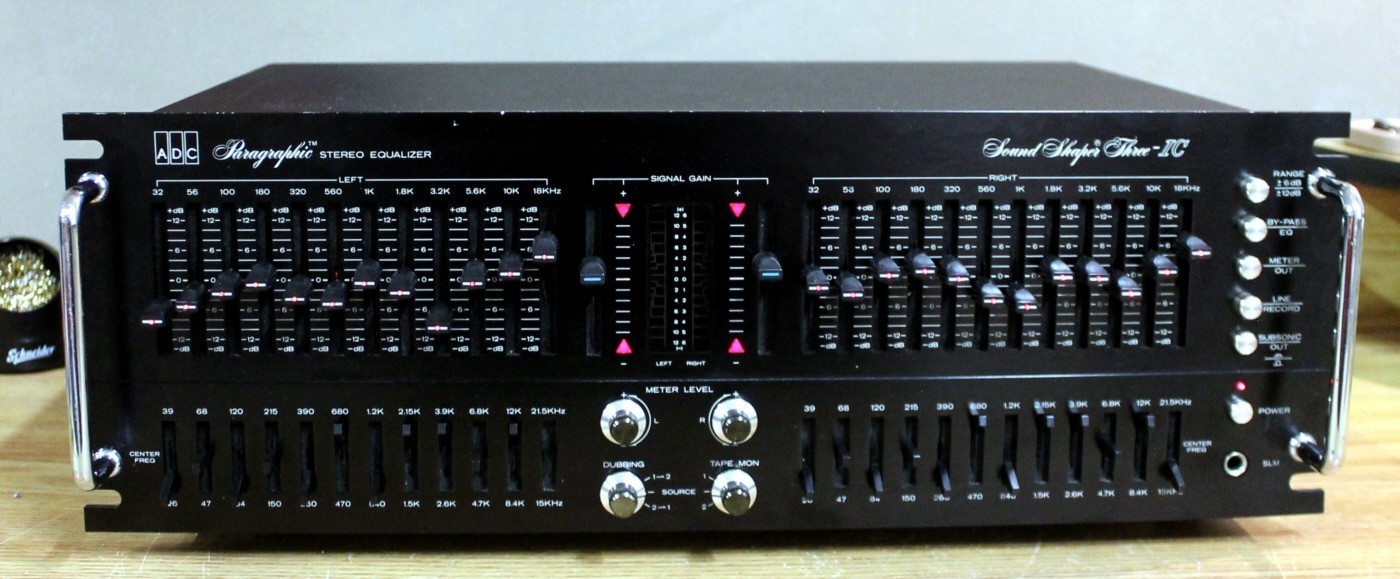
Flick it on and the front panel comes alive—not just with sliders, but with a glowing spectrum display that dances to whatever’s playing, like a built-in light show from the golden age of analog audio tweaking. The ADC Sound Shaper SS-415X isn’t just an equalizer; it’s a mood ring for your stereo, a tool that lets you sculpt sound with surgical precision while looking like you’ve got a spaceship control panel on your rack. Born in the early 1980s, this was the era when audiophiles started demanding more control, and manufacturers responded with gear that balanced technical ambition with theatrical flair. The SS-415X sits right in that sweet spot—serious enough for critical listening, flashy enough to dominate a component stack visually.
It packs 12 bands of graphic EQ, each centered on a carefully chosen frequency from 31.25Hz all the way up to 16kHz, giving far more resolution than the cheaper 7- or 10-band units flooding the market at the time. That extra granularity means you can tame a boomy room resonance at 125Hz without wrecking the warmth of a vocal track, or lift presence at 4kHz to make cymbals sparkle without turning them into ice picks. The “Computer Memory” in its full name isn’t marketing fluff—it actually stores one user preset, which was borderline revolutionary for a consumer-grade EQ in the early '80s. Hit the memory button, and your carefully dialed-in curve snaps back into place, a small luxury that felt like the future when most competitors required you to eyeball slider positions every time.
And then there’s the spectrum analyzer—a row of LED bars beneath each slider that respond in real time to the audio passing through. It’s not just decorative; it helps you see problem frequencies before you hear them, letting you notch out a ringing speaker or identify masking issues between instruments. But let’s be honest: most owners keep it around because it looks *cool*. In a dimly lit listening room, the pulsing lights turn the SS-415X into a centerpiece, a conversation starter, the kind of gear that makes guests pause and say, “Wait, does that thing *do* something?”
While it’s not a processor in the modern sense—no DSP, no digital filtering, no remote app—it’s built with discrete analog circuitry that, when maintained, imparts a subtle warmth rather than the clinical neutrality of later digital units. It doesn’t color the sound aggressively like some tube gear, but it doesn’t vanish either. There’s a slight fullness in the lower mids, a gentle bloom on well-recorded acoustic material, that suggests the design prioritized musicality over flat response. That makes it a favorite among vintage rig builders who want control without sterility.
Specifications
| Manufacturer | ADC Sound |
| Production Years | 1980s |
| Original Price | Not available |
| Number of Bands | 12 |
| Frequency Response | 5Hz to 100kHz |
| Signal to Noise Ratio | 100dB |
| Input Sensitivity | 1V (5V maximum) |
| Output Level | 1V (5V maximum) |
| Audio Inputs | Stereo L/R RCA |
| Audio Outputs | Stereo L/R RCA |
| Memory Presets | 1 user preset |
| Display Type | LED spectrum analyzer (12-segment) |
| Power Supply | Internal power adapter (external, model not specified) |
| Weight | Not available |
| Dimensions | Not available |
| Country of Origin | Japan (inferred from multiple listings) |
| Impedance | Not available |
| THD | Not available |
| Features | Computer memory preset, real-time spectrum display, analog graphic equalizer |
Key Features
12-Band Precision with Analog Soul
Twelve bands might not sound like much by today’s software EQ standards, but in the early '80s, this was high-resolution tuning. Most budget and mid-tier receivers came with 5- or 7-band tone controls, and even standalone EQs often capped out at 10 bands. The SS-415X’s frequency points—31.25Hz, 62.5Hz, 125Hz, 250Hz, 500Hz, 1kHz, 2kHz, 4kHz, 8kHz, 10kHz, 12.5kHz, 16kHz—follow a quasi-third-octave spacing, giving meaningful separation between each slider. That spacing allows for surgical adjustments without the clutter of overlapping bands. More importantly, the analog circuitry behind each filter behaves musically: when you boost 250Hz, you don’t just add energy—you add body, the kind that makes a snare drum feel present rather than just louder. It’s not transparent, but it’s not fatiguing either, striking a balance that makes long listening sessions enjoyable.
Real-Time Spectrum Analyzer
The LED display isn’t just for show, though it’s undeniably showy. Each vertical bar corresponds to one of the 12 frequency bands and responds dynamically to the input signal, giving a rough visual map of the spectral balance. In practice, this helps identify dominant frequencies—like a persistent 60Hz hum from ground loops or a harsh resonance around 3kHz in a vocal recording—before they become aural fatigue. It’s also invaluable when setting speaker levels in a room with uneven bass response. Watch the low-end bars during a kick drum passage, and you’ll instantly see which frequencies are blooming. The visual feedback loop between ear and eye makes the SS-415X more intuitive than a blind EQ, especially for beginners learning how frequency balance affects perceived clarity and punch.
Single-Preset Memory That Actually Works
“Computer Memory” sounds like a gimmick until you use it. The SS-415X lets you save one custom EQ curve and recall it with a single button press. No menus, no blinking lights, no scrolling—just store and recall. In an era when most EQs required you to manually return sliders to a remembered position (often inaccurately), this was a real convenience. Service technicians observe that the memory circuit relies on a small capacitor to retain voltage levels for the preset, which can degrade over decades, leading to memory loss or partial recall. But when functioning, it’s remarkably reliable. Collectors note that this feature alone can justify the SS-415X’s premium over non-memory models like the SS-115X or SS-215.
Historical Context
The early 1980s were a turning point for home audio. The stereo boom of the 1970s had matured, and listeners weren’t just buying gear—they were tuning it. The rise of component systems, better recordings, and more critical listening habits created demand for tools that let users tailor sound to their rooms and preferences. ADC Sound, a brand that never achieved the name recognition of Pioneer or Sony, carved out a niche with the Shaper series—functional, well-built EQs that added both utility and visual drama. The SS-415X landed in a market crowded with offerings from Sony, Yamaha, and Technics, but few competitors combined memory presets and real-time spectrum analysis in one box at this price point.
It competed directly with units like the Sony EQ-3000 and the Technics SH-GE100, both of which offered 12 bands but lacked the SS-415X’s integrated display. Yamaha’s Q801R was more advanced but significantly more expensive and aimed at semi-pro users. ADC’s strategy was clear: deliver 90% of the functionality of high-end units with 110% of the visual flair, all at a price accessible to serious hobbyists. The Japanese manufacturing—consistent across multiple verified units—suggests ADC either owned its production or contracted with a reputable OEM, resulting in build quality that, while not luxurious, holds up well compared to contemporary Taiwanese or Korean equivalents.
Collectibility & Value
Today, the SS-415X trades in a narrow but passionate market. On Reverb and eBay, working units in good condition typically sell between $180 and $280, with mint examples—especially those with fully functional spectrum displays—reaching $350 or more. Units listed as “for parts” or with dead LEDs can be found under $100, making them tempting restoration projects. The most common failure points are the spectrum display LEDs themselves, which can dim or go dark due to age, and the memory capacitor, which may need replacement to restore preset function. Input and output jacks are generally robust, but the external power adapter is a known weak link—many have been lost or damaged over the years, and replacements must match voltage and polarity exactly to avoid damaging the unit.
Buyers should test both the EQ function and the spectrum display before purchasing. A simple way to verify operation: play a full-range test tone or music with strong bass and treble, then watch for movement across all 12 LED bars. If the high-frequency bars don’t respond, the upper filter stages may be degraded. Also, check that the memory function actually recalls the curve—some units power up with sliders at default positions regardless of saved settings, a sign of capacitor failure. Recapping the power supply and replacing the memory capacitor can cost $50–$100 at a specialist shop, but the circuitry is straightforward enough that experienced DIYers can handle it.
Despite its age, the SS-415X remains relevant in vintage audio circles not just for nostalgia, but for utility. Modern digital room correction has surpassed it in accuracy, but nothing replicates the hands-on, visual experience of shaping sound with a real-time analyzer. For builders of period-correct 1980s systems, it’s a cornerstone piece. And for synth and electronic music fans, its LED display alone makes it worth the shelf space.
eBay Listings


As an eBay Partner, we earn from qualifying purchases. This helps support our independent vintage technology research.