ADC Sound Shaper SS-412X (1985–1987)
A 10-band EQ with a hypnotic 12-band spectrum analyzer that turns room acoustics into a light show — if you can find one that still lights up.
Overview
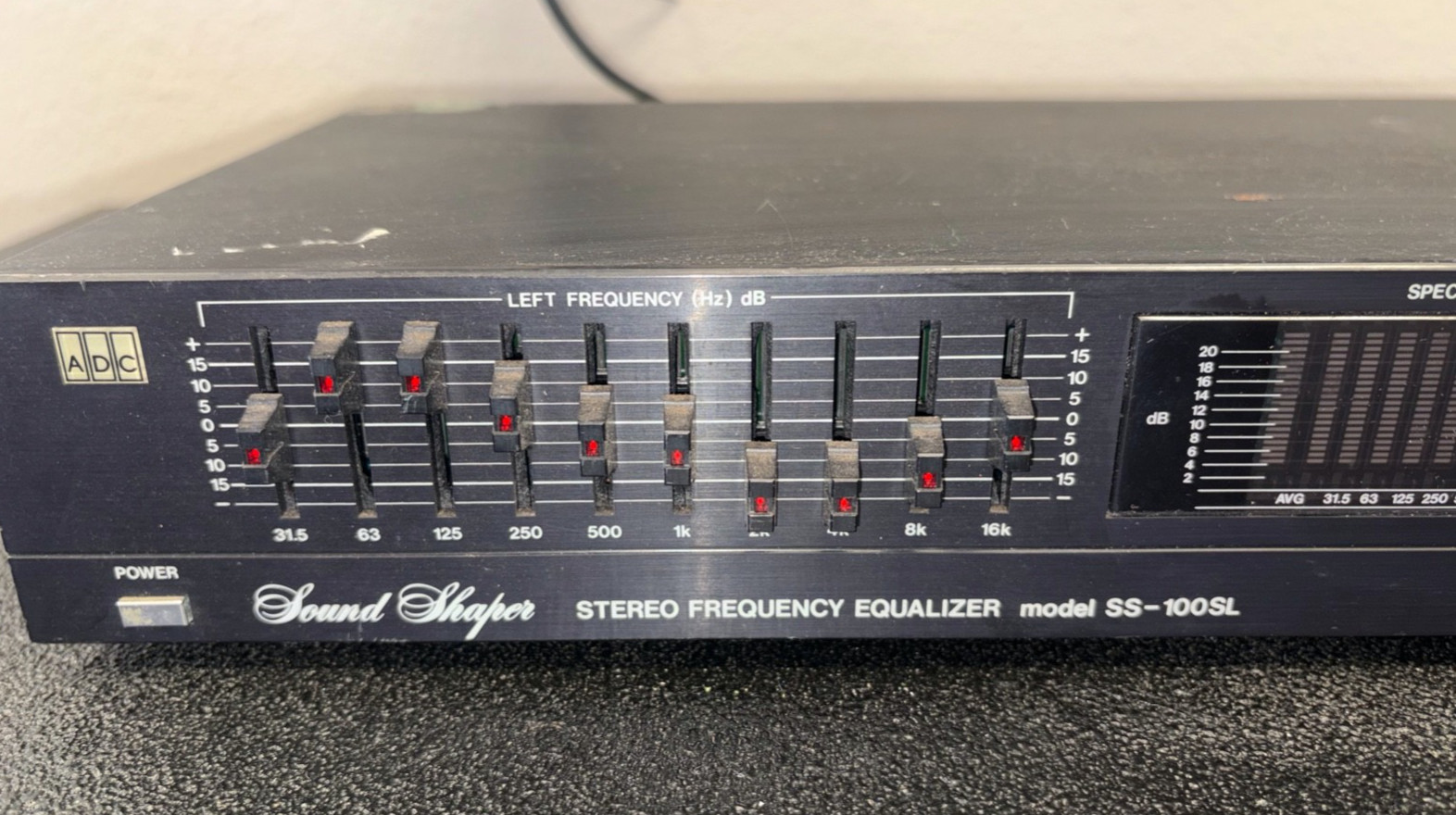
Plug it in, hit play on a dense orchestral cut, and the front panel comes alive like a slow-motion firework — tiny fluorescent bars dancing in real time, each one a pulse of the music’s soul. The ADC Sound Shaper SS-412X isn’t just an equalizer; it’s a diagnostic machine, a tuning fork for your listening room, wrapped in brushed steel and blinking with the quiet confidence of late-'80s American engineering. This was the era when audiophiles started demanding more than flat response — they wanted control, visibility, and a way to fight the acoustic gremlins hiding in their corners and ceiling reflections. The SS-412X answered with a dual identity: a surgical 10-band graphic EQ on one side, and on the other, a real-time spectrum analyzer that could show you exactly where your room was murdering your highs or bloating your bass.
It wasn’t the first EQ with a built-in analyzer, but it was one of the few to do both at this level of resolution and build quality while staying under the five-figure price tag of the high-end European competition. The 12-band analyzer, fed by an included measurement microphone, breaks down the audio spectrum from 31.5 Hz to 16 kHz, displaying amplitude with 156 individual fluorescent segments — 13 per band — plus an additional 26-segment “average response” indicator that smooths out the peaks to reveal long-term trends. That’s not just useful; it’s borderline obsessive. And that’s the point. This wasn’t gear for casual tweakers. It was for people who owned real test records, who kept their turntable azimuth gauges calibrated, and who believed that a room was just another component in the signal chain — one that needed equalizing like anything else.
Despite its technical ambition, the SS-412X never became common. It was expensive when new — over $900 in Germany, which was serious money in 1987 — and its niche appeal meant it didn’t flood the used market. Today, it’s a rare sight outside specialist collections or the back shelves of aging home studios. But when you find one that works, it’s a revelation. The EQ section uses precision passive filters with low-distortion amplification, and the measured specs back it up: a claimed THD of just 0.008%, signal-to-noise ratio of 100 dB, and frequency response flat from 20 Hz to 20 kHz. That’s not just good for the era — it’s good by modern standards. And unlike many EQs of the time, it doesn’t add grain or smear when you boost or cut. It just shapes.
Specifications
| Manufacturer | Audio Dynamics Corporation (ADC), New Milford, CT |
| Production Years | 1985–1987 |
| Original Price | 908.00 DM (Germany, 1987) |
| Equalizer Bands | 10 bands (31.5 Hz, 63 Hz, 125 Hz, 250 Hz, 500 Hz, 1 kHz, 2 kHz, 4 kHz, 8 kHz, 16 kHz) |
| Equalizer Adjustment Range | ±12 dB per band |
| Spectrum Analyzer Bands | 12 bands (31.5 Hz to 16 kHz) |
| Display Type | Fluorescent indicator tube with 156 active segments + 26 average response segments |
| Inputs | 2 x RCA (stereo line-level) |
| Outputs | 1 x RCA (stereo line-level) |
| Microphone Input | Built-in preamp for included measurement mic |
| Frequency Response | 20 Hz – 20 kHz (±0.5 dB) |
| Total Harmonic Distortion (THD) | ≤ 0.008% |
| Signal-to-Noise Ratio | 100 dB |
| Input Sensitivity | 250 mV for rated output |
| Output Level | 2 V RMS maximum |
| Power Supply | AC 220 V (switchable for other regions?) |
| Power Consumption | Not specified |
| Dimensions | Standard 19-inch rack width, 2U height (exact depth not specified) |
| Weight | Not specified |
| Construction | Steel chassis, brushed aluminum front panel |
| Mounting | Rack-mountable (19-inch) |
Key Features
The Fluorescent Display That Tells You What You’re Missing
The SS-412X’s most arresting feature is also its most fragile: the fluorescent spectrum display. Unlike the LED bars that would dominate the '90s, this uses a single vacuum fluorescent tube divided into 13 vertical segments per frequency band, creating a smooth, glowing cascade of light that responds instantly to transients. The 12 analyzer bands don’t perfectly align with the 10 EQ bands — a deliberate choice, according to service documentation — allowing users to see how their adjustments affect adjacent frequencies. The average response overlay, rendered in a separate 26-segment bar, acts like a slow-motion exposure, revealing room resonances that might be masked by momentary peaks. It’s not just a gimmick; it’s a diagnostic tool that, when used with test tones and pink noise, can pinpoint standing waves, nulls, and reflections with startling clarity. But that beauty comes at a cost: these tubes degrade over time, and replacements are nonexistent. A dim or flickering display isn’t just cosmetic — it’s a sign the unit may be nearing the end of its functional life.
Passive EQ With Surgical Precision
While many graphic equalizers of the era used active filter designs that could color the sound even when set flat, the SS-412X relies on a passive EQ network buffered by low-noise amplifiers. This means the signal path stays clean when no correction is applied, and the EQ bands interact minimally with one another. Each slider controls a tightly defined frequency band with a Q factor calibrated to affect only the targeted range — no smearing into neighboring octaves. That precision makes it ideal for room correction, where broad boosts can make things worse. The ±12 dB range is generous but not excessive, discouraging the kind of over-EQing that turns music into a caricature. And because the circuitry was designed with headroom in mind, it handles dynamic peaks without clipping, even when multiple bands are boosted. This isn’t a “vibe” EQ — it won’t warm up your mix like a tube unit or add grit like an API. It’s a scalpel, not a sledgehammer.
Integrated Measurement System With Real-World Use
ADC didn’t expect users to guess where their room problems were. The SS-412X ships with a calibrated measurement microphone, a rare inclusion at any price point in the mid-'80s. Plugged into the front-panel mic input, it feeds a dedicated preamp that drives the analyzer display. The process is straightforward: play pink noise through your system, place the mic at the listening position, and watch the analyzer reveal the room’s frequency response. Then, adjust the EQ sliders to flatten the display. It’s not perfect — microphone calibration drifts over decades, and the analyzer’s resolution is limited by its 12-band structure — but for pre-digital room correction, it’s remarkably effective. Collectors report that original mics are often missing or damaged, and replacements are hard to source. Some have substituted modern measurement mics with success, but the original’s frequency response curve was tailored to the SS-412X’s analyzer, so substitutions require careful calibration.
Historical Context
The mid-1980s were a turning point for high-end audio. Digital recording was gaining ground, CDs were replacing vinyl in many homes, and manufacturers were responding with gear that emphasized technical transparency over sonic character. The SS-412X arrived in 1985, just as audiophiles were beginning to realize that no matter how perfect the electronics, the listening room itself could ruin everything. Competitors like Sony and Technics offered basic tone controls or rudimentary EQs, but few provided real-time visual feedback. The SS-412X stood apart by treating room acoustics as a solvable engineering problem — not a mystical force to be endured. It competed most directly with European units like the Sennheiser MD-05 and the much more expensive Brüel & Kjær analyzers used in professional studios, but at a fraction of the price. It also predated the DSP-based room correction systems of the 2000s by nearly two decades, making it a pioneer in accessible acoustic tuning. Built in the U.S. but marketed internationally — evidenced by its 220V default power supply — it reflected a brief moment when American companies still competed in the high-resolution audio space before being overtaken by Japanese and later European digital solutions.
Collectibility & Value
Finding a working SS-412X today is like finding a vintage oscilloscope that still calibrates — possible, but increasingly rare. Units in excellent cosmetic and functional condition typically sell between $400 and $700, but prices spike when the fluorescent display is bright and stable, the sliders move smoothly, and the original microphone is included. The display is the Achilles’ heel: these tubes were not designed for 40-year lifespans, and when they fail, they can’t be replaced. Some units exhibit flickering, dim segments, or complete failure in the higher bands — a sign of cathode depletion or internal gas contamination. There’s no repair path; the tube is a custom part, long out of production. Beyond the display, the most common issues are dirty slide pots, which cause crackling or channel imbalance, and dried-up electrolytic capacitors in the power supply, which can lead to hum or failure to power on. Recapping is recommended for any unit that hasn’t been serviced in the last 15 years. The rack-mount ears are sturdy, but the steel chassis can show rust at the edges if stored in damp environments. When buying, insist on video proof of the display in operation — a still photo won’t reveal flicker or dead segments. And test the microphone input with a known source if possible; the preamp is sensitive and can drift out of spec.
Despite its age, the SS-412X still has practical value. In analog studios or high-end vinyl setups, it can outperform modern digital room correction in terms of phase coherence and transparency. But it’s not a plug-and-play solution. It requires knowledge, patience, and a willingness to engage with its analog workflow. For collectors, it’s a trophy piece — a symbol of a time when high fidelity meant not just listening, but measuring, adjusting, and optimizing. It’s also a conversation starter: that glowing display still turns heads at audio shows. But it’s not for everyone. If you want something that integrates with Dirac or MiniDSP, look elsewhere. The SS-412X is a standalone artifact, a self-contained acoustic laboratory from an era when the future was analog, visible, and glowing faintly green in the dark.
eBay Listings

As an eBay Partner, we earn from qualifying purchases. This helps support our independent vintage technology research.