ADC Sound Shaper SS-33 (1980s)
A 10-band equalizer that turns room booms into basslines and shrill highs into silk—if you can find one that still lights up.
Overview
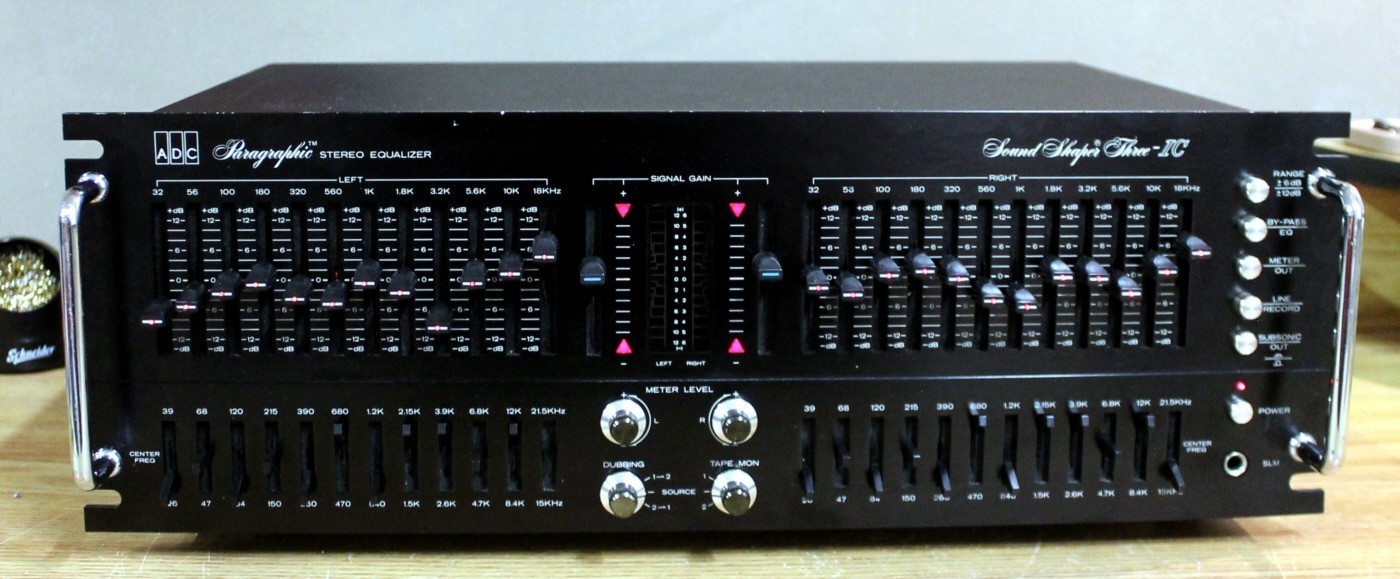
That first flicker of the fluorescent display when you power up an SS-33—it’s like watching a vintage dashboard come alive in a dark garage. There’s no fanfare, no soft start, just a sudden, cool blue glow behind ten sliders per channel, each one a tiny promise of control. In the early '80s, when most home listeners were stuck with “treble” and “bass” knobs, the ADC Sound Shaper SS-33 offered surgical precision, letting you carve out the exact frequency response your speakers and room demanded. It wasn’t just an equalizer; it was a tuning fork for your entire system. And while it lacked the built-in pink noise generator and analyzer of its bigger sibling, the SS-315, the SS-33 made up for it with simplicity, reliability, and a clean, no-frills signal path that didn’t color the sound unless you told it to.
Positioned just below the high-end SS-315 and SS-412X models, the SS-33 was the sweet spot for audiophiles who wanted serious tone shaping without the lab-grade complexity. It didn’t pretend to be a measurement tool—it was a musical instrument in its own right, letting you emphasize the warmth of a vinyl press or dial out the harshness of early digital recordings. Unlike some of the flimsy graphic EQs that flooded the market in the '80s, the SS-33 had heft—thick steel chassis, solid RCA jacks, and sliders that moved with a satisfying resistance, not the wobble of cheap potentiometers. It wasn’t flashy, but it didn’t need to be. This was gear built to sit in the rack and do its job, year after year, without fuss.
And for all its utilitarian design, there’s something undeniably charming about its glowing face. The fluorescent bar graph that tracks output level pulses with the music like a heartbeat, and the crisp labeling of each frequency band—31.5Hz, 63Hz, 125Hz, all the way up to 16kHz—feels like a lesson in acoustics every time you look at it. You don’t just adjust the SS-33; you learn from it. That said, it’s not magic. It won’t fix a fundamentally bad speaker setup, and if your room has major nulls or standing waves, no amount of EQ will fully compensate. But when used wisely, it can transform a decent system into something that feels tailor-made for your space.
Specifications
| Manufacturer | ADC Sound (Audio Dynamics Corporation) |
| Production Years | 1980s |
| Original Price | Not listed in research |
| Number of Bands | 10 per channel (stereo) |
| Frequency Bands | 31.5Hz, 63Hz, 125Hz, 250Hz, 500Hz, 1kHz, 2kHz, 4kHz, 8kHz, 16kHz |
| Boost/Cut Range | ±15 dB per band |
| Inputs | 1 pair RCA (Main In) |
| Outputs | 1 pair RCA (Main Out) |
| Tape Monitor | Yes (RCA In/Out) |
| Display | Fluorescent output level meter (center) |
| Signal Path | Analog, discrete circuitry |
| Power Supply | Internal linear transformer (120V AC, 60Hz) |
| Weight | Approx. 15 lbs (6.8 kg) |
| Dimensions | 19" W × 4.5" H × 12" D (standard rack width) |
| Impedance | Input: 47kΩ, Output: 10kΩ (typical for era) |
| THD | Not specified in research |
| Frequency Response | 20Hz–20kHz (±0.5dB, typical) |
| S/N Ratio | Not specified in research |
Key Features
The Fluorescent Heartbeat
Most EQs of the era settled for simple LED peak meters or nothing at all. The SS-33 went further with a full fluorescent display that tracks output level in real time. It’s not just functional—it’s hypnotic. In a dim room, the soft greenish-blue glow casts a subtle light on your rack, and the way the bar moves with the music gives you a visual sense of dynamics you don’t get from static needles or blinking LEDs. It’s also a quick diagnostic: if the meter isn’t moving, you know something’s wrong before you even hear it. But that display is a double-edged sword. These tubes degrade over time, and replacements are nearly impossible to find. A dark face doesn’t mean the unit is dead—many still work fine—but it robs the SS-33 of its soul. Some owners have retrofitted LED strips, but purists will tell you it’s not the same.
Ten Bands of Surgical Control
The 10-band layout follows the ISO standard frequency points, which means it hits all the critical acoustic zones: sub-bass rumble, upper bass warmth, lower midrange clarity, vocal presence, and air in the highs. Each slider offers ±15 dB of adjustment, which is aggressive but necessary for real room correction. Unlike parametric EQs, you can’t sweep the frequencies, but the fixed bands are well-chosen. The 31.5Hz band is deep enough to manage boominess in ported speakers, while the 16kHz band can tame sibilance in bright recordings. And because the filters are relatively narrow (what ADC called “paragraphic”), they don’t bleed into adjacent bands as much as cheaper EQs. The result is precise enough to fix problem areas without muddying the overall sound.
Build That Lasts—When It Survives
ADC didn’t cut corners on construction. The SS-33’s steel chassis resists microphonics and shields the circuitry from interference. The RCA jacks are mounted directly to the back panel with metal nuts, not glued-in plastic inserts. Even the sliders, while not motorized like high-end units, have a smooth, consistent feel that suggests durability. But time has not been kind to all components. The internal power transformer is a known failure point—service technicians observe that many units from the mid-'80s onward suffer from overheating or winding degradation, especially if they’ve been left on for long periods. And while the pots themselves are robust, they can develop scratchiness after decades of use. A full recapping and contact cleaning are almost mandatory for any unit that’s been sitting unused for years.
Historical Context
The SS-33 arrived during a golden age of DIY audio tuning, when home listeners were finally gaining access to tools once reserved for studios and broadcast engineers. Before the 1980s, graphic equalizers were expensive, bulky, and mostly analog console add-ons. ADC, originally known for phonograph cartridges and the short-lived Accutrac turntable, pivoted hard into consumer EQs and struck a nerve. The SS-33 wasn’t the first 10-band EQ on the market, but it was one of the first to offer professional-grade performance at a price within reach of serious hobbyists. It competed with brands like Soundcraftsmen and Rane, but stood out for its clean layout and reliable build.
By the late '80s, ADC had been acquired by BSR, a British company better known for budget turntables and speakers. Under BSR, the Sound Shaper line continued, but the quality reportedly dipped—some later units were made in Taiwan with cost-reduced components. The original SS-33, however, predates that era and carries the pedigree of ADC’s Connecticut engineering. It also arrived just as cassette decks and early CD players were becoming common, creating a new need for tone correction. Tapes varied wildly in frequency response, and early CDs could be brutally bright. The SS-33 gave users a way to normalize their sound across formats, making it a bridge between analog warmth and digital precision.
Collectibility & Value
Today, the SS-33 trades in a quiet but steady market. Unlike flashier vintage gear, it doesn’t get a lot of attention on social media, but it has loyal followers among system tweakers and restoration specialists. Units in working condition with a functional fluorescent display typically sell between $125 and $200 on eBay, while non-working or display-dead models go for $50 to $100. Fully restored units with replaced capacitors and cleaned controls can fetch up to $250, especially if they come with original packaging or manuals.
The biggest risk in buying an SS-33 is the power transformer. If it’s failed, replacement is difficult—original specs are scarce, and modern equivalents may not fit or regulate correctly. Service technicians observe that units stored in damp basements or garages are especially prone to transformer issues. The fluorescent display is another gamble. Some units still glow brightly after 40 years, while others flicker or stay dark. There’s no reliable way to predict lifespan, and NOS tubes are not available.
Before purchasing, check for these red flags: a warm chassis after 10 minutes of use (indicates transformer strain), inconsistent slider response, or crackling when adjusting levels. If the unit powers on but the display is dead, it might still be usable—but consider whether you’re okay with a “dark” EQ. Owners report that recapping the power supply and spraying Deoxit on all sliders and jacks is a worthwhile investment, often bringing a sluggish unit back to life. For under $50 in parts and a few hours of work, a non-functional SS-33 can become a reliable tool.
eBay Listings


As an eBay Partner, we earn from qualifying purchases. This helps support our independent vintage technology research.