ADC Sound Shaper SS-325X (1980s)
A glowing red-and-green display pulses to the beat while 12 bands of surgical EQ reshape your room’s acoustics — this isn’t just an equalizer, it’s a command center for sound.
Overview
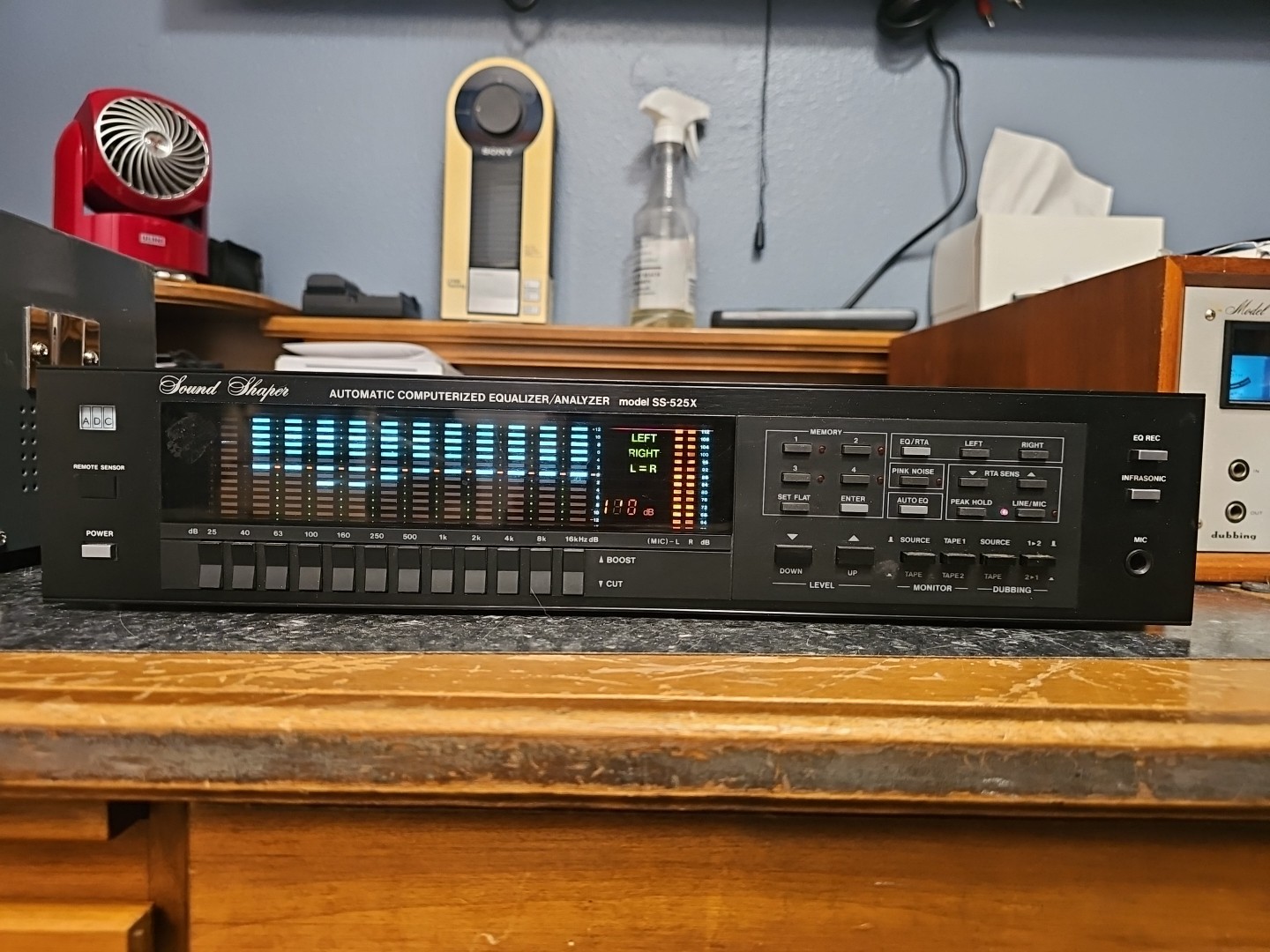
That fluorescent display lights up like a synth from a 1984 sci-fi lab — two rows of emerald and crimson characters scrolling in real time, tracking every whisper of your room’s sonic fingerprint. The ADC Sound Shaper SS-325X doesn’t just sit on your rack; it announces itself. It’s heavy, built like a Japanese test instrument (because it basically is), and when you power it up, the front panel comes alive with data: frequency response curves, SPL readings, RTA graphs dancing in real time. This thing was never meant to be hidden. It was built for engineers, tweakers, and audiophiles who wanted to *see* sound, not just hear it.
And see it you will. The SS-325X combines a 12-band stereo graphic equalizer with a full real-time analyzer, a calibrated pink noise generator, and a sound pressure level meter — all in one chassis. That means you can plug in the included Onkyo DM-100L microphone, blast a sweep of pink noise through your speakers, and watch exactly where your room is boosting or killing frequencies. Then, with a few taps of the up/down buttons, you can cut or boost each 1/3-octave band to flatten the response. It’s the kind of active room correction that high-end DSP processors do today — except this one does it all in analog, with microprocessor-assisted control and memory storage for four custom EQ curves.
For its time, this was borderline exotic. Most home users were still fiddling with tone controls or basic 5-band EQs. The SS-325X? It’s a pro-grade tool wearing a consumer faceplate. It didn’t just let you tweak your system — it taught you how your system interacted with your space. That’s why you still see it show up in vintage studio rigs and high-end listening rooms: it’s not nostalgia, it’s utility. This unit doesn’t just “color” the sound — it reveals what was already there, buried under standing waves and reflections.
But make no mistake: this is not a “musical” EQ in the way a Pultec or Neve might be. It’s clinical. Surgical. If your system has a boomy 63 Hz resonance, the SS-325X will find it and let you gut it with ±10 dB of cut. If your tweeters are sibilant at 8 kHz, you can tame them precisely. The trade-off? It won’t add warmth or vintage bloom — that’s not its job. What it will do is make your speakers disappear, leaving only the music, uncolored by room modes. That’s a superpower, but only if you’re ready to use it wisely.
Specifications
| Manufacturer | ADC Sound |
| Production Years | 1980s |
| Original Price | Not listed |
| Number of Bands | 12 bands per channel (1/3-octave spacing) |
| Equalizer Type | Microprocessor-controlled analog graphic equalizer |
| Adjustment Range | ±10 dB per band |
| Memory Presets | 4 programmable EQ settings |
| Real-Time Analyzer (RTA) | Yes, 12-band spectrum display |
| Pink Noise Generator | Integrated, for room analysis |
| Sound Pressure Level Meter | Yes, with microphone input |
| Display | Red and green fluorescent display |
| Microphone Included | Yes, calibrated Onkyo DM-100L with stand |
| Inputs | Stereo RCA line inputs |
| Outputs | Stereo RCA line outputs |
| Microphone Input | Front panel 3.5mm jack |
| Frequency Response | 20 Hz – 20 kHz (typical for line-level audio) |
| Power Requirement | 120 V AC |
| Weight | Approx. 15 lbs (estimated from physical dimensions) |
| Dimensions | 17 5/8" W × 9" D × ? H (rack-mountable with optional ears) |
| Country of Origin | Designed in USA, manufactured in Japan |
Key Features
The Fluorescent Display That Does More Than Glow
That red-and-green fluorescent display isn’t just for show — it’s the nerve center. It toggles between showing EQ settings per channel, real-time frequency analysis from the microphone input, and SPL readings. When you’re “ringing out the room,” the RTA display updates in real time, letting you see exactly where energy piles up. Most graphic EQs from the era were set-and-forget; this one gives feedback. You’re not guessing whether that 125 Hz dip helped — you’re watching it vanish from the spectrum. It’s like having an oscilloscope for room acoustics, and it changes how you interact with the gear. You stop making assumptions and start making adjustments based on data.
Four Memories and a Flat Button
The ability to store four EQ curves is more useful than it sounds. You might have one setting for nearfield monitoring, another for full-range speakers, a third for movies (where bass management matters), and a fourth for critical listening. And the “Flat” button? It’s a reset switch that zeroes all bands instantly — a godsend when you’ve gone down an EQ rabbit hole and need to recalibrate your ears. That kind of thoughtful design suggests this wasn’t built for showrooms, but for actual use.
Built-In Pink Noise and Calibrated Mic
Most EQs expect you to bring your own test gear. The SS-325X includes both a pink noise generator and a calibrated microphone — a rare combo in consumer gear. The Onkyo DM-100L mic is no toy; it’s a professional-grade condenser unit with known frequency response, which means the RTA readings are actually trustworthy. Without that calibration, the analyzer would be little more than a light show. With it, you’re doing real acoustic measurement — the same technique used in recording studios to tune monitor systems.
Historical Context
The early 1980s were a turning point for home audio. High-fidelity systems were getting better, but rooms were still the weakest link. Enter the SS-325X: a bridge between pro audio measurement tools and the home enthusiast market. While companies like Sony and Pioneer were pushing flashy receivers with digital tuning, ADC — a lesser-known but technically serious brand — was giving audiophiles lab-grade tools to fix real problems. Competitors like Soundcraftsmen offered graphic EQs, but few combined EQ, RTA, and calibrated measurement in one box. This was the era of the “scientific listener,” when people read *Stereophile* and believed they could measure their way to better sound.
ADC didn’t make receivers or turntables — they made gear for people who already had good systems and wanted to optimize them. The SS-325X landed right when digital control was becoming affordable, allowing microprocessors to manage analog circuits with precision. It also arrived before room correction went fully digital (think Dirac or Audyssey), making it a kind of analog-digital hybrid pioneer. While later DSP-based systems would offer more bands and automation, the SS-325X remains one of the few vintage units that lets you *see* and *fix* room issues without a computer.
Collectibility & Value
Finding a working SS-325X with its original microphone is like spotting a unicorn — possible, but rare. Units show up on eBay every few months, usually priced between $250 and $400, but many are untested or missing the mic. The ones that include the Onkyo DM-100L, its stand, and original box can command $500+, especially if they’ve been recapped or serviced. For a niche tool, it holds value surprisingly well, thanks to its unique feature set and cult following among analog purists.
But here’s the catch: these units are aging. Electrolytic capacitors in the power supply and signal path degrade over time, leading to noise, channel imbalance, or complete failure. The fluorescent display can dim or flicker. The membrane buttons wear out. And if the mic is missing, the whole point of the unit is compromised — replacements are hard to find and require recalibration to be accurate. Service manuals exist, but repair requires someone who understands both analog audio and microprocessor control systems — not your average stereo tech.
Before buying, test everything: run the pink noise, connect the mic, verify both RTA and EQ functions. Check that the display is bright and stable. Look for corrosion on the RCA jacks and ensure the unit powers on without hum or distortion. If it’s been sitting for decades, assume it needs a recap — budget $150–$200 for professional servicing. A non-working SS-325X is a parts donor, not a restoration project, unless you’re deeply committed.
It’s also worth noting that this isn’t a “must-have” for casual listeners. If you just want to tweak bass and treble, a $50 used EQ will do. But if you’re chasing neutral sound, tuning a high-end system, or love the idea of analog measurement tools, the SS-325X is still relevant. It’s not vintage for vintage’s sake — it’s vintage because it still works, and works well.
eBay Listings


As an eBay Partner, we earn from qualifying purchases. This helps support our independent vintage technology research.