ADC Sound Shaper SS-315 (1980s)
A flickering rainbow of sound lives behind the glass of this analog equalizer, where every bump in the bass or dip in the treble shows up in real time—tweak by tweak, band by band.
Overview
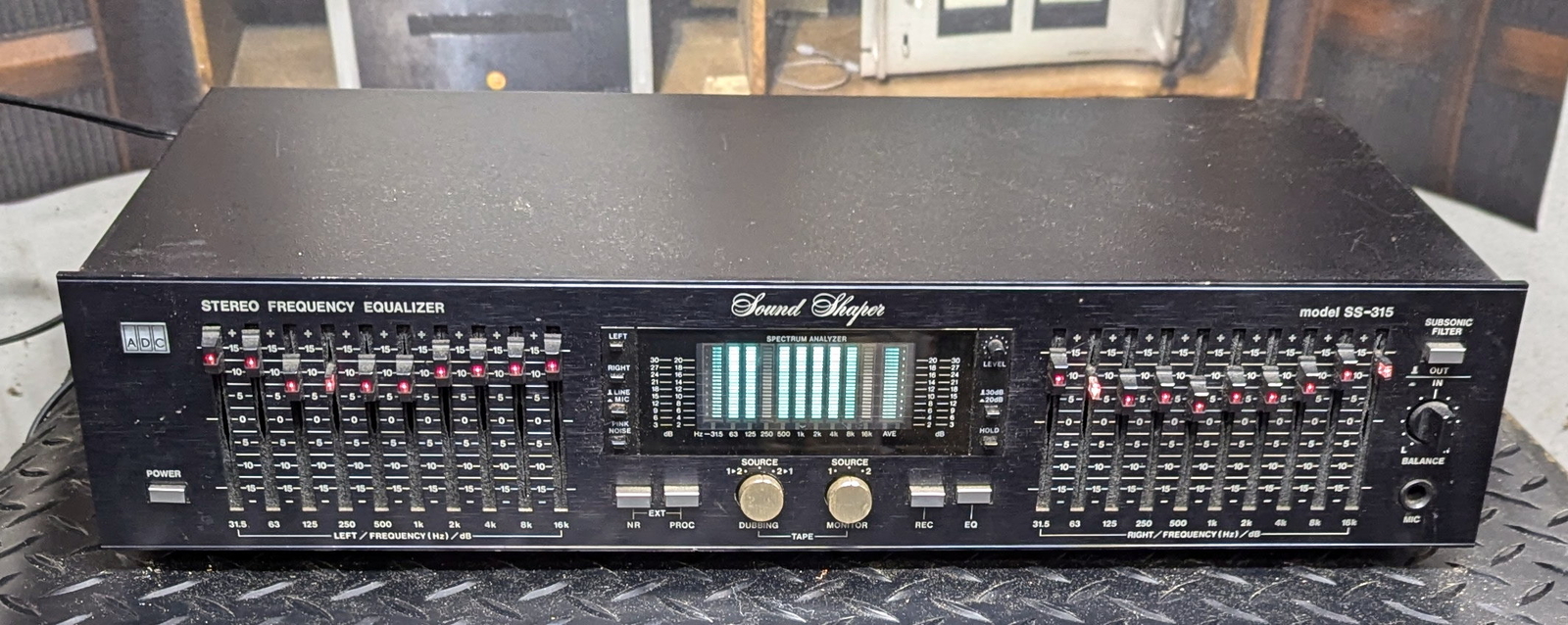
Flick the power switch, and the ADC Sound Shaper SS-315 doesn’t just turn on—it wakes up. The spectrum analyzer flares to life first, a row of vertical LEDs dancing in jagged, colorful symmetry across the front panel, translating your music into a live light show that responds to every snare hit, every synth swell, every breath of reverb. This isn’t just an equalizer; it’s a conversation with your stereo system, a way to see what your ears hear and then reshape it with your hands. The ten sliders under your fingertips control a surgical yet musical array of frequency bands, spaced logarithmically from 31.5Hz all the way up to 16kHz, giving you granular control over the tonal balance of your setup. And while the SS-315 lacks the digital precision or recall of later units, it makes up for it with immediacy and charm—this is analog audio tuning at its most tactile.
Built during the golden era of high-end home audio customization—the early to mid-1980s—the SS-315 arrived when audiophiles were no longer content with just better speakers or amplifiers. They wanted control. Room acoustics, speaker placement, and source limitations meant that even the best systems had tonal quirks, and the graphic equalizer became the tuning fork of the serious listener. ADC Sound, a division of Audio Dynamics Corporation, wasn’t the first to market with a 10-band EQ, but they nailed the formula: solid construction, clear labeling, and a real-time spectrum analyzer that felt like magic at the time. The SS-315 wasn’t the cheapest option, but it wasn’t the flagship either—it sat squarely in the sweet spot between prosumer functionality and audiophile-grade build.
Sonically, the SS-315 doesn’t impose itself. It’s transparent when you want it to be, letting recordings breathe without obvious coloration. But when you start pulling sliders, the effect is immediate and dramatic. Boost the 250Hz band, and you can feel the warmth swell in your chest. Cut 2kHz slightly, and harsh vocals suddenly relax. The unit handles wide swings without introducing harshness or muddiness, a testament to its well-thought-out circuit design. It’s not a “vintage tone” box like a tube preamp—it’s more like a scalpel. And like any surgical tool, it demands respect: misuse it, and you’ll ruin the mix. Use it wisely, and you can fix problem frequencies, tame boomy rooms, or simply tailor your system to your taste.
Specifications
| Manufacturer | Audio Dynamics Corporation (ADC Sound) |
| Production Years | Early 1980s (circa 1982–1986) |
| Original Price | $299 (approx. $900 today) |
| Equalizer Bands | 10-band per channel (31.5Hz, 63Hz, 125Hz, 250Hz, 500Hz, 1kHz, 2kHz, 4kHz, 8kHz, 16kHz) |
| Equalization Range | ±12dB per band |
| Input Sensitivity | 150mV |
| Gain | ±1dB |
| Frequency Response | 5Hz to 100kHz |
| Total Harmonic Distortion | 0.05% (typical) |
| Signal to Noise Ratio | 102dB |
| Input Impedance | 47kΩ |
| Output Impedance | 1kΩ |
| Inputs | 1 pair RCA (unbalanced) |
| Outputs | 1 pair RCA (unbalanced) |
| Throughput | Yes (defeatable via front panel switch) |
| Spectrum Analyzer | 10-band LED display (real-time, stereo) |
| Power Supply | Internal 120V AC, 60Hz (non-switchable) |
| Weight | 9.5 lbs (4.3 kg) |
| Dimensions | 19" W × 1.75" H × 7.5" D (48.3 × 4.4 × 19 cm) |
| Color | Black anodized aluminum front panel |
Key Features
The Light Show That Listens
The spectrum analyzer isn’t just a gimmick—it’s functional. Unlike later models that used crude peak-hold circuits or simplified displays, the SS-315’s analyzer updates in real time, giving a near-instantaneous readout of the frequency content of your music. This lets you see where energy builds up (like a resonant bass note in your room) or where detail is missing (a dull midrange). It’s especially useful when EQing for room correction: play pink noise, watch the analyzer, and flatten the response by adjusting sliders until the bars form a straight line. Of course, you shouldn’t flatten everything—natural recordings aren’t flat—but it’s a powerful starting point. And once you’ve dialed things in, the analyzer becomes a performance tool, letting you watch your music move in three dimensions.
Ten Bands of Analog Control
Ten bands was the gold standard in the 1980s, offering enough resolution to fix most tonal issues without overwhelming the user. The SS-315’s bands are spaced using the ISO 266 standard, meaning they cover the full audible spectrum in octave increments, with a few extra points in the critical midrange. Each slider is a high-quality potentiometer with a smooth, detent-free action—no gritty resistance or crackling when you adjust them. The ±12dB range is generous: enough to carve out a vocal notch or boost presence without driving the output stage into distortion. And because the EQ is analog and passive in design (with active makeup gain), it doesn’t digitize or sample the signal—it just reshapes it, preserving the original waveform’s integrity.
Throughput Switch for A/B Comparisons
One of the most underrated features is the front-panel bypass switch. Flick it, and the audio passes straight through the unit without any EQ processing, letting you instantly compare your tuned sound with the original. This is critical for avoiding “EQ creep”—the tendency to keep boosting and cutting until everything sounds “exciting” but unnatural. The switch is mechanical and solid, with a satisfying click, and it breaks the signal path cleanly. Some users report a slight level difference between bypassed and engaged modes, but this is usually minor and can be compensated by adjusting your preamp volume.
Historical Context
The early 1980s were a turning point for home audio. High-fidelity systems had become more affordable, but room acoustics and speaker limitations remained major hurdles. The rise of graphic equalizers like the SS-315 was a direct response to this—consumers wanted not just better sound, but *corrected* sound. ADC Sound wasn’t alone in this space. Competitors like Sony, Pioneer, and Technics all offered their own 10-band EQs, some with built-in analyzers. But ADC carved out a niche by focusing on build quality and visual feedback. The SS-315 was often sold alongside separates from brands like Marantz, Denon, and Sansui, slotted between preamp and power amp via the tape loop or main in/out jacks. It also found a second life in semi-pro studios and broadcast booths, where engineers used it for quick tonal fixes or speaker tuning.
What set the SS-315 apart from budget models was its combination of real-time analysis and low noise. Many cheaper EQs added hiss or muddied the signal, but the SS-315’s 102dB signal-to-noise ratio meant it could sit in the chain without degrading the sound when not in use. It wasn’t a mastering-grade tool, but for home use, it was more than capable. The era also saw a fascination with “audio visualization”—the idea that seeing sound could help you understand it. The SS-315 tapped into that perfectly, turning equalization from a technical chore into an engaging ritual.
Collectibility & Value
Today, the SS-315 trades in a narrow but passionate market. On the secondary market, working units in good cosmetic condition typically sell between $150 and $250. Units listed as “tested and fully functional” with a clean faceplate and responsive sliders tend to land near the top of that range. Non-working or “for parts” models can be found for as low as $50, but buyers should be cautious—these often suffer from dried-up electrolytic capacitors or failing power supplies. The internal power supply is a known weak point: the original filter caps degrade over time, leading to hum, noise, or complete failure. Replacing them isn’t difficult for a technician, but it’s not a beginner project. The cost of a full recap runs $80–$120 if outsourced, so factor that into any purchase below $120.
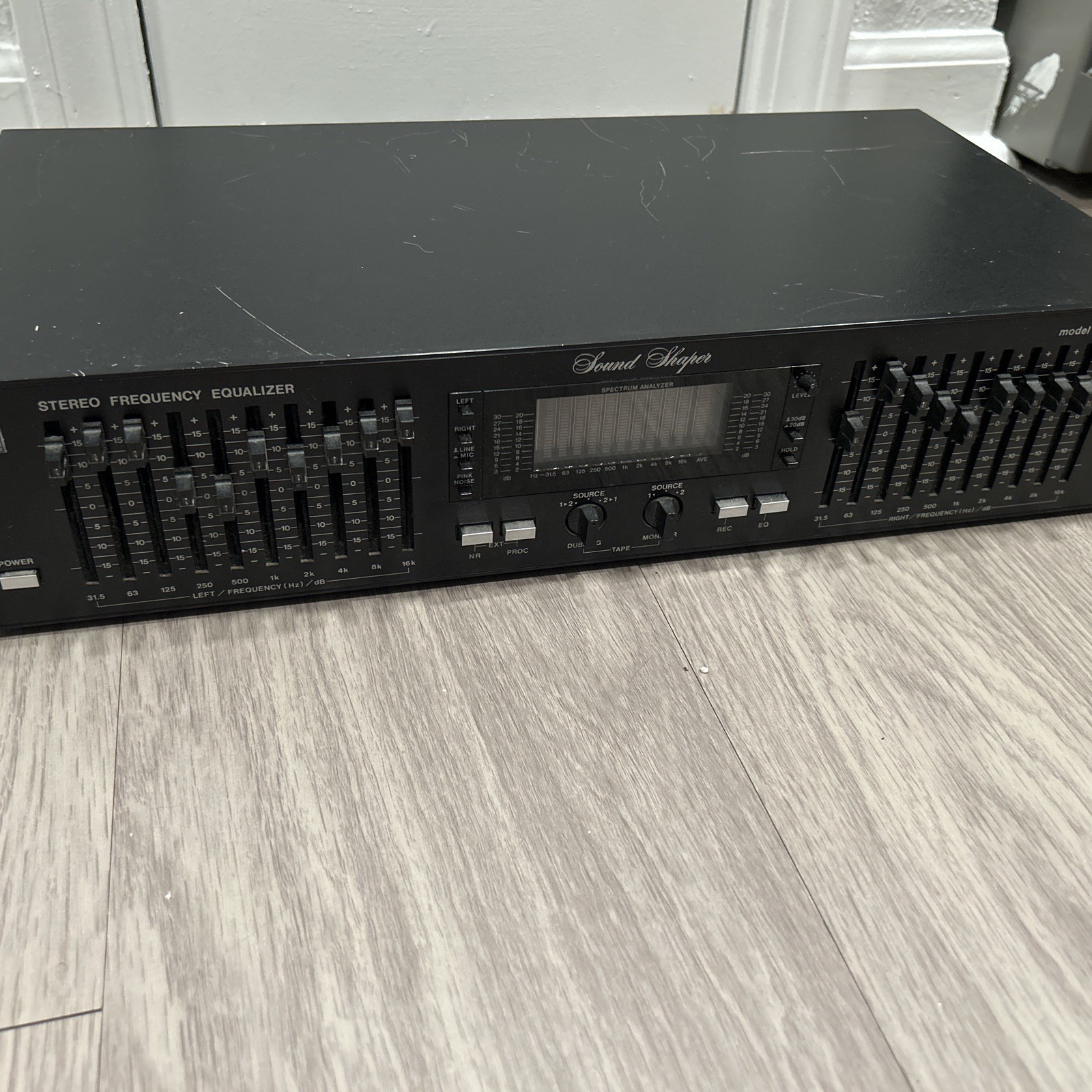
The LED spectrum analyzer is another potential failure zone. While the individual LEDs are robust, the driver circuitry can drift, causing uneven bar heights or stuck segments. Cleaning the slider pots with contact cleaner is almost always necessary on units that have sat unused for decades—dusty pots cause scratchy audio or intermittent signal. The front panel is aluminum and generally holds up well, but the black finish can scratch, and the silk-screened labels may fade if exposed to sunlight. Replacement faceplates are not available, so cosmetic condition matters.
For collectors, the SS-315 isn’t a trophy piece like a McIntosh C27 or a Lexicon Lambda. But it’s a functional artifact of a specific moment in audio history—a time when listeners wanted to *see* their music and tweak it like engineers. It’s also surprisingly usable today. While modern room correction software (like Dirac or Audyssey) is more precise, the SS-315 offers a hands-on experience that software can’t replicate. Plug it into a modern system via a preamp loop, and it still works exactly as intended. Just don’t expect digital recall or presets—this is analog control in its purest form.
When buying, always verify functionality. Ask for a video of the unit powering up, the sliders responding to music, and the analyzer moving in real time. Check for crackling, hum, or dead bands. If the seller says “untested,” assume it needs servicing. And if the price seems too good to be true—like under $80 for a “working” unit—it probably isn’t working.
eBay Listings

As an eBay Partner, we earn from qualifying purchases. This helps support our independent vintage technology research.