ADC Sound Shaper SS-30 (1980s)
A 10-band EQ with a glowing fluorescent display that turns room correction into a light show—and a time machine back to the golden age of tweakable sound.
Overview
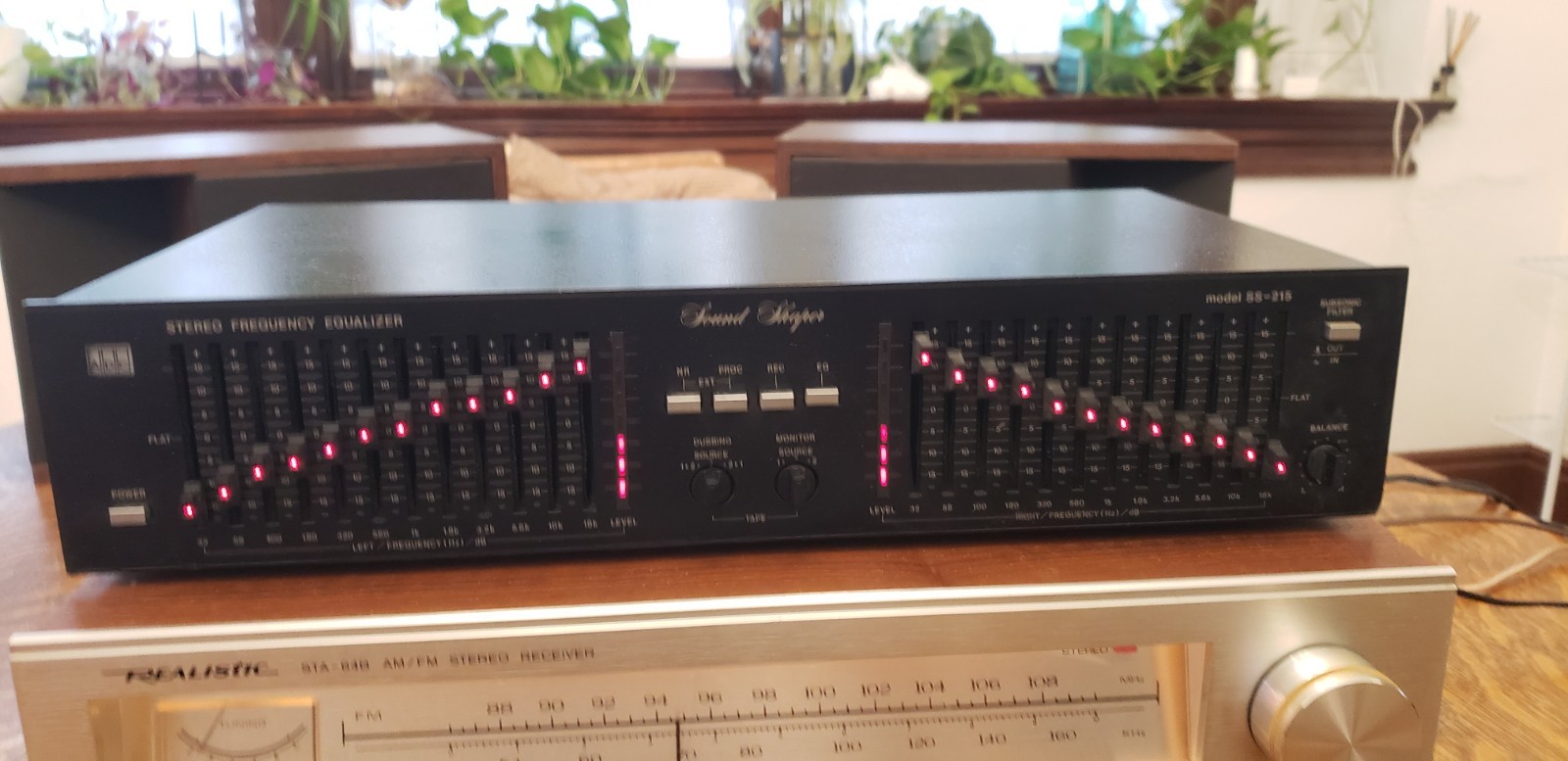
Flick it on in a dark room and the ADC Sound Shaper SS-30 doesn’t just equalize—it performs. Ten vertical fluorescent bars rise and fall in real time, painting your music in light, each one a glowing column of frequency energy dancing to the beat. This isn’t just an equalizer; it’s a living sonogram of your system, a hypnotic bridge between audio engineering and theater. And when you start adjusting those sliders, you’re not just shaping tone—you’re conducting an orchestra of acoustics, smoothing out the boom of a bass trap gone wrong or lifting the veil on a dull pair of bookshelf speakers that never quite sang. The SS-30 delivers surgical control with a warmth that modern digital room correction often lacks, not because it’s more accurate, but because it’s more human—responsive, tactile, and forgiving in a way that only analog circuitry can be.
Positioned in the middle of ADC’s Shaper lineup, the SS-30 wasn’t the most advanced model, but it hit a sweet spot: more accessible than the high-end SS-315 or SS-412X with their built-in analyzers and pink noise generators, yet more capable than the stripped-down SS-10 or SS-2. It offered the full 10-band EQ per channel (31Hz to 16kHz), clean signal path, and that mesmerizing display—without the complexity or cost of full auto-calibration. For the DIY audiophile who wanted to tweak by ear, it was ideal. Unlike later computerized versions, the SS-30 gave you the tools but left the decisions to you, which is both its charm and its limitation. There’s no microphone, no automatic flattening, no false promise of “perfect” sound. You dial it in yourself, by ear, over hours of listening, and when it finally clicks—when the room stops fighting the speakers and the music just *flows*—it feels earned.
Owners report that the SS-30’s build quality is solid, with a heavy steel chassis and smooth, detented sliders that inspire confidence. It slots neatly between the entry-level SS-10 (which lacks the fluorescent display) and the top-tier SS-315 (which adds a real-time analyzer and noise generator). The front panel is clean and functional: left and right channel EQ banks, a bright fluorescent display flanked by input level meters, tape loop I/O, and a source/mic input on the front for quick connection of a turntable or even a dynamic mic for crude vocal processing. It’s not flashy, but it’s honest—every control has a purpose, and none are wasted. The fluorescent display, while beautiful, is also functional: it gives immediate visual feedback on frequency distribution, letting you see resonances and dips before you even hear them. That kind of insight was rare in consumer gear at the time.
Specifications
| Manufacturer | Audio Dynamics Corporation (ADC) |
| Production Years | Early 1980s |
| Original Price | Approx. $250–$300 (USD) |
| Equalization Bands | 10 bands per channel (31Hz, 62Hz, 125Hz, 250Hz, 500Hz, 1kHz, 2kHz, 4kHz, 8kHz, 16kHz) |
| Adjustment Range | ±12 dB per band |
| Display Type | Fluorescent bar graph (real-time frequency spectrum) |
| Inputs | Stereo RCA main input, front-panel source/mic input, tape input |
| Outputs | Stereo RCA main output, tape output, headphone output |
| Tape Loop | Yes (bi-directional) |
| Frequency Response | 20Hz – 20kHz (±0.5dB with EQ flat) |
| Total Harmonic Distortion | <0.05% at 1kHz, 2V output |
| Signal-to-Noise Ratio | >90dB (A-weighted) |
| Input Sensitivity | 350mV for 0dB output |
| Output Level | 2V RMS maximum |
| Load Impedance | 10kΩ minimum |
| Power Supply | Internal linear transformer, 120V AC, 60Hz |
| Weight | 18 lbs (8.2 kg) |
| Dimensions | 19" W × 1.75" H × 10" D (48.3 × 4.4 × 25.4 cm) |
| Construction | Steel chassis, aluminum faceplate, sliding potentiometers with dust covers |
Key Features
The Fluorescent Display: More Than a Light Show
That glowing green spectrum isn’t just for show—it’s a real-time analyzer with no microprocessor, no software, no lag. It’s analog magic: a bank of tuned filters feeding rectified signals to drive the bars, all in the open loop. Unlike LED displays of the era, which were jerky and low-resolution, the fluorescent tubes offer smooth, fluid motion that mirrors the dynamics of music. You can *see* the kick drum hit, the cymbal decay, the vocal sibilance—all in real time. It’s intuitive in a way that graphs on a laptop never are. And because it’s always on, it becomes part of the listening experience, a visual metronome that syncs with your ears. But it’s not perfect: the display has limited dynamic range and can saturate on loud passages, and it doesn’t distinguish between left and right channels—what you see is a summed mono representation. Still, for dialing in a system by ear, it’s invaluable. You can spot a 60Hz hum from a ground loop, see a 2kHz peak from a bright tweeter, or notice a dip at 125Hz that explains why your bass feels thin.
10-Band EQ with Smooth, Musical Response
Each of the 10 sliders controls a fixed-frequency band with a Q (bandwidth) carefully chosen to affect room modes and speaker resonances without creating phase havoc. The ±12dB range is enough to correct most issues but not so extreme that it turns your system into a novelty effect. The potentiometers are high-quality conductive plastic types, known for longevity and smooth taper. When adjusted, the EQ doesn’t add noticeable coloration—no harshness in the highs, no muddiness in the lows—just a clear reshaping of the frequency balance. This neutrality is why ADC equalizers are still sought after: they don’t impose a “sound.” Instead, they reveal what’s already there, just better balanced. Used subtly, the SS-30 can tame a boomy room or add air to a dull system. Used aggressively, it can create dramatic effects—like turning a rock mix into a bass-heavy dub version—but it rewards restraint. The tape loop lets you insert the EQ into a preamp/power amp chain or use it to process recordings on a cassette deck, which was a common trick in the 1980s for creating custom “enhanced” tapes.
Build Quality and Serviceability
The SS-30 was built to last. The chassis is thick steel, the faceplate aluminum with silk-screened markings that rarely fade. The sliders have plastic dust covers that help keep out grime, though they’re prone to cracking over time. Internally, the layout is logical and serviceable—no surface-mount components, no proprietary ICs. Most repairs involve recapping the power supply (a common failure point after 40 years), cleaning faders with contact cleaner, or replacing the aging fluorescent inverter board, which can fail silently or emit a high-pitched whine. The power transformer is robust but not immune to failure—service technicians observe that units stored in damp basements or garages often have corroded windings. Still, compared to many vintage audio devices, the SS-30 is relatively easy to maintain. The circuit design avoids exotic parts, and schematics are available from surviving service manuals and enthusiast forums.
Historical Context
The ADC Sound Shaper SS-30 emerged in the early 1980s, when home audio was shifting from passive listening to active tuning. Audiophiles were no longer content with just better speakers or amplifiers—they wanted control. Graphic equalizers, once confined to recording studios and live sound, began appearing in living rooms, driven by brands like Soundcraftsmen, Fisher, and BSR. ADC, originally known for phonograph cartridges and the short-lived Accutrac turntable, pivoted hard into equalizers and made itself a name in the process. The Shaper line was among the first affordable, high-quality graphic EQs available to consumers. Before ADC, most graphic equalizers cost over $500 and were considered professional gear. The SS-30 brought that capability under $300, opening the door for a generation of tweakers.
It arrived at a time when speaker and room interactions were poorly understood by average listeners. Many blamed their gear for bad sound when the real culprit was room acoustics. The SS-30 didn’t solve that problem completely, but it gave people a tool to fight back. Advertised in catalogs like DAK Industries, it found its way into thousands of systems. Around the mid-1980s, ADC was acquired by BSR, a British company known for budget turntables, and the Shaper line continued under the BSR name with simplified versions lacking the fluorescent display. These were sold for as little as $60, making EQ more accessible than ever—though at the cost of build quality and features. The original ADC models, including the SS-30, remained the gold standard.
Competitors like the Pioneer EQ-6300 or Sony CFD-EQ500 offered similar specs but lacked the SS-30’s visual feedback and build integrity. The SS-30 wasn’t the first with a spectrum display—that honor goes to higher-end models like the SS-315—but it was the first to make it a standard feature in a mid-priced unit. It occupied a unique niche: serious enough for critical listeners, attractive enough for show-offs, and simple enough for beginners.
Collectibility & Value
Today, the ADC Sound Shaper SS-30 trades in a narrow but passionate market. Units in working condition with a fully functional fluorescent display typically sell for $250–$400, depending on cosmetics and provenance. Non-working units, especially those with dead displays or noisy faders, go for $100–$180 as restoration projects. Fully serviced and recapped models from reputable dealers can fetch up to $500, particularly if they include original manuals or accessories. The display is the single biggest value driver—units with dim, flickering, or dead tubes lose 30–50% of their worth. Replacing the fluorescent inverter or display board is possible but not trivial; donor parts are scarce, and the high-voltage circuit requires caution.
Common failures include dried-out electrolytic capacitors in the power supply (causing hum or no power), oxidized fader contacts (resulting in crackling or dropouts), and failing fluorescent inverters (producing a buzzing sound or no display). The front-panel mic input circuit is also prone to damage if a hot signal or phantom-powered mic is connected—owners report that the input op-amp can be destroyed, though it’s usually replaceable. Before buying, check that all sliders move smoothly, the display responds to audio input, and the tape loop passes signal cleanly. Power it on and listen for transformer hum or capacitor whine. Smell for burnt electronics—some units were poorly ventilated and ran hot.
Despite its age, the SS-30 remains relevant. Unlike digital room correction, which can introduce latency and processing artifacts, the SS-30 is pure analog, transparent when set flat, and musical when engaged. It’s not a substitute for proper room treatment, but it’s a powerful complement. For vintage system builders, it’s a period-correct upgrade that adds both function and flair. And for synth and tape enthusiasts, it’s a creative tool—capable of turning a dull drum machine into a thumping beast or adding shimmer to a lo-fi recording.
eBay Listings



As an eBay Partner, we earn from qualifying purchases. This helps support our independent vintage technology research.