ADC Sound Shaper SS-3-IC (1983)
A 12-band analog equalizer that turns room acoustics from enemy to ally—if you can find one that still lights up.
Overview
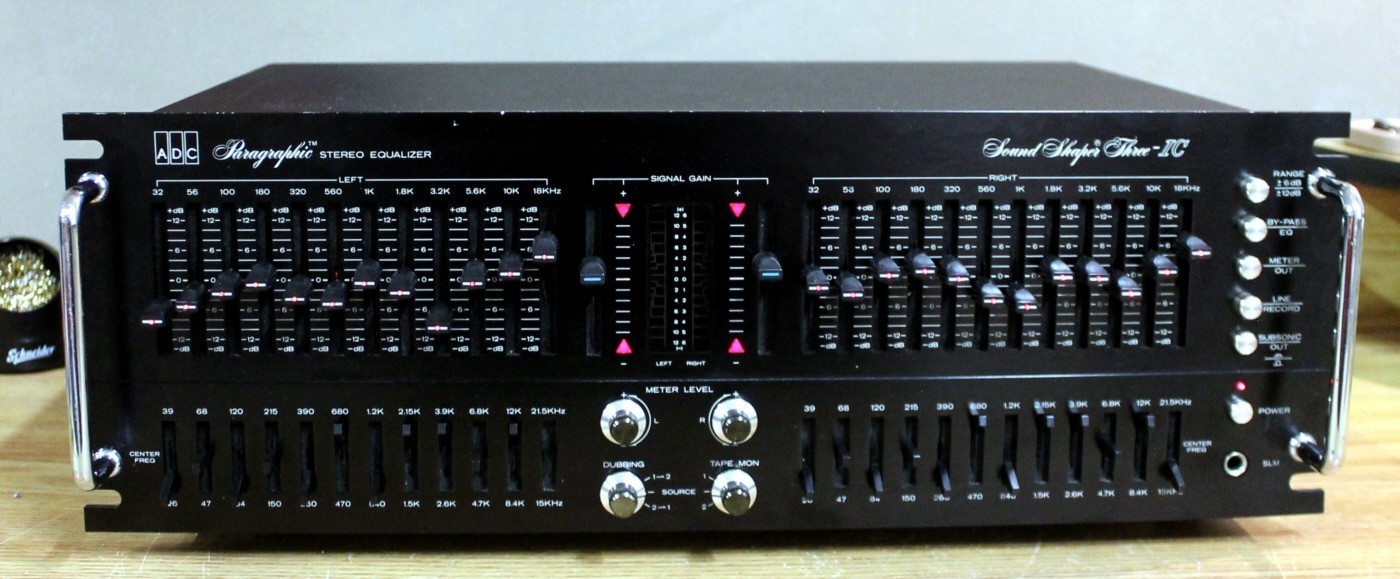
That first flick of the power switch tells you everything: a slow crawl of green fluorescence up the flanks of twelve sliders, each one guarding a narrow slice of sonic territory, from a loping 32Hz to a sharp 16kHz. The ADC Sound Shaper SS-3-IC doesn’t roar to life—it glows, like something waking up under glass. This isn’t just an equalizer; it’s a diagnostic tool, a room-tamer, a secret handshake among those who remember when “flat response” wasn’t a software preset but a weekend-long ritual involving pink noise, a mic on a tripod, and the patience of a monk. Built in Taiwan during the analog twilight of the early '80s, the SS-3-IC sits at the top of ADC’s consumer equalizer line—not the most advanced, but arguably the most usable. It splits the difference between the barebones SS-2 and the over-engineered, analyzer-laden SS-315, offering surgical control without the fragility of built-in real-time analysis. Twelve bands per channel, ±15dB of cut or boost, and a clean IC-based circuit mean you can carve out muddiness in the lower mids or add air to dull tweeters without smearing the signal like cheaper passive designs. It’s not warm or euphonic—this isn’t a tube-laden tone shaper. It’s precise, almost clinical, which is exactly what you want when you’re fighting standing waves in a rectangular living room or compensating for bookshelf speakers shoved into corners.
The “IC” in the name isn’t just marketing—it signals a shift in design philosophy. Earlier ADC equalizers relied on discrete transistor stages, but the SS-3-IC uses integrated circuits to handle gain and buffering, which keeps the unit compact and reduces heat buildup. That doesn’t mean it’s immune to age. These units were never built like Leica cameras; the sliders are the Achilles’ heel, prone to crackle and dropouts when the carbon tracks wear thin or oxidize. The fluorescent display, while gorgeous, is another weak point—many units today either flicker or stay dark, the cold cathode tubes long since expired. But when it works, the SS-3-IC delivers a level of control that few consumer-grade EQs of its era could match. It wasn’t meant to be a color box, slathering on sonic syrup. It was meant to fix problems—boomy bass, shouty vocals, lifeless highs—and it does so with surgical neutrality. That said, it won’t hide poor recordings or revive dead speakers. It reveals. And sometimes, that’s the hardest truth your system needs to hear.
Specifications
| Manufacturer | Audio Dynamics Corporation (ADC) |
| Production Years | 1983 |
| Model | Shaper SS-3-IC |
| Equalization Bands | 12 bands per channel (stereo) |
| Frequency Response | 32Hz, 63Hz, 125Hz, 250Hz, 500Hz, 1kHz, 2kHz, 4kHz, 8kHz, 10kHz, 12.5kHz, 16kHz |
| Adjustment Range | ±15dB per band |
| Inputs | RCA (unbalanced) |
| Outputs | RCA (unbalanced) |
| Tape Loop | RCA in/out (for integration with preamp tape monitoring) |
| Power Consumption | 18W |
| Power Supply | Internal AC/DC (120V AC, 60Hz) |
| Display | Fluorescent bar graph (green) |
| Construction | IC-based active circuitry |
| Dimensions | 19" W × 1.75" H × 10" D (approx.) |
| Weight | Approx. 12 lbs |
| Country of Origin | Taiwan |
| Original Price | Not available in research |
| Special Features | Center frequency selection switches per band (3-position), designed for use with external real-time analyzer setups |
Key Features
Twelve-Band Surgical Precision
Most graphic equalizers of the early '80s stuck to ten bands—standardized, predictable, and just enough to make a difference without overwhelming the user. The SS-3-IC goes further, packing twelve bands per channel with carefully spaced center frequencies that target trouble spots other EQs gloss over. The addition of 10kHz, 12.5kHz, and 16kHz sliders means you can actually address sibilance or lack of air without affecting the entire upper register. Likewise, the inclusion of 32Hz at the bottom end lets you nudge sub-bass without muddying the 63Hz kick drum region. Each slider has a 3-position switch to fine-tune the center frequency, letting you adapt to room modes or speaker roll-offs with surprising flexibility. This isn’t broad-brush tonal shaping—it’s acoustic microsurgery. And while it lacks the built-in analyzer of the SS-315, it was clearly designed to work with one, making it a favorite among DIY audiophiles who paired it with external mics and oscilloscopes.
IC-Based Signal Path
The shift to integrated circuits in the SS-3-IC was both a cost-saving move and a performance upgrade. By using op-amps and buffer ICs instead of discrete transistor stages, ADC reduced component count, improved channel matching, and minimized noise. The result is a cleaner, more transparent signal path than earlier models like the SS-2, which relied on older discrete designs. It doesn’t add coloration—no midrange bloom, no high-end softening—so it stays out of the way when you’re not actively shaping the sound. That neutrality is a double-edged sword: it means the EQ won’t mask flaws in your source or amplification chain, but it also won’t degrade a good signal. For purists, that’s the point. This is a tool, not a toy.
Fluorescent Display and Build Quality
The glowing green bar graph isn’t just for show—it provides real-time feedback on signal level and clipping, helping you avoid overdriving the output stage. But it’s also the unit’s most fragile element. The cold cathode tubes degrade over time, and replacements are nearly impossible to find. When working, the display pulses gently with the music, a hypnotic visual companion to the sonic adjustments. The chassis is standard brushed steel with a black faceplate, industrial but not unattractive. The sliders are smooth but not luxurious—serviceable, not premium. RCA jacks are front-loaded, which can make cable management tricky in tight racks. Still, the overall build reflects its era: functional, mass-produced, but with enough care to suggest it wasn’t built to fail immediately.
Historical Context
The early 1980s were a turning point for consumer audio. High-fidelity gear was no longer the exclusive domain of engineers and obsessives—cable TV ads, mail-order catalogs like DAK Industries, and big-box electronics stores brought audiophile concepts to the masses. The ADC Sound Shaper line rode that wave, offering professional-style equalization at prices regular buyers could stomach. Before ADC, graphic EQs were expensive, rare, and mostly found in studios or high-end custom installations. ADC democratized the technology, starting with simpler models like the 5-band SS-1 and scaling up to the 12-band SS-3-IC. The “IC” designation marked a generational shift, aligning with the broader industry move toward integrated circuitry in preamps and processors. Competitors like Sony, Pioneer, and Sansui offered similar units, but few matched ADC’s band count or frequency granularity. The SS-3-IC wasn’t the flashiest EQ on the shelf, but it was one of the most serious. It arrived just as home theater was beginning to stir, and while it wasn’t marketed for surround sound, its precision made it a favorite among early adopters trying to tame multichannel setups with mismatched speakers. By the late '80s, ADC would be absorbed by BSR, a British budget electronics firm, and the brand faded into obscurity. But for a few years, ADC stood for something: accessible, no-nonsense audio correction.
Collectibility & Value
Finding a working SS-3-IC today is like finding a vintage oscilloscope with a bright CRT—possible, but increasingly rare. Most units on the market have at least one failing slider or a dim, flickering display. The fluorescent tubes are long out of production, and while some technicians have experimented with LED retrofits, purists reject them as soulless replacements. Slider noise is the most common complaint—cleaning helps, but worn carbon tracks can’t be revived. Recapping the power supply is often necessary, especially in units that have been powered on after decades of storage. The ICs themselves are generally reliable, but socketed chips can oxidize, leading to intermittent faults. Buyers should insist on audio verification, not just a “powers on” description. A fully functional SS-3-IC in good cosmetic condition typically sells for $150–$250 on the secondary market. Units with dead displays or noisy faders drop to $75–$120, often bought for parts or restoration. Complete systems—SS-3-IC paired with an ADC SA-1 analyzer or matching preamp—are rare and can fetch $400 or more from collectors focused on period-correct setups. The real value isn’t in resale, though—it’s in utility. For someone restoring a vintage system with inefficient speakers or a problematic room, the SS-3-IC is still one of the most effective tools available. It’s not nostalgia; it’s functionality that hasn’t been fully replicated in the digital age. But it’s not for everyone. If you want warmth, character, or convenience, look elsewhere. The SS-3-IC demands respect, maintenance, and a willingness to stare at green bars while your neighbors pound on the wall during pink noise calibration.
eBay Listings


As an eBay Partner, we earn from qualifying purchases. This helps support our independent vintage technology research.