ADC Sound Shaper SS-3 (1978–1985)
A 12-band graphic equalizer that lit up like a dashboard from the future—and actually delivered on the promise of room-taming EQ.
Overview
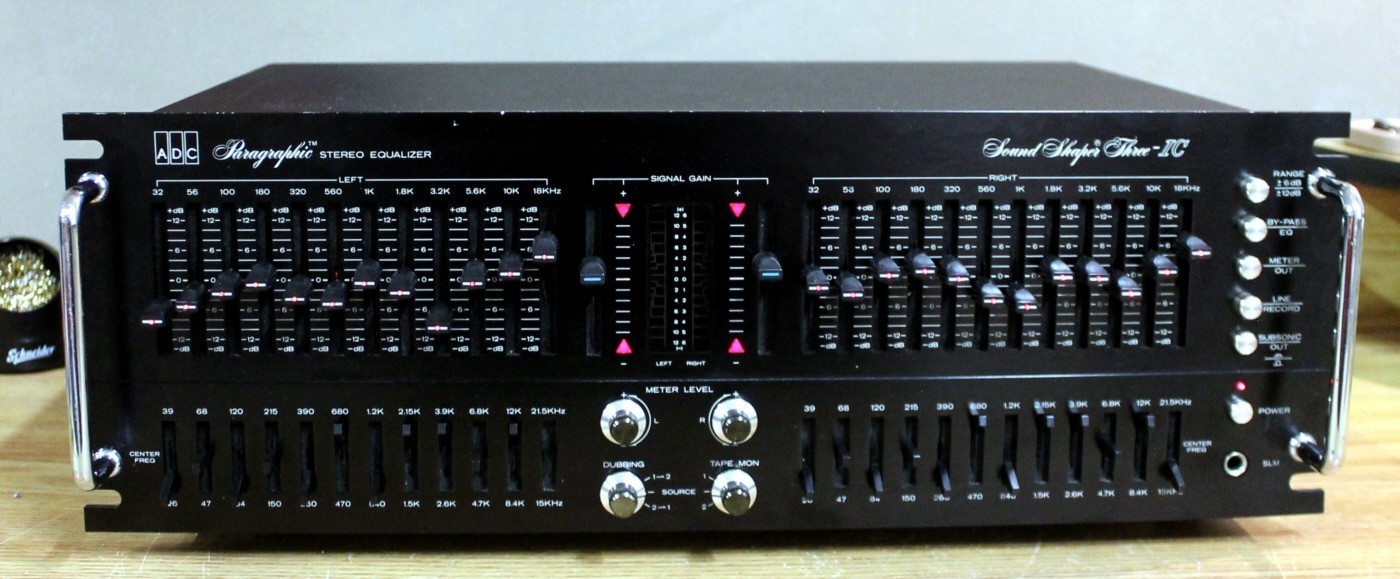
Flipping the power switch on an ADC Sound Shaper SS-3 isn’t like turning on most vintage gear—it’s more like booting up a lab instrument from a 1982 sci-fi thriller. The moment it powers up, the row of 12 vertical sliders on each channel glow faintly from behind, their smooth chrome caps catching the light like brushed steel aircraft controls. If you’re lucky enough to find a Mark 2 version, those sliders come with tiny LEDs embedded in the knobs, pulsing with soft red light as they track your adjustments. It’s theatrical, sure, but this isn’t just eye candy. The SS-3 was built for people who didn’t just want to listen to their systems—they wanted to *diagnose* them.
Released at the tail end of the 1970s, the SS-3 landed right as home audio was shifting from passive listening to active tuning. Audiophiles were starting to obsess over room acoustics, speaker placement, and frequency anomalies, and ADC delivered a tool that felt like it belonged in a recording studio, not a bookshelf stack. While many budget EQs of the era used basic op-amps and passive filters that colored the sound in unpredictable ways, the SS-3 leaned into its identity as a precision instrument. It wasn’t trying to be warm or euphonic—it was trying to be *accurate*. And for a consumer-grade graphic equalizer in the early '80s, that was borderline radical.
Positioned above the simpler 10-band SS-1 and SS-110 models, the SS-3 was ADC’s mid-tier workhorse with a pro-grade twist: 12 bands per channel, giving it finer resolution than most competitors. It sat just below the SS-315 and SS-315X, which added real-time spectrum analysis and pink noise generation—features that made those models more complex (and more temperamental). The SS-3, by contrast, was stripped down to the essentials: clean EQ, solid build, and a no-nonsense interface. That made it more reliable than its flashier siblings, and more accessible than high-end professional units from companies like API or Drawmer.
And yes, it sounds good—when used with restraint. The circuitry is IC-based, not discrete, and doesn’t rely on inductors or exotic components, but it avoids the harshness that plagues some early integrated designs. The EQ curves are smooth, with a ±15 dB range that gives real corrective power without introducing obvious phase smearing or signal degradation when set flat. It won’t transform a muddy speaker into a monitor, but it *can* smooth out a peaky room mode or tame a bright tweeter in a way that feels surgical rather than destructive. Used as a tonal sculptor rather than a crutch, the SS-3 earns its place in a high-fidelity chain.
Specifications
| Manufacturer | Audio Dynamics Corporation (ADC) |
| Production Years | 1978–1985 |
| Original Price | $299 (USD) |
| Equalization Type | 12-band paragraphic stereo graphic equalizer |
| Frequency Bands (per channel) | 32 Hz, 63 Hz, 125 Hz, 250 Hz, 500 Hz, 1 kHz, 2 kHz, 4 kHz, 8 kHz, 12 kHz, 16 kHz, 20 kHz |
| Boost/Cut Range | ±15 dB per band |
| Topology | Integrated circuit (IC) based, no inductors |
| Inputs | 1 pair RCA unbalanced |
| Outputs | 1 pair RCA unbalanced |
| Tape Loop | Yes, RCA in/out |
| Signal-to-Noise Ratio | 86 dB (A-weighted) |
| Total Harmonic Distortion | 0.05% at 1 kHz, 2 V output |
| Frequency Response | 20 Hz – 20 kHz, ±0.5 dB (with EQ flat) |
| Input Impedance | 47 kΩ |
| Output Impedance | 600 Ω |
| Maximum Input Level | 4 V RMS |
| Gain | Unity (0 dB) when EQ flat |
| Power Supply | Internal linear transformer, 120 V AC, 60 Hz |
| Power Consumption | 25 watts |
| Dimensions (W × H × D) | 17.25" × 5.75" × 14.5" |
| Weight | 18.5 lbs (8.4 kg) |
Key Features
Twelve Bands of Surgical Control
Most consumer EQs in the late '70s and early '80s stuck to 10 bands, spreading them across a standard third-octave layout. The SS-3 went further, adding 2 kHz and 12 kHz bands to the usual lineup, giving it tighter resolution in the critical midrange and upper treble. That extra granularity makes a real difference when dealing with room resonances or speaker crossover quirks. Where a 10-band unit might force you to compromise between two problem frequencies, the SS-3 lets you isolate them cleanly. The sliders themselves are long-throw, smooth-moving units with a satisfying mechanical feel—nothing like the flimsy faders on budget rack gear. They’re also backlit on the Mark 2 version, a subtle but effective touch that enhances usability in dim environments.
IC-Based Circuitry: Transparent, Not Bland
Unlike the inductor-based EQs of the 1970s (like the famed Pultec or even ADC’s own earlier passive designs), the SS-3 uses IC-based active filtering. Some purists dismiss this as “cold” or “sterile,” but in practice, it’s more accurate to call it *neutral*. The op-amp design avoids the resonant peaks and phase shifts inherent in inductor circuits, delivering a cleaner passband when the EQ is flat. That transparency means it doesn’t impose a character of its own—good news if you’re using it to correct a system, not color it. It won’t make your rig sound “vintage” or “tube-like,” but it also won’t add harshness or muddiness when used subtly. For a unit designed for corrective EQ, that’s exactly what you want.
Build Quality That Aged Gracefully
Housed in a heavy-gauge steel chassis with a brushed aluminum front panel, the SS-3 feels like it was built to last. The rear panel is cleanly laid out with gold-plated RCA jacks, a robust IEC power inlet, and a recessed fuse holder—no flimsy barrel plugs or molded cables here. The internal layout is serviceable, with point-to-point wiring and modular PCB sections that make repairs more feasible than in tightly packed modern gear. While later ADC models (like the SS-315) suffered from failing spectrum analyzer tubes and noisy power supplies, the SS-3’s simpler design avoids those pitfalls. It’s not immune to age—capacitors dry out, faders get scratchy—but overall, it’s one of the more reliable vintage EQs in regular use today.
Historical Context
The ADC Sound Shaper SS-3 arrived at a turning point in home audio. The late 1970s saw the rise of larger speakers, higher-powered amplifiers, and more reflective listening rooms—conditions that exposed acoustic flaws most listeners had previously ignored. At the same time, the pro audio world was adopting real-time analyzers and parametric EQs for studio tuning, and audiophiles began demanding similar tools for their homes. ADC, already known for its Accutrac turntables and ZLM cartridges, pivoted hard into test and measurement gear, positioning the Sound Shaper line as the bridge between consumer and professional use.
The SS-3 wasn’t the first graphic equalizer for home use—that honor goes to units like the Carver TE-200 or the Fisher 500-C—but it was among the first to offer pro-style resolution at a semi-affordable price. It competed with offerings from Sony, Pioneer, and KLH, but stood out with its 12-band layout and industrial design. By the mid-1980s, ADC had been acquired by BSR, the British turntable manufacturer, and later models (like the BSR-branded SS-315) were simplified and cost-reduced. The original SS-3, however, remained a product of ADC’s independent engineering era—ambitious, slightly overbuilt, and built for people who took sound seriously.
It also arrived just before the digital EQ revolution. By the late '80s, companies like Sony and Yamaha were introducing DSP-based room correction, making analog graphic EQs seem quaint. But unlike those early digital units, which often suffered from poor converters and limited processing, the SS-3’s analog nature gives it a immediacy and transparency that still holds up. It doesn’t “sound digital”—because it doesn’t *try* to be digital. It’s a hands-on tool, designed for ears, not algorithms.
Collectibility & Value
The ADC Sound Shaper SS-3 occupies a sweet spot in the vintage EQ market: it’s rare enough to feel special, but common enough that you won’t need a second mortgage to find one. Units in working condition typically sell between $180 and $300, with Mark 2 versions (with LED-lit sliders) commanding a $50–$75 premium. Cosmetically pristine examples with original packaging or manuals can reach $350, especially if they’ve been recently serviced.
The most common failure points are the faders and power supply. The sliders, while robust, are carbon-track units that degrade over time, leading to crackling or channel dropouts. Cleaning with a fader-specific contact cleaner (like DeoxIT Fader Lube) often restores function, but severely worn units may need replacement—fortunately, standard 40mm faders are a common size, and drop-in replacements exist. The internal power transformer is generally reliable, but older units should be checked for insulation breakdown or overheating, especially if they’ve been stored in damp environments.
One often-overlooked issue is the lack of input attenuation. The SS-3 expects line-level signals and can be overloaded by hot preamps or solid-state gear, leading to clipping even when the EQ is flat. Owners report inserting a passive attenuator pad between preamp and EQ when driving it from high-output sources. It’s not a flaw, per se, but a quirk of its pro-leaning design.
When buying, always verify that all sliders operate smoothly and that there’s no hum, buzz, or channel imbalance. Check the tape loop jacks, too—these are often used for integration with vintage receivers, and corroded or loose jacks are common in heavily used units. Avoid any SS-3 advertised as an “SS-315” or “with spectrum analyzer”—those are different models, and sellers often conflate them. The SS-3 has no microphone input, no pink noise generator, and no fluorescent display. If it’s got those, it’s not an SS-3.
Despite its age, the SS-3 remains a practical tool, not just a nostalgia piece. It’s still used by vintage system builders, analog tape enthusiasts, and even some mastering engineers as a colorless corrective EQ. It won’t add “mojo,” but it will fix problems—quietly, reliably, and without getting in the way.
eBay Listings


As an eBay Partner, we earn from qualifying purchases. This helps support our independent vintage technology research.