ADC Sound Shaper SS-215X (1980–1989)
That rare EQ that doesn’t just shape sound—it stares back at you with glowing eyes and a personality all its own.
Overview
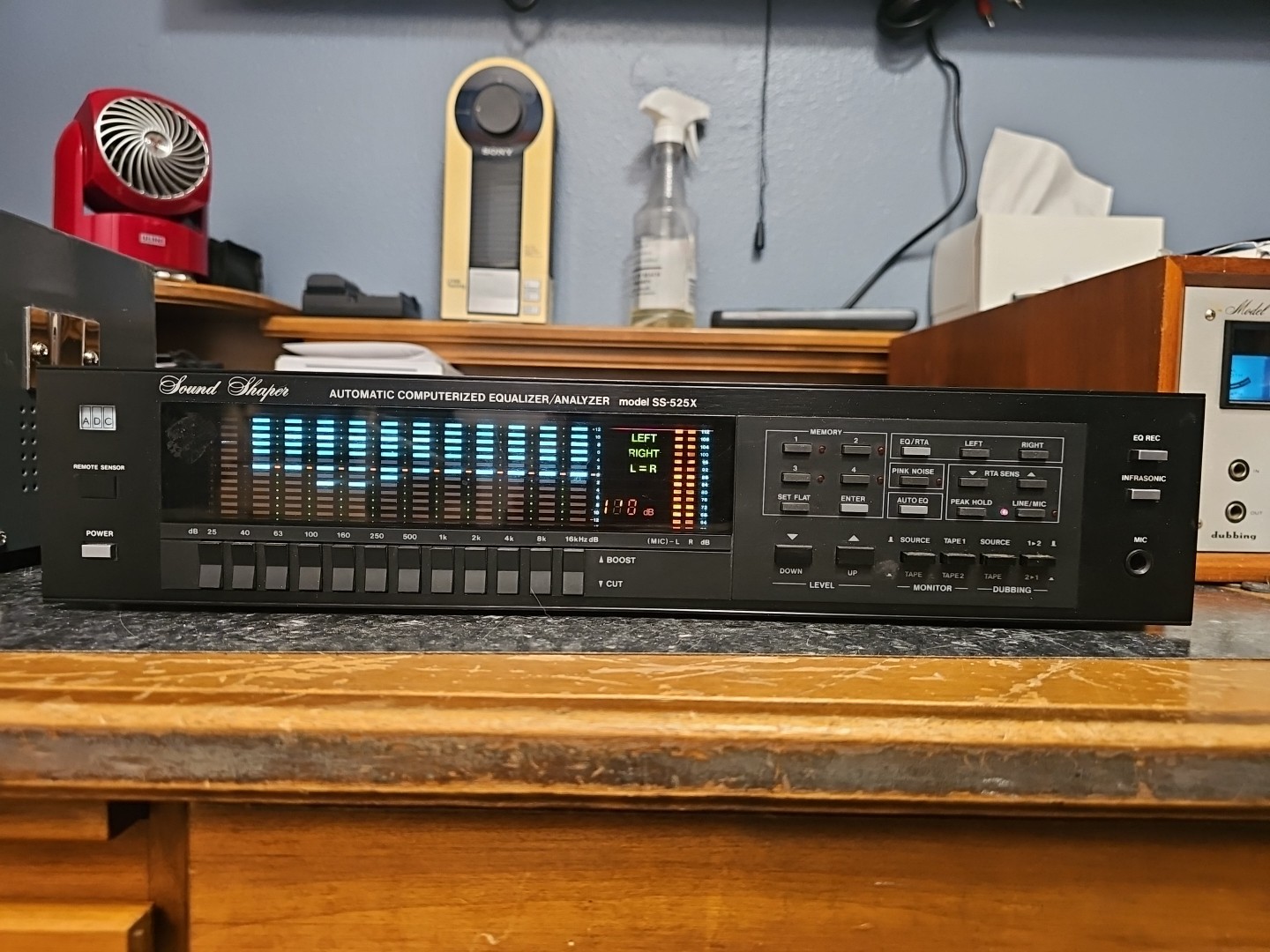
Plug in the ADC Sound Shaper SS-215X, flip the power switch, and the front panel comes alive like a dashboard from a sci-fi prototype: twin VU meters sweep to life, flanked by a row of 12 precisely spaced sliders that feel like they were milled from solid aluminum. This isn’t just an equalizer—it’s a statement. Built during the golden age of outboard gear excess, when every brand from BSR to Soundcraftsmen was throwing dials, lights, and sliders onto boxes and calling it high fidelity, the SS-215X stands apart not because it’s the most accurate, but because it’s the most theatrical. It doesn’t whisper into your system; it announces itself with a hum and a glow, like a synth arpeggiator powering up before a 1983 mall soundtrack.
And yet, for all its visual drama, the SS-215X delivers more than just nostalgia bait. Under the brushed steel faceplate lies a fully discrete, class-A preamp stage that imparts a subtle warmth—less aggressive than a tube stage, but warmer than the sterile IC-based EQs that would dominate the 1990s. The frequency bands are surgical enough for tonal shaping, but with a touch of analog character that makes boosting the 1kHz or 3.2kHz range feel musical rather than clinical. It won’t replace a mastering-grade parametric, but in a home studio or vintage rig, it adds presence and dimension in a way that feels organic, not corrective.
Positioned in the middle of ADC’s sprawling Sound Shaper lineup, the SS-215X wasn’t the flagship—that honor went to the SS-412X with its spectrum analyzer and stepped gain controls—but it wasn’t the entry model either. It sat right in the sweet spot: more bands and better build than the SS-115X, but without the premium price or complexity of the SS-315X or SS-412X. It offered 12 bands per channel (24 sliders total), a respectable signal-to-noise ratio, and a ±15dB boost/cut range that gave real tonal flexibility without encouraging reckless over-EQing. For the era, it was a serious piece of gear, aimed at semi-pro studios, broadcast booths, and the kind of audiophiles who treated their equipment racks like altars.
Specifications
| Manufacturer | ADC Sound |
| Production Years | 1980–1989 |
| Original Price | $495 (estimated, mid-tier for line) |
| Number of Bands | 12 per channel (stereo) |
| Frequency Bands | 32Hz, 56Hz, 100Hz, 180Hz, 320Hz, 560Hz, 1kHz, 1.8kHz, 3.2kHz, 5.6kHz, 10kHz, 18kHz |
| Control Range | ±15dB |
| Gain | ±1dB |
| Input Sensitivity | 1V (7V max) |
| Output Level | 1V (7V max) |
| Frequency Response | 5Hz – 100kHz |
| Total Harmonic Distortion | 0.008% |
| Signal to Noise Ratio | 100dB |
| Inputs | Stereo RCA |
| Outputs | Stereo RCA |
| Power Requirements | 120V AC, 60Hz (internal linear power supply) |
| Weight | 12.3 lbs (5.6 kg) |
| Dimensions | 19" W × 1.75" H × 7.5" D (48.3 cm × 4.4 cm × 19 cm) |
| Construction | Steel chassis, aluminum front panel, discrete analog circuitry |
| Country of Origin | Taiwan |
| Features | VU meters, 24-slide graphic EQ, class-A preamp, LED band indicators |
Key Features
The Theater of Control
The SS-215X doesn’t hide its function—it performs it. The 24 sliders (12 per channel) are arranged in a clean, symmetrical grid, each topped with a ridged cap that gives tactile feedback without being slippery. Unlike cheaper EQs of the era that used wobbly plastic faders, these feel damped and precise, with just enough resistance to discourage casual noodling. Each band is labeled with its frequency in crisp white silk-screening, and small LEDs next to each slider illuminate when the EQ is engaged, creating a cascading light show that mirrors your tonal adjustments. It’s not just functional—it’s hypnotic. In a dim room, with music playing and the VU meters dancing, the SS-215X becomes a kinetic sculpture, a centerpiece that draws eyes as much as ears.
Analog Warmth Without the Hype
While many graphic EQs from the 1980s relied on op-amps and ICs to keep costs down, the SS-215X uses a fully discrete, class-A preamp stage that contributes to its smooth, slightly rounded character. The THD of 0.008% is impressive for the era, but what matters more is how it behaves under load. When driving older receivers or tube preamps, it doesn’t strain or compress; it simply extends the frequency range with authority. The 100dB signal-to-noise ratio means you can crank the output without hearing hiss, even on quiet passages. And while the ±15dB range invites bold moves, the circuit design prevents harshness—even a full boost at 10kHz stays listenable, if not exactly subtle.
Built for the Long Haul
ADC didn’t skimp on construction. The chassis is thick steel, the front panel is anodized aluminum, and the RCA jacks are mounted on a reinforced rear panel with strain relief. Internally, the layout is orderly, with point-to-point wiring in critical signal paths and high-quality film capacitors in the filter network. The power supply is a heavy-duty toroidal transformer, which contributes to the unit’s heft but also ensures stable voltage under continuous use. These weren’t built to sit on a shelf—they were built to be used, day after day, in environments where reliability mattered.
Historical Context
The early 1980s were a boom time for consumer audio gear, fueled by the rise of home recording, the Walkman revolution, and a growing appetite for “high-end” equipment among middle-class buyers. ADC Sound, a brand that operated in the space between pro-audio and high-fidelity consumer gear, capitalized on this trend with the Sound Shaper line—a series of graphic equalizers that combined studio-style functionality with living-room aesthetics. The SS-215X landed in 1980, just as graphic EQs were transitioning from niche studio tools to living-room status symbols. Competitors like Soundcraftsmen, Rane, and BSR offered similar units, but few matched ADC’s attention to visual design and build quality.
At the time, the idea of shaping your sound with 12 bands per channel felt revolutionary. Most home systems had little more than bass and treble controls; the SS-215X let you notch out room resonances, brighten dull recordings, or simply sculpt your sound for dramatic effect. It found a niche not just with audiophiles, but with DJs, radio operators, and early home studio enthusiasts who wanted more control without stepping into the complexity of parametric EQs. While digital processors would eventually make graphic EQs seem quaint, the SS-215X arrived at the perfect moment—late enough to benefit from mature analog design, early enough to feel cutting-edge.
Collectibility & Value
Today, the SS-215X trades in a narrow but passionate market. Working units in good cosmetic condition typically sell for $150–$250, with pristine, boxed examples occasionally reaching $300. Units with dim or dead VU meters, cracked sliders, or power supply issues often go for under $100, sometimes as low as $50 if sold “for parts.” Unlike rarer models like the SS-412X or SS-315X, the SS-215X was produced in significant numbers, so scarcity isn’t a driver—character and condition are.
The most common failure points are the VU meters and the power supply. The meters, while robust, can lose calibration or develop weak coils over time, leading to sluggish or uneven needle movement. The internal linear power supply, while well-built, uses aging electrolytic capacitors that can dry out after decades, leading to hum, instability, or complete failure. A full recap—replacing all electrolytics—runs $80–$150 at a reputable tech, but it’s often worth it given the unit’s performance when restored.
When buying, check that all sliders move smoothly and that the output isn’t noisy at high gains. Test both channels for balanced output, and verify that the VU meters respond to signal. Look for corrosion on the RCA jacks and ensure the power switch clicks firmly. Units from Japan or Taiwan in original packaging with manuals command a premium, but even a well-used SS-215X has presence on a rack—this is one of those pieces where function and form elevate each other.
It’s not a must-have for purists chasing flat response, but for collectors who value character, craftsmanship, and a dash of 1980s flair, the SS-215X delivers. It’s the kind of gear that makes you want to play music just to watch the meters dance.
eBay Listings



As an eBay Partner, we earn from qualifying purchases. This helps support our independent vintage technology research.