ADC Sound Shaper SS-215 (1979–1985)
A no-nonsense graphic EQ that cleaned up muddy systems with surgical precision—quiet, reliable, and built like a tank.
Overview
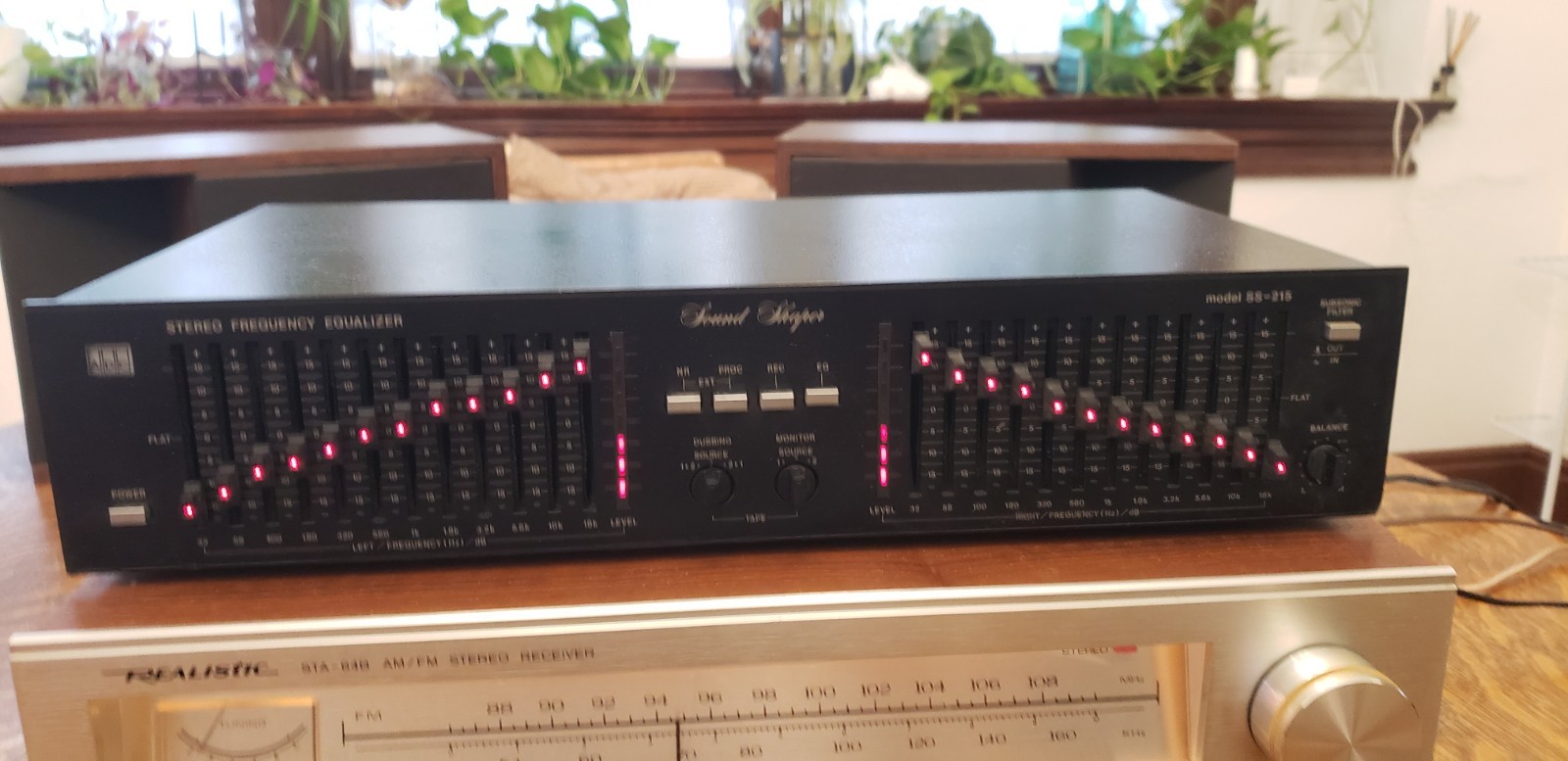
Flipping the power switch on an SS-215 doesn’t dazzle you with blinking lights or sweeping meters, but what it lacks in theatrics it makes up for in clinical clarity. This is the kind of equalizer that was never meant to be the star of the system—just the quiet professional in the background making sure everything else sounds its best. Slide those 12 detented sliders into place and the room tightens up: boomy bass pulls back, harsh highs soften, and the midrange clears like fog burning off at sunrise. It doesn’t add color; it removes clutter. That’s the magic of the SS-215. Not flash, not hype—just honest signal correction with a signal path so clean it feels like listening through glass.
ADC Sound, a subsidiary of Audio Dynamics Corporation, wasn’t chasing audiophile accolades with boutique finishes or exotic circuits. They were building tools for real systems in real rooms—living rooms, studios, broadcast booths—where acoustics were imperfect and speakers weren’t always perfectly matched. The SS-215 landed right in the sweet spot of that mission: a stereo 12-band graphic equalizer that delivered professional-grade performance without the professional-grade price tag. It wasn’t the flashiest box on the rack, but if your system had a resonance at 180Hz that made your neighbor bang on the wall, the SS-215 was the guy you called to fix it.
Compared to the wild-eyed tone sculptors of the late '70s that leaned into exaggerated curves and gimmicky filters, the SS-215 played it straight. Its frequency bands are spaced to match the critical points of human hearing—32Hz, 56Hz, 100Hz, 180Hz, 320Hz, 560Hz, 1kHz, 1.8kHz, 3.2kHz, 5.6kHz, 10kHz, 18kHz—giving precise control without the clutter of overlapping bands. The ±15dB range is more than enough to correct room modes or tame a bright tweeter, but not so wide that it encourages reckless over-EQing. And unlike some of its contemporaries, it doesn’t degrade the signal when you leave it flat. That’s rare. Many graphic EQs of the era introduced measurable noise or distortion just by being in the chain, but the SS-215’s discrete, direct-coupled design keeps the path transparent. Owners report that even with all sliders at unity, the sonic footprint is nearly undetectable—no veil, no grain, no added hum.
It’s not the most feature-laden unit ADC ever made. That title goes to the SS-315, which added switchable 12/24-band operation and a subsonic filter, or the SS-412X, which doubled as a spectrum analyzer. But the SS-215 was the workhorse—the model you’d find in mid-tier high-fidelity setups, university radio stations, and modest recording control rooms. It sat below the flagship models in capability but above the entry-level SS-115 in build quality and circuit refinement. For many, it was the first serious outboard processor they ever owned, and it often outlasted the amplifiers it was paired with.
Specifications
| Manufacturer | ADC Sound (Audio Dynamics Corporation) |
| Production Years | 1979–1985 |
| Original Price | $295 (1980 USD) |
| Type | Stereo Graphic Equalizer |
| Frequency Bands | 12 bands per channel: 32Hz, 56Hz, 100Hz, 180Hz, 320Hz, 560Hz, 1kHz, 1.8kHz, 3.2kHz, 5.6kHz, 10kHz, 18kHz |
| Control Range | ±15dB per band |
| Frequency Response | 5Hz to 100kHz |
| Total Harmonic Distortion | 0.008% at 1kHz |
| Intermodulation Distortion | 0.02% |
| Signal-to-Noise Ratio | 100dB |
| Input Sensitivity | 1V (7V maximum) |
| Output Level | 1V (7V maximum) |
| Gain | ±1dB |
| Input Impedance | 47kΩ |
| Output Impedance | 600Ω |
| Inputs/Outputs | 6 pairs of RCA inputs, 6 pairs of RCA outputs |
| Power Requirements | 120V AC, 60Hz, 25W |
| Weight | 12.5 lbs (5.7 kg) |
| Dimensions | 19" W × 1.75" H × 10.5" D |
| Construction | Steel chassis, aluminum front panel, rubberized black finish |
Key Features
Discrete, Direct-Coupled Signal Path
The SS-215 avoids the cost-cutting trend of capacitor-coupled stages that plagued many budget EQs of the era. Instead, it uses a fully discrete, direct-coupled design that eliminates coupling capacitors from the signal path. This means no phase shift at frequency extremes, no capacitor-induced coloration, and no risk of cap degradation over time affecting sound. It’s a design choice typically reserved for higher-end gear, and its presence here speaks to ADC’s commitment to performance over profit. The result is a neutral tonal balance even when no EQ is applied—something that can’t be said for many of its peers.
Detented, Precision Slide Controls
Each of the 24 sliders (12 per channel) features a positive detent at the center (0dB) position, making it easy to return to flat response or recall settings by feel. The sliders themselves are conductive plastic potentiometers—less prone to noise than carbon tracks—and while they can develop scratchiness after decades of use, a quick shot of contact cleaner like DeoxIT usually restores smooth operation. The tactile feedback is firm but not stiff, and the layout is uncluttered, with frequency labels clearly marked beneath each slider. No backlit scales or LED bars, just functional clarity.
Multi-Input/Output Routing
With six sets of stereo inputs and outputs, the SS-215 was designed to integrate into complex systems without requiring external switching. You could route a turntable, tape deck, tuner, and two auxiliary sources through the EQ without constantly plugging and unplugging. This made it a favorite in multi-source setups where one component—say, a bright FM tuner or a bass-heavy cassette deck—needed tonal correction while others didn’t. The rear panel also includes a grounding post, a feature often omitted on consumer gear but essential for eliminating ground loops in mixed-component systems.
Historical Context
The late 1970s and early 1980s were a golden age for outboard audio processors. As home stereo systems grew more sophisticated, so did the problems they revealed: room resonances, speaker inconsistencies, and source-specific tonal imbalances. The graphic equalizer, once a tool confined to broadcast and live sound, began appearing in living rooms. Companies like Rane, Drawmer, and Ashly led the professional side, but ADC Sound carved out a niche in the prosumer market—gear that performed like studio equipment but was priced for serious enthusiasts.
The SS-215 arrived in 1979, just as the graphic EQ craze peaked. Competitors like the Sony EQ-707 and the Pioneer EQ-P700 offered similar band counts but often used lower-grade components and capacitor-coupled circuits that colored the sound. The SS-215 stood out by prioritizing transparency and build quality. It wasn’t the first graphic EQ on the market, but it was among the first to deliver near-reference performance at a semi-affordable price. It also benefited from ADC’s reputation in broadcast and institutional markets—schools, churches, and radio stations trusted the brand, which gave the SS-215 a credibility many consumer brands lacked.
By the mid-1980s, the EQ boom began to fade. Audiophiles turned against tone shaping as a form of “fidelity fraud,” and the rise of digital audio promised built-in correction. ADC responded with more advanced models like the SS-315 and the SS-215X (which added switchable bandwidth), but the original SS-215 remained in production until 1985 as a reliable, no-frills option. It never won awards for innovation, but it earned quiet respect for doing its job exceptionally well.
Collectibility & Value
Today, the SS-215 trades in a narrow but steady market. It’s not a showpiece like a vintage Revox or a sought-after tube preamp, but it’s valued by system builders who want a transparent EQ that won’t degrade their signal. Units in working condition with clean sliders and no chassis damage typically sell between $150 and $250. Non-working or “for parts” units can be found for as little as $60, making them a low-risk project for tinkerers.
The most common failure point is slider noise—scratchy or intermittent output when adjusting bands. This is almost always due to oxidized potentiometer tracks and is usually fixable with contact cleaner. Less common but more serious are power supply issues, particularly in units that have been stored in humid environments. The internal transformer is robust, but the terminal strip and solder joints can corrode over time. A full recapping isn’t usually necessary unless the unit has been powered continuously for decades, but it’s not a bad idea if you plan to use it long-term.
When buying, check that all sliders move smoothly and that the output remains silent when no signal is present. Hum or hiss above the noise floor (which should be inaudible on a quiet system) suggests a failing op-amp or grounding issue. Also inspect the rear panel for cracked solder joints—common on older gear that’s been moved frequently. The rubberized coating on the top panel often chips or peels with age, but this is cosmetic only.
Despite its age, the SS-215 remains functional in modern systems. Its 600Ω output impedance is higher than ideal for driving long cables, but it pairs well with most integrated amps and preamps. It’s also a favorite among vinyl enthusiasts who use it to tame resonant peaks in older speakers or correct for uneven room acoustics. Unlike DSP-based EQs, it introduces no latency and requires no software—just plug in and adjust.
eBay Listings


As an eBay Partner, we earn from qualifying purchases. This helps support our independent vintage technology research.