ADC Sound Shaper SS-2-IC (1982–1988)
A 12-band surgical scalpel for your stereo field—transparent, precise, and built like a tank, if you can keep its sliders from turning to sand.
Overview
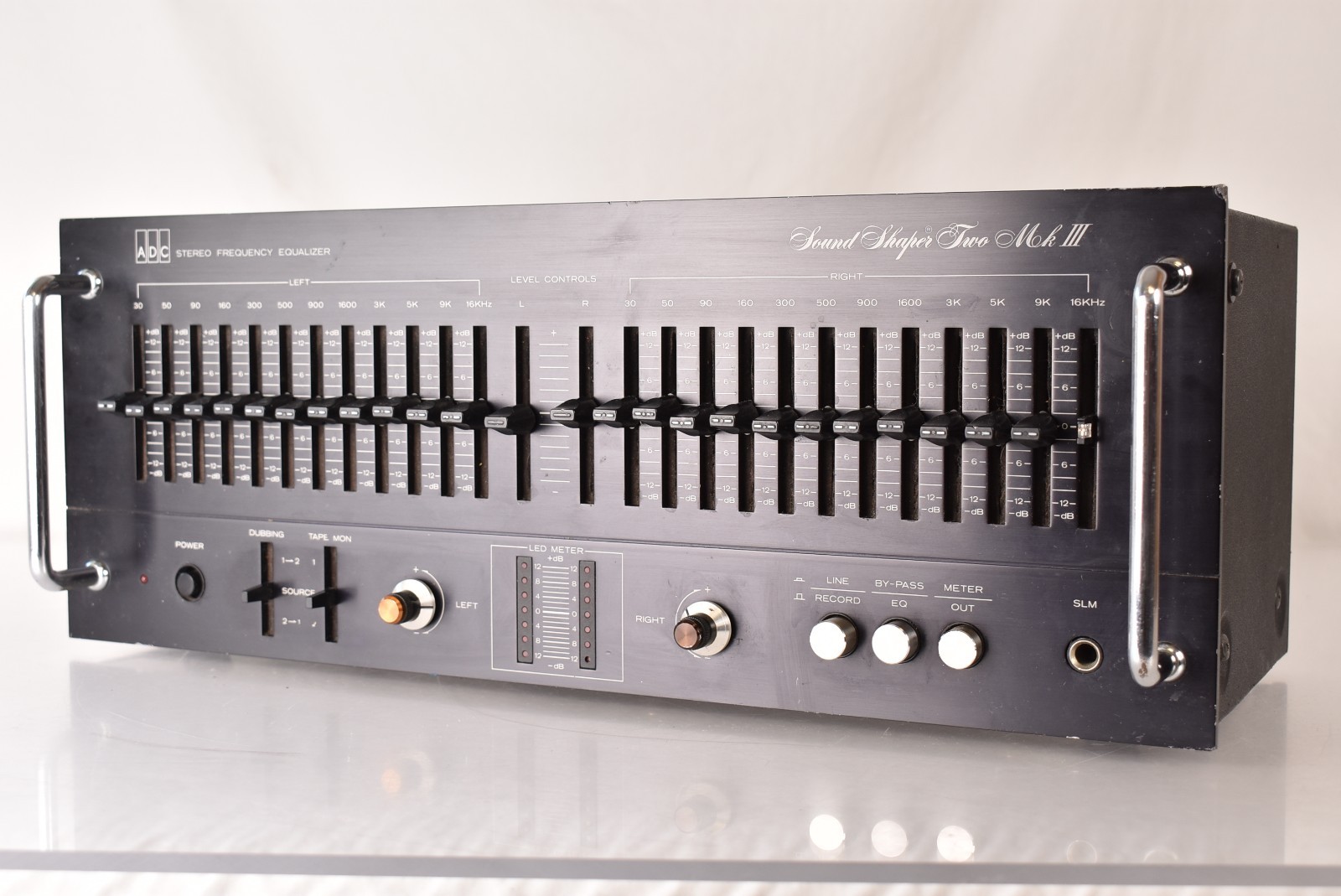
That first flick of the power switch on an SS-2-IC still carries a little drama—amber pilot light glows, the RCA jacks click solidly into place, and the row of 24 chunky sliders (12 per channel) sit like soldiers at attention, ready to reshape the frequency spectrum with surgical precision. This isn’t a colorizer or a vibe machine; the Shaper SS-2-IC was built for correction, not character. It’s the kind of equalizer you’d find in a well-appointed 1980s listening room where flat response was religion, and every bump in the bass or dip in the treble was treated like a design flaw to be fixed. And yet, despite its clinical mission, it manages to sound remarkably neutral—no added grain, no veiling, no low-level hum—just clean, direct control over your signal path.
Introduced in 1982 as an upgrade to the original SS-2, the “IC” in SS-2-IC stands for integrated circuit, marking a shift from the earlier discrete transistor design. That change brought tighter tolerance, lower distortion, and better channel matching, but it also sparked debate among purists. Some longtime ADC fans swore by the warmth of the original SS-2’s discrete topology, while others welcomed the SS-2-IC’s improved clarity and consistency. Either way, the IC version landed at a sweet spot in ADC’s lineup—above the budget SS-1 and SS-5, below the full-rack, 31-band monsters like the SS-33, and just under the analyzer-equipped SS-315. It wasn’t the most powerful or the most exotic, but for many, it was the most practical: a full 12-band per channel EQ in a compact 19-inch chassis, with enough range and resolution to tackle room modes, speaker quirks, or tape hiss without overwhelming the user.
The SS-2-IC’s frequency bands are spaced to cover the full audible spectrum with surgical accuracy—30Hz, 50Hz, 90Hz, 150Hz, 250Hz, 500Hz, 1kHz, 2kHz, 4kHz, 6.3kHz, 10kHz, and 16kHz—each offering ±12dB of cut or boost. That’s not the ultra-granular resolution of a 31-band EQ, but it’s more than enough for meaningful tonal shaping, especially when paired with a good test tone generator and an SPL meter. And unlike some graphic EQs of the era that colored the sound even when flat, the SS-2-IC stays remarkably out of the way. When all sliders are centered, the signal passes through with minimal degradation—documentation shows a signal-to-noise ratio of 85dB and THD under 0.02%, which was excellent for a consumer-grade EQ in the early '80s.
Specifications
| Manufacturer | ADC Sound |
| Production Years | 1982–1988 |
| Original Price | $395 |
| Number of Bands | 12 per channel (24 total) |
| Frequency Bands | 30Hz, 50Hz, 90Hz, 150Hz, 250Hz, 500Hz, 1kHz, 2kHz, 4kHz, 6.3kHz, 10kHz, 16kHz |
| Control Range | ±12dB per band |
| Input Sensitivity | 1V |
| Output Level | 1V (9V maximum) |
| Gain | ±1dB |
| Frequency Response | 5Hz to 100kHz |
| Total Harmonic Distortion | 0.02% |
| Signal to Noise Ratio | 85dB |
| Inputs | 1 pair RCA (stereo) |
| Outputs | 1 pair RCA (stereo) |
| Power Supply | 120V AC, 60Hz (internal) |
| Weight | 9.8 lbs (4.45 kg) |
| Dimensions | 19" W × 1.75" H × 8.5" D (48.3 × 4.4 × 21.6 cm) |
| Construction | Steel chassis, aluminum front panel, wood end caps (on early models) |
| Country of Origin | United States (later units from Taiwan) |
Key Features
Surgical 12-Band EQ with Precision Matching
The SS-2-IC’s 12-band layout wasn’t arbitrary—it followed the ISO standard for octave-based center frequencies, making it compatible with common test methodologies used in home and semi-pro environments. Each slider controls a fixed-frequency band with a Q (bandwidth) that’s tight enough to isolate problem areas but wide enough to avoid phase chaos. Unlike some graphic EQs that get “smeary” when multiple adjacent bands are adjusted, the SS-2-IC maintains coherence, even with aggressive curves. Service technicians observe that the IC-based filtering network contributes to this stability, offering better repeatability and less drift over time compared to the earlier discrete designs. The result is a tool that feels predictable—what you set is what you get, without surprises.
Integrated Circuit Topology: Transparency Over Warmth
By 1982, ADC had shifted from discrete transistor circuits to op-amp-based designs, and the SS-2-IC was one of the first in the Shaper line to fully embrace this change. The move wasn’t just about cost or reliability—it fundamentally altered the unit’s sonic signature. Where the original SS-2 had a subtle warmth, almost a softness in the upper mids, the SS-2-IC is flatter, cleaner, and more revealing. That’s a win for accuracy, but it can expose flaws in source material or downstream components. Owners report that pairing it with overly bright speakers or harsh digital sources can make the system sound clinical, even fatiguing. But when used to correct a muddy room or tame a boomy subwoofer, its transparency becomes a strength. It doesn’t sugarcoat—it just fixes.
Build Quality That Lasts (If Maintained)
The chassis is all-steel, the sliders are Alps or equivalent, and the RCA jacks are mounted directly to the PCB with strain relief. Even the knobs (on models with gain trim) feel substantial. Early units came with real wood end caps—walnut or rosewood, depending on finish—while later production shifted to plastic as costs tightened. But the real Achilles’ heel isn’t the frame—it’s the sliders. After 40 years, many have developed scratchiness or channel imbalance due to oxidized conductive plastic elements. Deoxit can help, but it’s often a temporary fix. Collectors note that fully recapped and slider-rebuilt units command a premium, and for good reason: a clean, quiet SS-2-IC is a joy to use, but a noisy one can ruin an otherwise pristine signal chain.
Historical Context
The early 1980s were peak years for the home audio enthusiast—the era of the “dual mono” preamp, the $2,000 receiver, and the graphic equalizer as a status symbol. ADC Sound, based in California, rode that wave with a lineup of no-nonsense, high-performance EQs aimed at the serious listener. The SS-2-IC arrived just as compact cassettes and early digital recordings were exposing the limitations of typical living-room acoustics. Unlike mass-market EQs from RadioShack or Soundcraftsmen, which often added noise and distortion, the SS-2-IC was designed to be sonically invisible when needed and surgically effective when called upon. It competed directly with the Audipath EQ-1000, the Rane DEQ-23, and the more expensive 31-band units from Drawmer and Ashly, but carved out a niche by balancing performance, price, and usability.
ADC didn’t try to reinvent the wheel—they refined it. The Shaper line evolved logically: the SS-1 (5-band) for entry-level, the SS-2/SS-2-IC (12-band) for serious tuning, and the SS-3 and above for studio-grade work. The “IC” designation wasn’t marketing fluff; it reflected a real engineering shift toward integrated circuits, which were becoming more reliable and cost-effective. While some audiophiles still debate the sonic merits of discrete vs. IC-based designs, the market spoke: the SS-2-IC outsold its predecessor and remained in production for six years, a long run for a niche product. By the late '80s, however, the EQ craze began to fade. Flat-response speakers improved, room correction software emerged, and many listeners decided that “perfect” sound wasn’t worth the hassle of a wall of sliders. ADC adapted with analyzer-equipped models like the SS-315, but the SS-2-IC remained a favorite for those who wanted control without complexity.
Collectibility & Value
Today, the SS-2-IC trades in a narrow but passionate market. Clean, fully functional units sell between $180 and $280, depending on condition and whether they’ve been serviced. Units with original wood end caps and black faceplates (early production) fetch a slight premium, especially if they come with the original manual or packaging. But buyers should be cautious—untested or “for parts” listings often hide slider decay, dried-up electrolytics, or cracked solder joints on the input/output jacks. Service technicians observe that the power supply capacitors are the most common failure point after decades of use, and replacing them (a process known as “recapping”) is almost a prerequisite for long-term reliability.
The sliders, though, are the real gamble. Even if a unit powers on and passes audio, the sliders may crackle or drift. Replacing them isn’t impossible—NOS Alps sliders are available, and some techs retrofit modern conductive plastic sliders—but it’s labor-intensive and expensive. A full restoration can cost $150 or more, which means an untested $100 SS-2-IC could quickly become a $250 project. For that reason, collectors strongly recommend buying only from sellers who explicitly state the unit has been tested for noise and channel balance. Units advertised as “cleaned with Deoxit” should be viewed skeptically—while it helps in the short term, it doesn’t fix worn-out slider tracks.
Despite these quirks, the SS-2-IC holds value better than most graphic EQs of its era. Its reputation for transparency, solid build, and useful feature set keeps demand steady. It’s not a flashy collectible like a Marantz 2270 or a Technics SU-V5, but for someone building a vintage high-fidelity system that actually measures well, the SS-2-IC is still a relevant tool. It’s the kind of gear that doesn’t announce itself—it just makes everything else sound better, quietly, night after night.
eBay Listings


As an eBay Partner, we earn from qualifying purchases. This helps support our independent vintage technology research.