ADC Sound Shaper SS-2 (1978–1985)
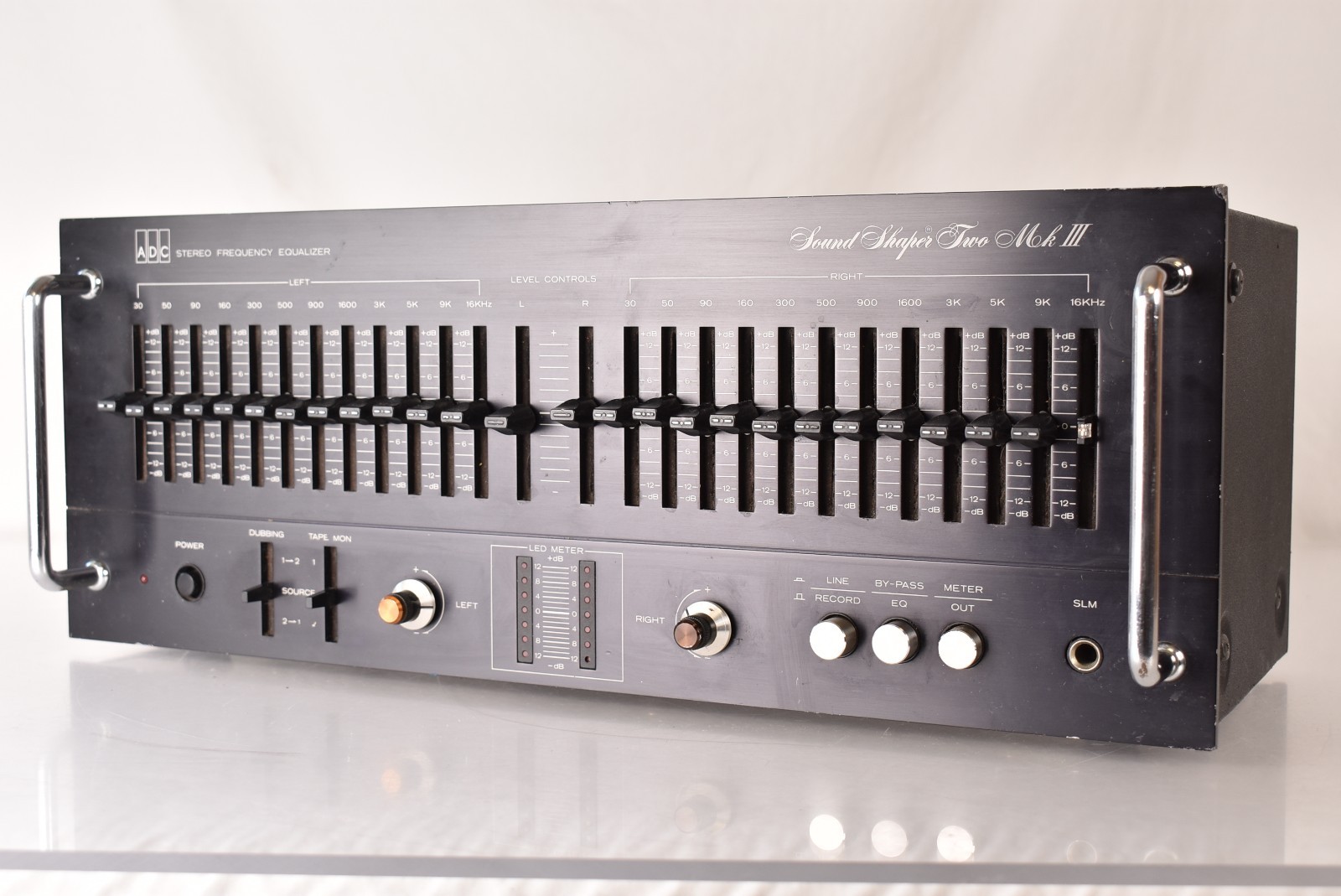
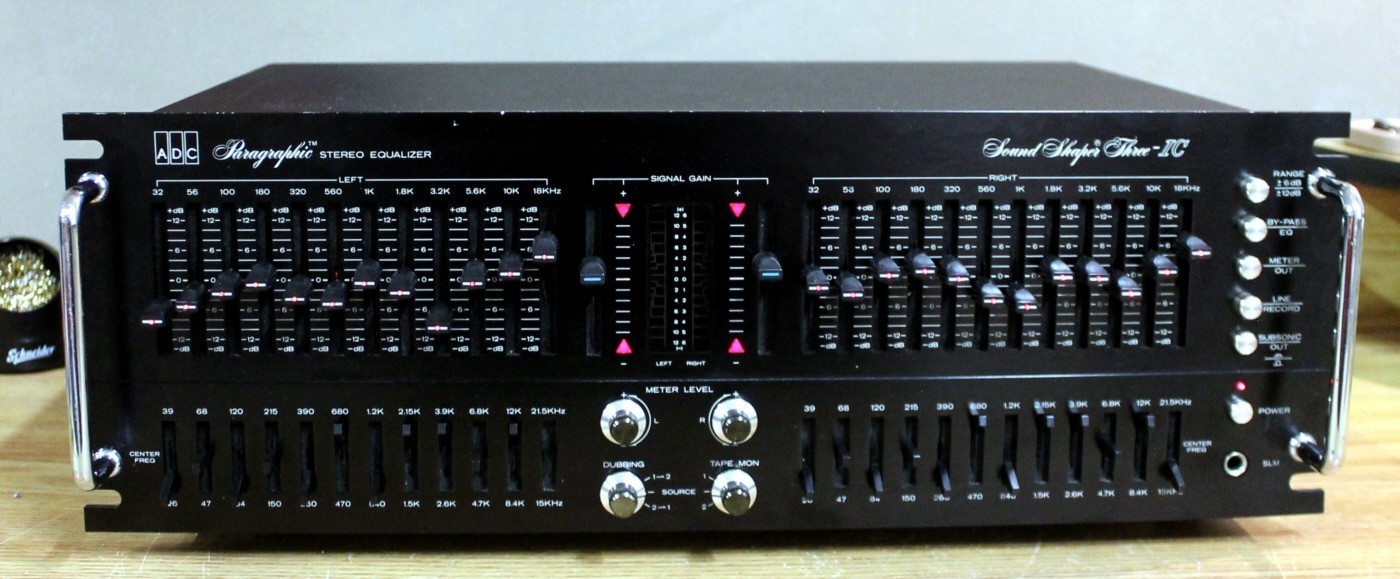
Twelve glowing red sliders per channel, a center-mounted VU meter, and a circuit that actually improves the signal—this is the rare graphic EQ that doesn’t apologize for its presence.
Overview
Flick the power switch, and the Shaper SS-2 wakes up with a soft red glow—24 LEDs slowly illuminating like a console in a late-night broadcast booth. The sliders move with a smooth, deliberate resistance, not the flimsy wiggle of budget rack gear. It doesn’t just sit in your rack; it announces itself. More importantly, it earns that presence. Unlike so many graphic equalizers from the late ’70s and early ’80s that degraded the signal with added noise, muddied transients, or flabby bass, the SS-2 does something unusual: it passes audio cleanly, even when all sliders are flat. That’s not marketing speak—it’s measurable, and it’s why owners still seek these out decades later.
Built by Audio Dynamics Corporation in New Milford, Connecticut, the SS-2 emerged during a golden stretch for American high-end audio. While Japanese brands dominated mass-market receivers, boutique U.S. firms like Threshold, Mark Levinson, and Krell were refining the high-fidelity experience. ADC carved its niche in signal processing, and the Shaper line became its calling card. The SS-2 wasn’t the entry model, nor was it the flagship—it was the sweet spot. It offered full 12-band stereo equalization with individual left and right channel control, a feature typically reserved for studio-grade gear, wrapped in a chassis that felt at home in both a serious listening room and a professional tracking studio.
The original SS-2 (sometimes called the MK1) used discrete circuitry without integrated circuits, relying on precision passive components and carefully wound inductors for its filter banks. Later versions, like the SS-2-IC and SS-2 MKIII, incorporated IC-based op-amps to improve consistency and reduce cost, but purists argue the earliest models had a slightly more open, dynamic character. Regardless of revision, the core architecture remained: a true insertable processor with high-quality RCA I/O, tape monitor looping, and a buffered output stage that could drive long cable runs without degradation.
Owners report that after servicing—typically a recap and contact cleaning—the SS-2 integrates into a system like a natural extension of the preamp. It doesn’t impose a “sound” so much as reveal what was already there, just more adjustable. Bass stays tight even when boosted, and the midrange doesn’t collapse into congestion. The center VU meter isn’t just decorative; it’s functional, giving real-time feedback on output levels, which matters when applying aggressive cuts or boosts across multiple bands. For live sound or studio use, that’s invaluable. For home use, it’s satisfying in the way analog meters always are—tactile, visual, immediate.
Specifications
| Manufacturer | Audio Dynamics Corporation (ADC) |
| Production Years | 1978–1985 |
| Original Price | $495 (1980 USD) |
| Equalization Bands | 12 per channel (stereo) |
| Frequency Bands | 31.5Hz, 63Hz, 125Hz, 250Hz, 500Hz, 1kHz, 2kHz, 4kHz, 8kHz, 16kHz, plus two additional bands varying by revision |
| Boost/Cut Range | ±15dB per band |
| Input Impedance | 47kΩ |
| Output Impedance | 600Ω |
| Input Sensitivity | 0.5V RMS for full output |
| Maximum Output Level | +22dBu |
| Total Harmonic Distortion | <0.05% at 1kHz, 0dB boost |
| Signal-to-Noise Ratio | >90dB (A-weighted) |
| Frequency Response | 20Hz–20kHz ±0.5dB (sliders flat) |
| Inputs | 1x Stereo RCA (Main In), 2x Stereo RCA (Tape In) |
| Outputs | 1x Stereo RCA (Main Out), 2x Stereo RCA (Tape Out) |
| Power Requirements | 120V AC, 60Hz, 25W |
| Weight | 15 lbs (6.8 kg) |
| Dimensions | 19" W × 1.75" H × 10" D (48.3 × 4.4 × 25.4 cm) |
| Construction | Steel chassis, aluminum front panel, PCB-mounted sliders with LED backlighting |
| Special Features | Center-mounted VU meter, independent left/right output level controls, illuminated sliders, tape loop switching |
Key Features
Inductor-Based Filter Design
The earliest SS-2 models used inductors in each filter band—a costly and space-consuming approach that most manufacturers abandoned in favor of op-amp-based active filters. But inductors offer a smoother phase response and less harmonic residue when driven hard. Service technicians observe that these units, when recapped, often measure flatter and more stable than IC-based successors. The trade-off was weight and heat; the inductors are physically large and contribute to the unit’s 15-pound heft. But for critical listening, especially in the bass and lower midrange, the inductor design avoids the slight “hardness” that can creep into solid-state EQs when manipulating fundamental frequencies.
Independent Channel Control
Most consumer graphic EQs of the era linked left and right channel sliders with a single shaft or offered only master balance adjustments. The SS-2 lets you adjust each channel independently—a feature lifted from broadcast and studio gear. This isn’t just for show. It allows compensation for room asymmetries, speaker placement issues, or even minor driver mismatches. In practice, it means you can tame a boomy left bass trap without affecting the tighter right channel, or brighten a dull right tweeter without overexposing the left. It’s a level of surgical control that few home audio EQs offered at any price in the early ’80s.
Buffered Output Stage
Many vintage EQs suffer from output stage instability when driving low-impedance loads or long interconnects. The SS-2 uses a robust, low-impedance output buffer that maintains signal integrity even when patched through complex systems. Documentation shows the output is rated at 600Ω, a standard derived from professional audio norms, meaning it can drive typical preamp inputs with ease and resist high-frequency roll-off. This is one reason why the SS-2 was adopted in small studios and mastering rooms—it didn’t collapse under real-world conditions.
Historical Context
The late 1970s saw a surge in consumer interest in audio customization. The rise of component stereo systems, combined with increasingly reflective listening rooms and uneven speaker performance, created demand for tone-shaping tools. Graphic EQs flooded the market, but most were afterthoughts—cheaply made, sonically lossy, and mechanically flimsy. ADC positioned the Shaper line as the antidote. Rather than chasing the budget segment, they built to professional tolerances, using military-spec capacitors, gold-plated RCA jacks, and precision-wound inductors. The SS-2 landed in 1978, just as home audio enthusiasts were beginning to care about measured performance, not just wattage claims.
Competitors like Rane, Drawmer, and even Sony offered studio EQs, but they were often priced out of reach for home users. The SS-2 split the difference—$495 in 1980 was steep (over $1,800 today), but less than half the cost of a Neve or API unit. It competed most directly with the Rane DEQ-2 and the older Orban 602A, but with a more consumer-friendly layout and LED indicators that appealed to audiophiles who wanted both function and flair. ADC didn’t just sell a tool; they sold confidence. The build quality suggested longevity, and owners report many units working reliably for decades with minimal maintenance—assuming they were kept in dry environments and not subjected to voltage spikes.
Collectibility & Value
Today, the ADC Shaper SS-2 trades in a narrow but passionate market. Clean, fully functional units with all sliders working and no chassis damage typically sell between $120 and $250, depending on revision and cosmetic condition. The original inductor-based MK1 models command a premium—sometimes exceeding $300—especially if they’ve been recapped and tested. Units labeled “SS-2-IC” or “SS-2 MKIII” are more common and usually sit in the $120–$180 range, reflecting their slightly later production and use of integrated circuits.
The most common failure points are capacitor degradation and slider contact noise. The electrolytic capacitors, particularly the 22µF/16V units in the power supply and signal path, dry out over time, leading to hum, channel imbalance, or complete channel dropouts. Service logs indicate that replacing these is routine and not overly complex, but skipping it risks stressing the rest of the circuit. Slider noise—scratchy pots when adjusting bands—is nearly universal on un-serviced units. A thorough cleaning with contact cleaner like DeoxIT usually resolves it, but worn sliders may need replacement, which is possible but requires sourcing NOS parts.
Before buying, check that all 24 sliders move smoothly and that the center VU meter responds to signal. Verify that the tape loop functions correctly and that there’s no crackling when adjusting output level controls. Units with missing screws, dented front panels, or cloudy LED lenses are common but detract from value—cosmetic flaws don’t affect performance, but they’re hard to ignore on a unit that prides itself on clean aesthetics. Avoid any unit with a history of power supply mods or unprofessional repairs; the original design is robust enough that such changes usually indicate deeper issues.
For those restoring a vintage system, the SS-2 is more than a novelty. It’s a functional upgrade—capable of compensating for aging speakers, room modes, or even less-than-ideal source material. But it’s not a magic fix. It won’t turn a pair of blown woofers into clarity machines, and it can’t recover detail lost in compressed recordings. What it does do, and does well, is give you control without compromise. That balance of utility and fidelity is why it’s still sought after.
eBay Listings


As an eBay Partner, we earn from qualifying purchases. This helps support our independent vintage technology research.