ADC Sound Shaper SS-115X (1980s)
That first flick of the power switch—when the glowing sliders rise like a sci-fi control panel coming alive—is half the thrill of owning this analog beast.
Overview
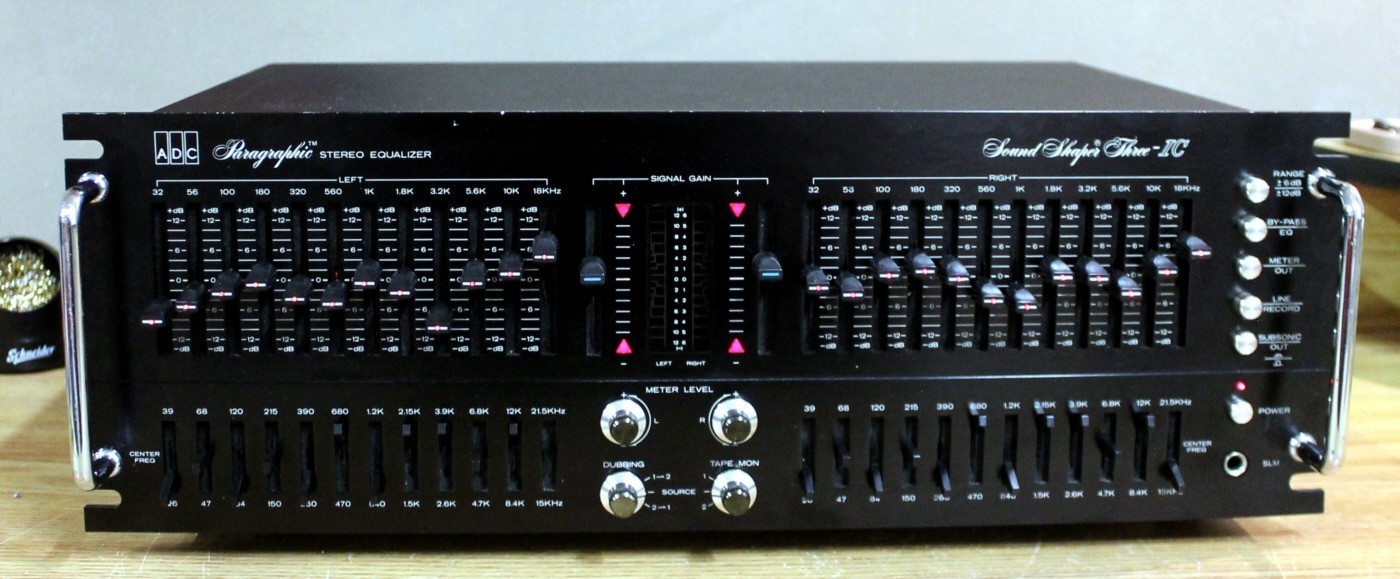
Plug in the ADC Sound Shaper SS-115X, flip the switch, and watch the front panel ignite: ten illuminated sliders per channel, a softly lit ADC logo, and twin bar-graph meters tracking output level like twin heartbeats. It’s not just an equalizer—it’s theater. Built in Japan by the ADC Professional Group during the golden era of high-end home audio, the SS-115X was engineered for audiophiles who wanted surgical control over their sound without surrendering to sterile digital processing. This is a 10-band stereo graphic equalizer with ±15 dB of cut and boost across a full audiophile-grade spectrum—from 31.5 Hz up to 16 kHz—giving it the rare ability to shape bass weight and airiness with equal authority. Unlike many consumer EQs of the era that capped at ±10 dB, the SS-115X lets you really *sculpt*, making it a favorite among users who battled problematic room acoustics or mismatched speakers.
It’s not a preamp, not a processor—just pure, discrete analog signal shaping. The circuit relies on the JRC4559D operational amplifier, a chip known for clean gain and low noise, paired with carefully tuned passive components to define each frequency band. Input and output are standard stereo line-level, but what sets it apart is the inclusion of dual tape loops—two sets of tape in/out jacks with switchable dubbing routing. That means you can insert the SS-115X between your source and amplifier while still maintaining tape monitoring and recording flexibility, a thoughtful touch for users still building out reel-to-reel or cassette-based systems in the mid- to late-1980s. The build is all metal, heavy, and industrial—this isn’t a piece you hide in a rack. It demands center stage.
And while it shares DNA with the nearly identical SS-115 (same banding, similar layout), the SS-115X is the version that surfaced more often in North American and European markets, often with slightly updated labeling and minor internal refinements. It wasn’t the flagship of ADC’s Sound Shaper line—models like the SS-315 or SS-412X added spectrum analyzers and more advanced features—but the SS-115X hit the sweet spot: serious performance without studio-level complexity or price. For the discerning listener, it was the tool that turned a good system into a tailored one.
Specifications
| Manufacturer | ADC Professional Group |
| Production Years | Mid-1980s (circa 1985–1987) |
| Original Price | Not available |
| Frequency Bands | 31.5 Hz, 63 Hz, 125 Hz, 250 Hz, 500 Hz, 1 kHz, 2 kHz, 4 kHz, 8 kHz, 16 kHz (per channel) |
| Control Range | ±15 dB |
| Frequency Response | 20 Hz – 20 kHz |
| Input Sensitivity | 1 V |
| Output Level | 1 V |
| Total Harmonic Distortion | 0.1% |
| Signal to Noise Ratio | 100 dB |
| Inputs | Stereo line in, two stereo tape in (switchable) |
| Outputs | Stereo line out, two stereo tape out (switchable dubbing) |
| Display | LED bar graph meters (AN6877 IC), illuminated sliders, backlit ADC logo |
| Power Supply | Internal linear power supply |
| Construction | Steel chassis, aluminum front panel, slider potentiometers |
| Dimensions | Not available |
| Weight | Not available |
| Country of Origin | Japan |
Key Features
The Analog Advantage: No Digital Artifacts, Just Real EQ
In an age when even mid-tier gear began flirting with early digital processing, the SS-115X stayed resolutely analog. Each of its ten frequency bands uses a dedicated passive filter network paired with the JRC4559D op-amp to deliver smooth, musical correction. There’s no sampling, no latency, no quantization—just electrons moving through capacitors and resistors. The result? Even when pushed to ±15 dB, the sound remains coherent, never brittle or phasey like some early digital EQs. Audiophiles who’ve A/B’d this against later DSP-based units often describe the SS-115X as “more forgiving” and “organic,” especially in the midrange. The wide control range means it can compensate for bass-trapped rooms or overly bright speakers, but it also rewards subtlety—nudging a few dB at 125 Hz can add warmth without muddiness, while a slight lift at 10 kHz can restore air without sibilance.
Illuminated Interface: Function Meets Drama
The front panel isn’t just functional—it’s a statement. Each slider has a built-in LED that glows when powered, making it usable in dim environments and adding to the unit’s visual appeal. The stepped action of the sliders gives tactile feedback, avoiding the wobble of cheaper potentiometers. Above the controls, a dual-channel bar graph meter—driven by a pair of AN6877 ICs—displays output level in real time, helping prevent clipping when aggressive EQ curves are applied. And then there’s the ADC logo, backlit by a small incandescent bulb. It’s a small detail, but one that collectors either love or mourn—because those bulbs burn out, and replacements are now scarce. When working, it casts a warm, vintage glow; when dead, it leaves a dark void in the center of the panel. Some owners retrofit LEDs, but purists insist on preserving the original look.
Tape Loop Flexibility: Built for Real Systems
Unlike simpler EQs that only offer in/out jacks, the SS-115X includes two complete tape loops with switchable routing. This means you can connect a cassette deck and a reel-to-reel (or two cassettes) and choose which one gets monitored or recorded through the EQ. The dubbing switch lets you route the EQ’d signal to either tape output independently, a feature that made this unit a favorite among tapers and home archivists. It also means the SS-115X can sit cleanly in a chain with a receiver or preamp that lacks built-in tape monitoring. For users still deep in the analog tape ecosystem of the 1980s, this wasn’t just convenient—it was essential.
Historical Context
The mid-1980s saw a surge in high-fidelity home audio systems, driven by the rise of CD players, improved turntable designs, and a growing awareness of room acoustics. Graphic equalizers, once the domain of live sound and recording studios, began appearing in living rooms. Companies like Sony, Pioneer, and Yamaha offered consumer-grade EQs, but many capped at ±10 dB and used lower-grade components. ADC, though less known than those giants, carved a niche with its Sound Shaper line—professional-grade units built for accuracy and durability. The SS-115X competed with models like the Sony EQ-800 and the Yamaha GE-707, but offered more gain range and a more robust build. It wasn’t marketed as a “tone control” but as a precision tool, appealing to listeners who treated their systems like instruments. ADC’s use of discrete analog circuitry, rather than integrated solutions, reflected a philosophy that fidelity came from component quality, not cost-cutting. While never a mass-market hit, the SS-115X found loyal users among audiophiles, broadcast engineers, and even some small studios looking for an affordable way to tune monitor rooms.
Collectibility & Value
Finding a working SS-115X today is a minor victory. These units were built well, but time has not been kind to their internals. The most common failure point is the power supply—electrolytic capacitors in the linear supply are prone to leaking, especially in units stored in damp environments. Once those go, they can corrode the PCB and damage nearby components. The JRC4559D op-amps are generally reliable, but the slider potentiometers are a different story. Decades of dust, oxidation, and wear turn them into crackle machines. While some sellers claim to have “cleaned and tested” sliders, that often means a quick shot of contact cleaner—effective short-term, but not a fix for deeply contaminated pots. The real solution? Disassembly and ultrasonic cleaning, or even replacement with modern conductive plastic sliders, a painstaking process few technicians now offer.
The illuminated ADC logo is another Achilles’ heel. The incandescent bulb burns out, and sourcing an exact replacement is difficult. Some owners bypass it entirely; others retrofit miniature LEDs, though the color temperature rarely matches the original warm glow. The bar graph meters, powered by the AN6877 ICs, are generally robust, but if one channel fails, the chip must be sourced from old stock or salvaged units.
In terms of value, working, clean units with full slider function and intact lighting sell between $250 and $400 on the secondary market. Units described as “for parts” or “untested” go for $75 to $150, but beware: a non-working SS-115X can cost more to repair than it’s worth unless you’re doing the work yourself. Fully restored examples with recapped power supplies, cleaned sliders, and upgraded audio-grade capacitors occasionally appear on specialty forums for $500+, but they’re rare. For buyers, the rule is simple: insist on clear video of all sliders moving without noise, meters responding, and the unit powering on cleanly. If the seller can’t provide that, assume it needs a full service. And if you’re buying to restore? Budget at least $100 for parts and several evenings of careful work.
eBay Listings



As an eBay Partner, we earn from qualifying purchases. This helps support our independent vintage technology research.