ADC Sound Shaper SS-115 (1980s)
A wall of glowing sliders that let you carve your sound with surgical precision—and a vintage analog warmth digital EQs still can’t touch.
Overview
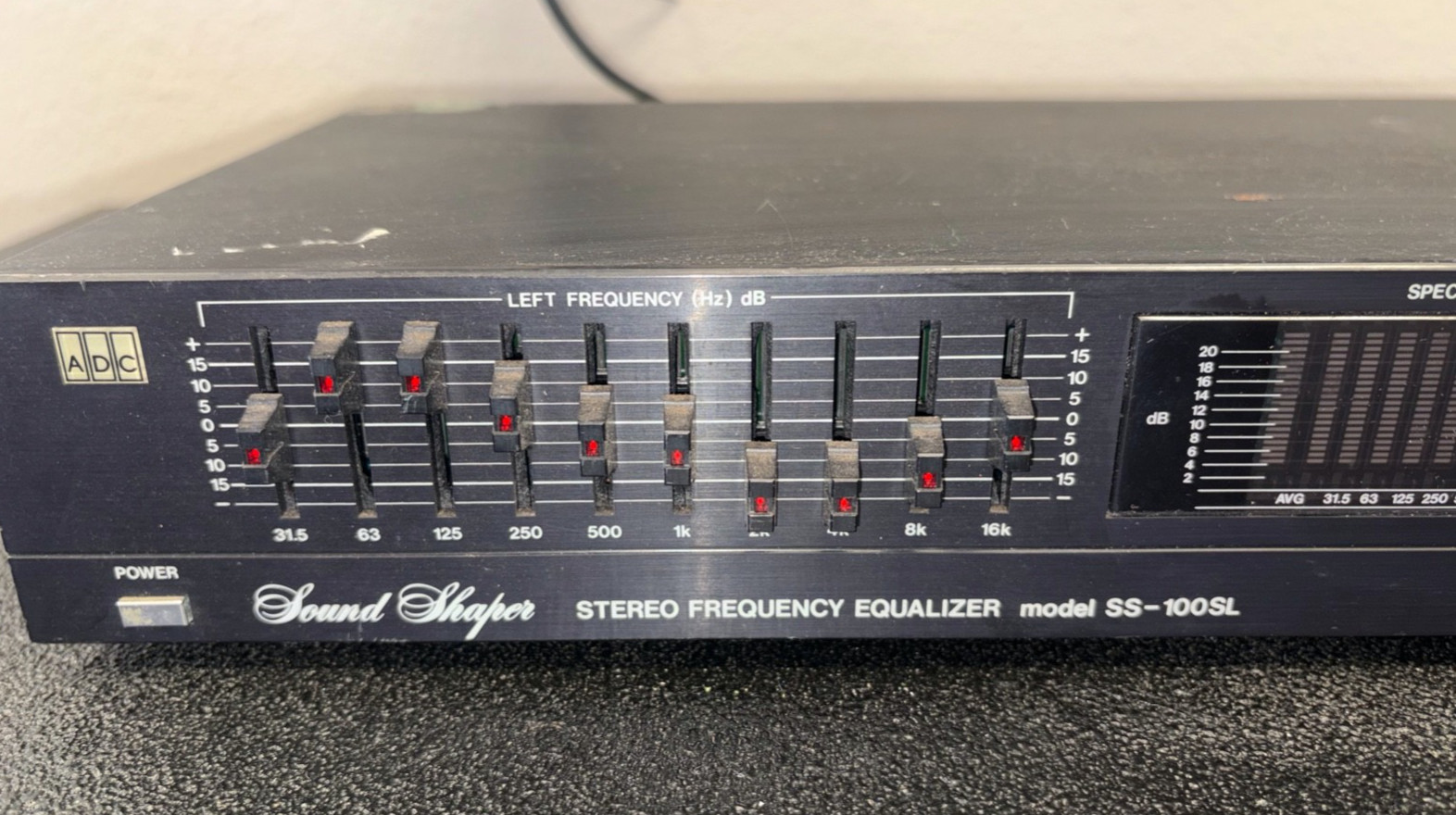
Flick it on and the front panel comes alive: ten amber-lit sliders per channel, each crowned with a tiny glowing dot, marching in perfect symmetry from rumbling sub-bass to ear-tickling treble. The ADC Sound Shaper SS-115 doesn’t whisper its presence—it announces itself like a console from a 1980s recording studio that somehow escaped into a living room. This is a serious piece of analog signal shaping, built when graphic equalizers weren’t just accessories but essential tone tools for audiophiles, DJs, and system tuners battling imperfect rooms and even more imperfect speakers. Unlike the flimsy plastic EQs that cluttered budget receivers, the SS-115 feels like it was engineered to last—thick steel chassis, hefty knobs, and a weight that tells you this thing means business.
It’s a stereo 10-band graphic equalizer, with frequency bands spaced to cover the full audible spectrum: 31.5 Hz, 63 Hz, 125 Hz, 250 Hz, 500 Hz, 1 kHz, 2 kHz, 4 kHz, 8 kHz, and 16 kHz. Each slider offers ±15 dB of cut or boost, which is more aggressive than many modern equivalents—especially today’s digital units that often cap out at ±10 dB. That extra headroom means you can really reshape a system’s character, whether you’re taming a boomy room node at 125 Hz or adding crispness to dull highs. And because it’s fully analog, built around discrete components and JRC4559D op-amps, the signal path stays warm and coherent even when you’re making drastic adjustments. There’s no sampling, no latency, no quantization—just pure, real-time analog filtering that reacts instantly to your touch.
The SS-115 isn’t just about EQ. It’s a full signal hub, with stereo line inputs and outputs, plus dedicated tape in/out loops that support switched dubbing—meaning you can patch in a tape deck and route signals through the EQ during recording or playback with a flip of a switch. That kind of flexibility was gold in the tape era, letting users fine-tune recordings on the fly or match levels between sources. The front panel also features a dual-channel bar graph meter, driven by AN6877 ICs, that gives a real-time readout of output level—useful for avoiding clipping when you’re boosting multiple bands. And yes, the iconic “ADC Sound Shaper” logo lights up in red, though after 40 years, that incandescent bulb is more likely to be a memory than a functioning feature.
While it shares DNA with the SS-115X—so much so that many listings use the names interchangeably—the SS-115 appears to be the slightly earlier or base variant in a family of professional-grade equalizers from ADC’s Japanese engineering team. It lacks the “X” suffix, but functionally it’s nearly identical: same frequency bands, same ±15 dB range, same physical layout and signal architecture. The differences, if any, are likely in minor component revisions or production batch variations rather than core functionality. What matters is that both represent a high-water mark for analog graphic EQs in the consumer and pro-sumer space—offering performance that rivaled more expensive studio units, without the rack-mount price tag.
Specifications
| Manufacturer | ADC Professional Group |
| Production Years | Early to mid-1980s |
| Original Price | Not documented |
| Number of Bands | 10 per channel |
| Frequency Bands | 31.5 Hz, 63 Hz, 125 Hz, 250 Hz, 500 Hz, 1 kHz, 2 kHz, 4 kHz, 8 kHz, 16 kHz |
| Gain Range | ±15 dB per band |
| Signal to Noise Ratio | 100 dB |
| Frequency Response | 20 Hz – 20 kHz |
| Inputs | Stereo line in, stereo tape in |
| Outputs | Stereo line out, stereo tape out |
| Tape Dubbing | Switched dubbing function |
| Level Meters | Dual-channel bar graph (AN6877 IC driven) |
| Power Supply | Internal linear power supply with electrolytic capacitors |
| Construction | Steel chassis, aluminum front panel |
| Country of Origin | Japan |
| Weight | Not documented |
| Dimensions | Not documented |
| Operational Amplifiers | JRC4559D |
| Channel Configuration | Stereo (dual mono) |
Key Features
Analog Signal Path with Discrete Design
The SS-115 doesn’t rely on digital processing or microcontrollers. Instead, it uses a fully analog signal path built around discrete components and the JRC4559D operational amplifier—a chip known for its clean, stable performance in audio applications. This means no aliasing, no sample rate conversion, and no added noise floor from digital conversion stages. The result is an EQ that integrates smoothly into an analog chain, preserving the character of the original signal even when making dramatic tonal changes. Audiophiles who’ve used both analog and digital EQs often describe the SS-115 as “transparent” when flat, and “musical” when adjusted—qualities that are hard to quantify but instantly audible.
±15 dB Cut/Boost with Precision Sliders
Each of the ten frequency bands offers a full ±15 dB range, giving far more control than the ±10 dB found on many modern graphic EQs. This extra headroom is especially useful for room correction, where deep nulls or sharp peaks might require aggressive filtering. The sliders themselves are precision potentiometers with a stepped feel, providing tactile feedback as you adjust. They’re also illuminated from below, making them easy to read in dim environments. However, decades of dust and oxidation can turn them scratchy—owners report that cleaning with contact cleaner is often necessary, and in extreme cases, disassembly and washing under tap water (as one restorer documented) may be required to restore smooth operation.
Integrated Tape Loops and Dubbing Control
Beyond EQ, the SS-115 acts as a signal router. It features dedicated tape in and tape out jacks, allowing integration with cassette decks for recording or playback. A dubbing switch lets you route the signal path so that the EQ affects either the playback loop, the record loop, or both—crucial for users who wanted to monitor with EQ but record flat, or vice versa. This level of control was standard in high-end preamps and receivers of the era, but rare in standalone EQs. It reflects ADC’s intent: this wasn’t just a tone tweak box, but a central hub for a complete analog system.
Bar Graph Level Meters and Illuminated Display
Flanking the sliders are dual bar graph meters that display output level for each channel, helping users avoid clipping when boosting multiple bands. Driven by AN6877 ICs, these meters respond quickly and accurately to signal peaks. The front panel’s visual design is equally striking—the red-lit “ADC Sound Shaper” logo and individual slider indicators create a retro-futuristic glow that’s as much a part of the experience as the sound. While the logo bulb is often burned out today (it’s a filament type), replacing it or retrofitting with an LED can restore the full effect.
Historical Context
The early 1980s were the golden age of the graphic equalizer. Home audio systems were growing more powerful, but speaker and room acoustics hadn’t caught up—leading to boomy bass, harsh mids, and dull highs. The graphic EQ became the audiophile’s scalpel, letting them surgically correct imbalances. ADC, part of the ADC Professional Group based in Japan, positioned itself in the upper tier of this market—not as expensive as studio-grade units from companies like API or Drawmer, but far more capable than the toy-like EQs built into mass-market receivers.
The SS-115 landed in a competitive field. It went head-to-head with offerings from Soundcraftsmen, Rane, and Sony, all of whom were pushing the limits of analog filter design. What set the SS-115 apart was its combination of wide gain range, clean signal path, and professional features like tape switching and level meters—all in a compact desktop form. It was also built during a time when Japanese manufacturers dominated high-end audio engineering, and ADC leveraged that reputation for precision and reliability. While not as famous as some of its contemporaries, the SS-115 earned a quiet following among users who valued its no-nonsense performance and robust build.
Collectibility & Value
Finding a working SS-115 today is a challenge—and restoring one is a labor of love. These units were built to last, but time has not been kind to their internal components. The most common failure point is the electrolytic capacitors in the power supply, which often leak and corrode the circuit board. Owners report that recap jobs are almost mandatory for any unit that’s been sitting for decades. The original mains cable is another weak spot: thin two-core wiring with no earth connection, which modern restorers routinely replace with a proper three-core grounded cable for safety.
Slider pots are another issue. After 40 years, the carbon tracks wear out or collect conductive dust, leading to crackling and channel dropouts. While contact cleaner can help, it’s often a temporary fix. Deep cleaning—sometimes involving disassembly and rinsing under water—is what serious restorers resort to. The illuminated logo bulb is almost certainly dead by now, but that’s a minor cosmetic issue compared to the electrical upgrades needed.
In terms of value, working units in good condition typically sell between $100 and $250, depending on cosmetics and functionality. Units listed as “for parts” or “untested” go for under $100, but they’re only worth it if you’re prepared to do a full restoration. Mint, fully serviced examples with upgraded caps and clean sliders can command higher prices, especially from collectors who appreciate the visual impact and analog purity of the design. However, demand is niche—this isn’t a Grado SR80 or a Nakamichi cassette deck with a massive resale market. It’s a specialist tool for analog purists, not a mainstream collectible.
If you’re considering buying one, test it thoroughly: listen for hum (especially when boosting low frequencies), check every slider for smooth operation, verify the tape loops work, and inspect the mains cable. A unit that powers on is not the same as a unit that’s safe to use. And if you’re restoring one, budget for new capacitors, a new power cord, and several hours of cleaning and recalibration. But if you pull it off? You’ll own a piece of audio history that still outperforms most digital EQs when it comes to analog feel and surgical control.
eBay Listings


As an eBay Partner, we earn from qualifying purchases. This helps support our independent vintage technology research.