ADC Sound Shaper SS-110 (1970s–1980s)
A no-frills, no-compromise 10-band graphic EQ that shaped more than just frequencies—it defined how living rooms heard rock, funk, and disco at full volume.
Overview
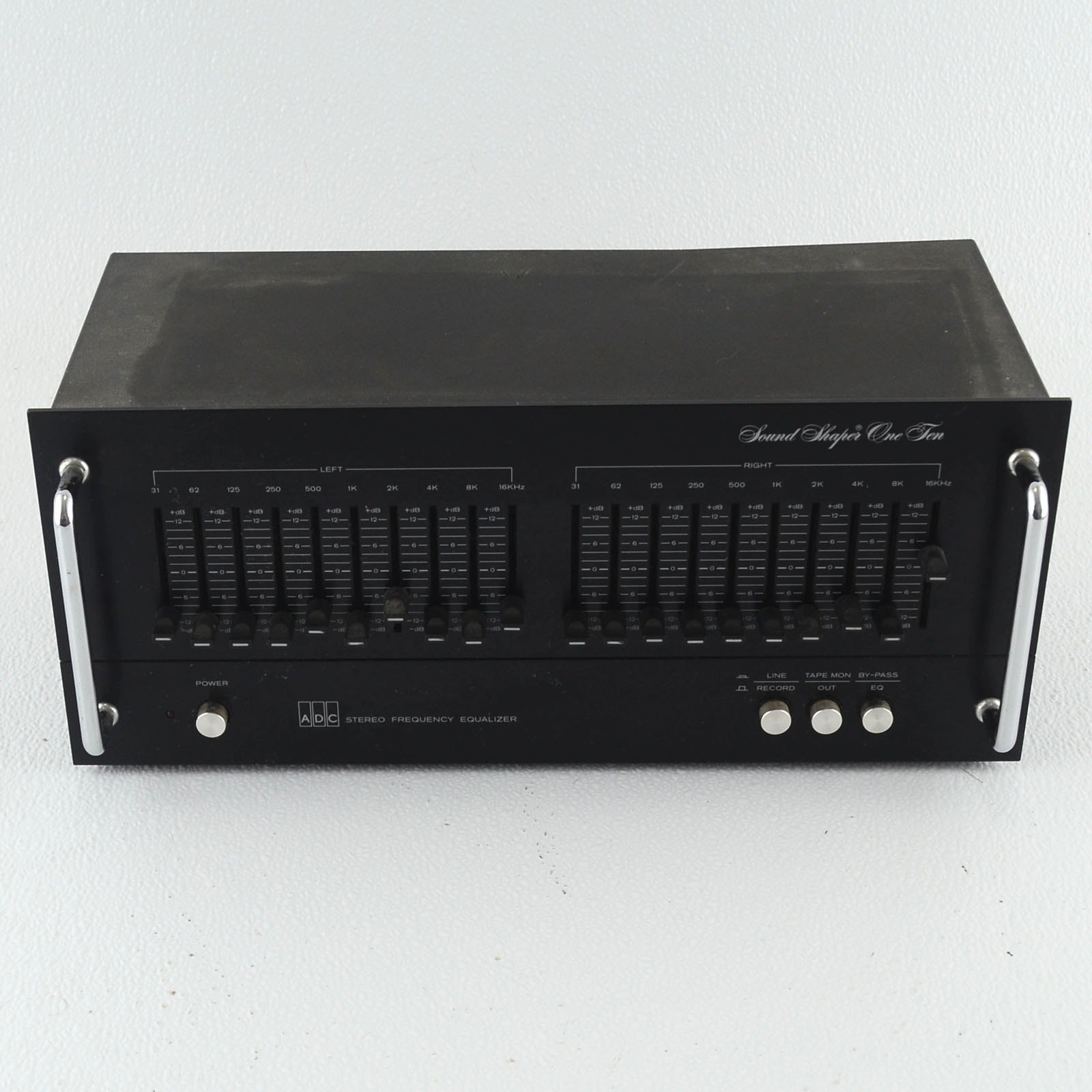
Flick on the power switch and watch the twin rows of faders twitch to life, their smooth action betraying decades of use. The ADC Sound Shaper SS-110 doesn’t announce itself with chrome or blinking lights, but it makes its presence known the moment you crank the bass and feel the floorboards start to hum. This is a workhorse EQ from the golden age of home audio tweaking—when “flat response” was for purists and everyone else wanted to hear the kick drum punch through the drywall. Built like a tank and wired with a surprisingly clean discrete signal path, the SS-110 was never meant to win audiophile awards. It was built to survive basement parties, college dorms, and the occasional smoke session where someone inevitably cranked the 60 Hz slider all the way up “just to see what happens.”
Despite its modest branding and utilitarian faceplate, the SS-110 punches above its weight in terms of sonic transparency. Unlike later IC-based equalizers that could color or compress the signal when pushed, this one uses discrete bipolar amplifiers with LCR (inductor-capacitor-resistor) filters in the feedback loop—old-school analog tech that maintains headroom and avoids the “sag” some graphics develop when multiple bands are boosted. The result? A tone that stays firm even when you’re sculpting aggressively. It won’t add warmth like a tube preamp or give you the surgical precision of a parametric, but it delivers exactly what it promises: control, clarity, and a satisfying physicality to the sound shaping process.
Positioned below ADC’s pro-oriented Mark II revisions and flagship studio units, the SS-110 was the accessible entry point into the brand’s “Sound Shaper” line. It didn’t have stepped attenuators or balanced outputs, nor did it pretend to. But it brought real equalization power to the consumer market at a time when most “tone controls” were little more than crude shelving filters. For under $100 new, you got 20 individual faders (10 per channel), smooth ±12 dB adjustment, and a design that encouraged experimentation. That tactile interface—each slider moving with a firm, slightly damped glide—turned EQing into a performance, not just a setup step.
Specifications
| Manufacturer | ADC Sound (Audio Dynamics Corporation) |
| Production Years | Mid-1970s to early 1980s |
| Original Price | $89.95 (USD) |
| Equalization Type | 10-band stereo graphic equalizer |
| Frequency Bands | 32 Hz, 63 Hz, 125 Hz, 250 Hz, 500 Hz, 1 kHz, 2 kHz, 4 kHz, 8 kHz, 16 kHz |
| Boost/Cut Range | ±12 dB per band |
| Signal Path | Discrete bipolar amplifier design |
| Filter Type | LCR (inductor-capacitor-resistor) in feedback loop |
| Inputs | 2 × RCA (stereo) |
| Outputs | 2 × RCA (stereo) |
| Throughput Bypass | Mechanical toggle switch (non-defeatable in some units) |
| Power Supply | Internal AC transformer, 120V AC (North American models) |
| Power Consumption | 15 watts |
| THD | Less than 0.05% at full output (typical) |
| Frequency Response | 20 Hz – 20 kHz (±0.5 dB, flat setting) |
| S/N Ratio | Greater than 90 dB (A-weighted) |
| Input Sensitivity | 250 mV for rated output |
| Output Level | 2 V RMS maximum |
| Dimensions | 17" W × 5" H × 6.5" D |
| Weight | 6.8 lbs (3.1 kg) |
Key Features
The Discrete Advantage
While many of its contemporaries began adopting op-amps and integrated circuits to cut costs, the SS-110 stuck with a fully discrete signal path for the audio circuitry—a decision that paid dividends in headroom and transparency. The use of discrete bipolar transistors in the gain stages, combined with precision LCR filters, meant the unit could handle dynamic program material without flinching. This wasn’t just marketing speak; owners report noticeably cleaner performance when driving complex signals like full-bandwidth rock mixes or live jazz recordings. The EQ doesn’t “disappear” like modern digital units, but it avoids the wooliness that plagues cheaper graphics from the late '70s. Even with multiple bands boosted, the signal remains articulate—no small feat for a consumer-grade box.
Tactile, No-Nonsense Interface
Every fader on the SS-110 moves with a deliberate, mechanical precision that feels reassuring under the fingers. Unlike flimsy plastic sliders found on budget EQs, these are metal-shafted and glide on internal rails that, when clean, offer smooth resistance without wobble. The layout is logical: two parallel rows of sliders, left and right channels mirrored, with frequency labels etched directly into the brushed aluminum faceplate. There’s no digital display, no memory presets, no gimmicks—just your hands, the music, and twenty points of control. The bypass switch, while basic, is a sturdy rocker that clicks with authority. However, some early units lack true relay bypass, meaning the signal still passes through the circuit even when “defeated,” potentially degrading the chain slightly when not in use.
Built for the Real World
ADC didn’t try to make the SS-110 look like studio gear, but they built it like it belonged there. The steel chassis is thick, the rear panel is densely populated with robust RCA jacks, and the internal layout shows signs of thoughtful routing—no spaghetti wiring or point-to-point chaos. The internal power transformer is potted to reduce microphonics, and the circuit boards are hand-soldered with consistent joints. It’s not military-grade, but it’s overbuilt by consumer standards. That toughness explains why so many still work today, even after decades of being shoved behind racks, knocked over, or subjected to questionable power conditions.
Historical Context
The mid-1970s saw a surge in home audio customization, driven by the rise of high-fidelity component systems and the cultural embrace of bass-heavy music—from Motown to Zeppelin to disco. Graphic equalizers, once exclusive to broadcast and recording studios, started trickling down to living rooms. ADC, short for Audio Dynamics Corporation, was one of several American companies—alongside BSR, Radio Shack, and Fisher—trying to capture that market. But where others cut corners with IC-based designs or flimsy enclosures, ADC leaned into solid engineering, offering a middle ground between affordability and performance.
The SS-110 arrived just before the EQ craze peaked, landing in a sweet spot between the ultra-cheap no-name units and the $300+ professional models from companies like Rane or API. It competed directly with the Realistic SA-5000, the BSR X1000, and the Fisher EQ-900—units that often used cheaper filter designs and suffered from higher distortion. ADC’s use of discrete circuitry and LCR filters gave it a technical edge, even if the brand lacked the prestige of a Marantz or Sansui. It wasn’t marketed with flashy ads or celebrity endorsements; it was sold through audio specialty shops and mail-order catalogs to people who read the specs and cared about signal integrity.
By the early 1980s, the graphic EQ boom began to wane. Audiophiles dismissed them as “tone benders,” and the rise of digital audio shifted focus to other forms of processing. ADC responded with the Mark II revision of the SS-110, which added features like stepped controls and improved metering, but the original SS-110 remained the most widely distributed model. It never became a legend, but it became a fixture—pulled from attics, reconditioned, and plugged into modern systems by those who appreciate its hands-on approach and honest sound.
Collectibility & Value
The ADC Sound Shaper SS-110 is not a rare find, but a functional, clean unit is increasingly hard to come by. Most surfaced from basements or estate sales, often with oxidized faders, cracked knobs, or failing power supplies. Prices reflect this: non-working units or parts donors sell for $25–$50, while tested, fully operational models in good cosmetic condition typically fetch $80–$150. Units with original boxes, manuals, or the less common Mark II designation can reach $200, especially if listed as “collector clean.”
The most common failure points are mechanical, not electrical. Fader pots accumulate dust and develop scratchy operation, particularly in the bass and treble bands that get the most use. Cleaning with contact cleaner often restores function, but some sliders may require disassembly or replacement. The RCA jacks, while sturdy, can loosen over time and need resoldering. The internal power transformer is generally reliable, but units stored in damp environments may show signs of corrosion on the secondary windings.
Before buying, test every fader for smooth travel and listen for crackling or dropouts. Check that the bypass switch engages cleanly and that both channels pass signal equally. Visually inspect the faceplate for missing slider caps—common on the rightmost faders, especially the 16 kHz band—and ensure the unit powers on without hum or distortion. Recapping isn’t usually urgent unless the unit has been unused for 20+ years, but replacing the electrolytics can improve long-term reliability and reduce noise floor.
While not a high-end collectible like a vintage Neve or API, the SS-110 has a loyal following among DIY audio tinkerers and analog enthusiasts who appreciate its build quality and hands-on EQ experience. It’s not essential gear, but it’s satisfying gear—the kind you keep powered on just to watch the faders dance with the music.
eBay Listings



As an eBay Partner, we earn from qualifying purchases. This helps support our independent vintage technology research.