ADC Sound Shaper SS-100SL (1980–1989)
A spectrum analyzer that dances to your music, paired with surgical EQ sliders that actually behave
Overview
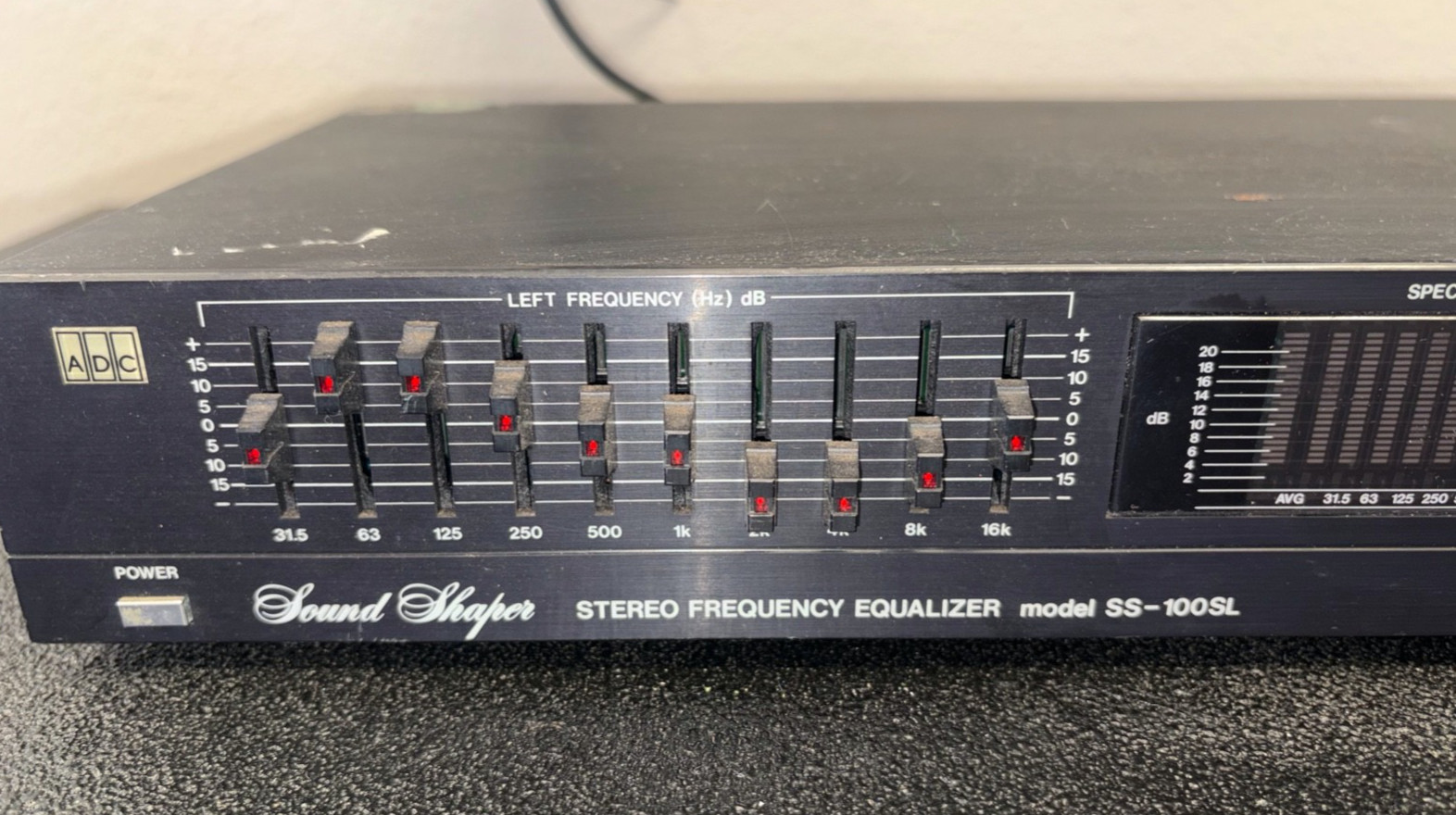
That first flicker of the FL display when you power it up—green phosphor rising and falling like breath—is why people hunt this thing down. The ADC Sound Shaper SS-100SL isn’t just an equalizer; it’s a living dashboard for your stereo, a real-time X-ray of whatever’s playing, glowing with the kind of analog urgency digital spectrum plugins only pretend to replicate. You don’t just tweak frequencies here—you watch them move, react, collide. And when you nudge one of those ten chunky sliders on the left or right channel, you’re not guessing at correction. You’re responding, like a surgeon adjusting pressure mid-incision.
Built in Japan during the late analog golden age—somewhere between 1980 and 1989, though no exact start or end year is documented—the SS-100SL landed at a moment when audiophiles were starting to demand more control without sacrificing signal purity. It wasn’t the cheapest graphic EQ on the shelf, nor was it the most extreme. But it hit a sweet spot: serious measurement-grade tools wrapped in a clean, usable chassis. The 10-band design follows octave spacing (31.5 Hz to 16 kHz), which means the filters are wide enough to avoid the brittle, overcooked sound of 1/3-octave monsters, but precise enough to dial out room modes or brighten a dull tape deck without turning your mix into mush.
What sets it apart from the sea of vintage EQs isn’t just the analyzer—it’s how everything works together. The RTA (real-time analyzer) isn’t a gimmick tacked on for show. It’s calibrated, responsive, and paired with a bar graph meter on the left that shows average signal level across the spectrum. You can switch the EQ circuit in and out with a front-panel button, A/Bing your adjustments instantly—a feature still missing on many modern processors. And despite its analytical demeanor, the SS-100SL doesn’t sound clinical. When the sliders are flat, the signal path stays remarkably transparent, with specs that still impress: 20Hz–20kHz ±0.5dB response, 0.05% THD, and a 100dB signal-to-noise ratio. This wasn’t built to color your sound—it was built to reveal it, then let you reshape it with authority.
It’s also built like a lab instrument. The chassis is dense, the sliders are smooth but positive, and the front panel layout makes immediate sense. No menu diving, no cryptic LEDs. Just sliders, a big display, and a few essential switches. The back panel includes line in/out, tape in/out (so you can record your EQ’d signal directly to deck), and a subsonic filter that rolls off below 20Hz at -18dB/octave—useful for killing rumble without touching the meat of the bass. At 3.3kg and 435mm wide, it fits neatly into a standard rack or shelf, though its 70mm height means you’ll have room above and below. It’s not flashy, but it radiates competence.
Specifications
| Manufacturer | ADC Sound (Audio Dynamics Corporation) |
| Production Years | 1980–1989 |
| Original Price | ¥36,000 (approx. $270 USD in 1988) |
| Type | Stereo graphic equalizer with RTA display |
| Channels | 2 (independent left/right 10-band EQ) |
| Center Frequencies | 31.5, 63, 125, 250, 500, 1k, 2k, 4k, 8k, 16 kHz |
| Adjustment Range | ±15 dB per band |
| Gain Accuracy | ±1 dB |
| Frequency Response | 20 Hz – 20 kHz ±0.5 dB (sliders at center) |
| Total Harmonic Distortion | 0.05% |
| Cross Modulation Distortion | 0.05% |
| Signal-to-Noise Ratio | 100 dB (A-weighted, at 1V or less) |
| Maximum Input/Output Level | 4 V RMS or more |
| Input Sensitivity | Not specified |
| Load Impedance | Not specified |
| Subsonic Filter | 20 Hz and below, -18 dB/octave |
| Inputs/Outputs | Line In, Line Out, Tape In, Tape Out |
| Display | FL (fluorescent) real-time analyzer, 10-segment spectrum + left-side bar meter |
| EQ Bypass | Front-panel switch for A/B comparison |
| Weight | 3.3 kg |
| Dimensions | 435 mm (W) × 70 mm (H) × 324 mm (D) |
Key Features
The Fluorescent Real-Time Analyzer That Actually Works
Most vintage EQs with built-in spectrum displays are either too slow, too dim, or too coarse to be useful. The SS-100SL’s FL display breaks that trend. It’s bright, fast, and segmented cleanly across the ten frequency bands, mirroring the EQ sliders directly below. Unlike LED bar graphs that average or lag, this fluorescent tube responds instantly, making it possible to see transient peaks, harmonic buildups, or resonant spikes as they happen. The left-side bar meter adds context—showing overall level so you don’t mistake a hot signal for a frequency anomaly. It’s not a calibrated measurement mic setup, but for a living room or studio tweak session, it’s shockingly effective. Owners report using it to identify room nodes, verify tape deck frequency roll-off, or just enjoy the hypnotic dance of a well-mixed track.
Independent Left/Right 10-Band EQ with Surgical Precision
While many graphic EQs of the era shared a single set of sliders for both channels, the SS-100SL gives full left/right independence. That means you can correct an off-axis speaker, tame a bright right tweeter, or even create subtle spatial effects by EQ’ing one channel differently. The ±15dB range is generous but not extreme—enough to fix problem frequencies without encouraging abuse. The sliders themselves are long-throw and smooth, with a mechanical feel that inspires confidence. More importantly, the filters are well-behaved; they don’t ring, phase smear, or collapse the soundstage when adjusted. This isn’t a “character” EQ—it’s a corrective tool, and it shows in the measured flatness when centered.
Tape Loop and Bypass for Practical Use
The inclusion of a tape loop isn’t just nostalgic—it’s functional. You can route your source into the SS-100SL, apply EQ, and send the corrected signal directly to your tape deck’s line input via the tape out. The tape in then feeds back to the main output, preserving your chain. This lets you record EQ’d material without extra patching. And the front-panel EQ bypass switch is a quiet hero. It lets you instantly compare your adjusted sound with the flat, unprocessed signal—a feature that should be standard but often isn’t. It’s the difference between thinking you’ve improved the sound and knowing you have.
Historical Context
The early 1980s saw a surge in consumer-grade audio measurement tools. The rise of high-end home audio, the popularity of live sound reinforcement, and the lingering influence of broadcast engineering all fed into a demand for gear that didn’t just sound good—but could prove it. The ADC Sound Shaper line emerged in this climate, offering Japanese-built precision at prices accessible to serious hobbyists. While companies like Sony and Denon were pushing all-in-one receivers, ADC targeted the tinkerer: the guy with a good preamp, a tape deck, and a room that wasn’t acoustically perfect.
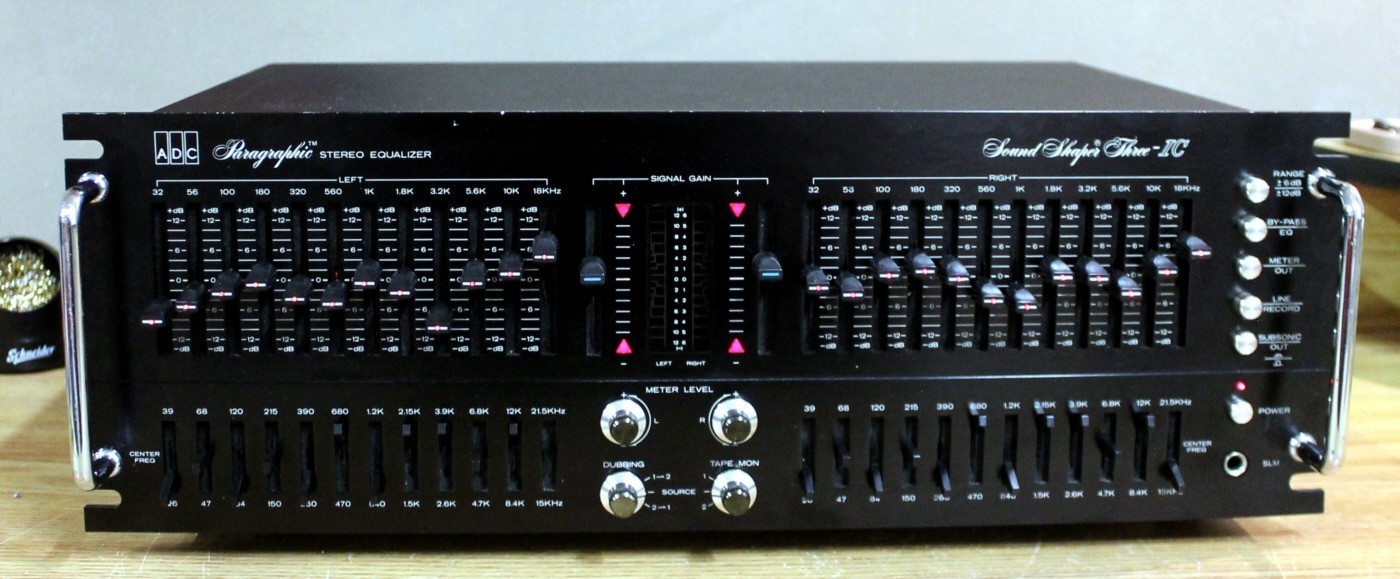
The SS-100SL sat in the middle of the Shaper lineup—above the basic SS-100 but below the more advanced SS-300SL and SS-315 models. It wasn’t the first graphic EQ with an analyzer, but it was one of the first to integrate the two so cohesively at this price point. Competitors like the Sony EQ-3000 or the Kenwood EQ-7000 offered similar slider layouts but lacked real-time visual feedback. The SS-100SL’s closest rival might have been the Realistic SA-1000, a rebranded OEM unit with a similar feature set but lower build quality. ADC’s advantage was its precision display and cleaner signal path—engineered for people who cared about accuracy, not just aesthetics.
It also arrived just before the digital EQ wave. By the late '80s, products like the DBX 120A and the Peavey SPV-2016 began offering parametric control and digital displays, but they were expensive and often alienating to home users. The SS-100SL stayed analog, approachable, and visual in a way that felt intuitive. It didn’t try to do everything—just one thing, very well.
Collectibility & Value
Today, the SS-100SL trades in the $150–$300 range depending on condition, with fully tested, clean units commanding the higher end. Unpowered or untested lots can dip below $100, but that’s a gamble. The most common failure points are mechanical: broken slider caps, cracked knobs, or damaged pushbuttons (especially on the 2kHz and 4kHz bands, as noted in several eBay listings). The fluorescent display is generally reliable, but aging units may show dim segments or flickering—often due to failing driver circuitry or dried solder joints rather than the tube itself.
More concerning is the tape input circuit, which has been reported dead in some units even when line I/O works fine. Service technicians observe that this is often due to corroded jacks or failed coupling capacitors, not a systemic flaw. The subsonic filter and EQ bypass relay are other potential weak spots, though not widespread. Recapping isn’t mandatory yet for most units, but it’s recommended if you plan to use it regularly—especially the power supply and signal path caps.
When buying, prioritize units with all sliders functional, intact caps, and a bright, responsive display. The original manual is a bonus (rare but occasionally found in auctions), and having both tape in and out working expands usability. Avoid anything with cracked solder on the rear panel terminals—this model sees enough DIY repairs that poor rework is common. For daily use, it’s stable; for display, it’s a standout. The green glow and symmetrical layout make it a centerpiece on any rack.
Restoration is straightforward for a competent tech. The board layout is clean, service points are labeled, and the full manual is available online. Replacement slider caps and knobs can be sourced from other vintage ADC models (SS-115, SS-315X), and the FL display, while proprietary, isn’t prohibitively expensive when NOS units surface. As vintage analyzers go, this is one of the more maintainable.
eBay Listings


As an eBay Partner, we earn from qualifying purchases. This helps support our independent vintage technology research.