ADC Sound Shaper III Paragraphic (Late 1970s)
Twelve sliding tabs sit above a row of fluorescent lights, waiting to carve shape out of raw sound.
Overview
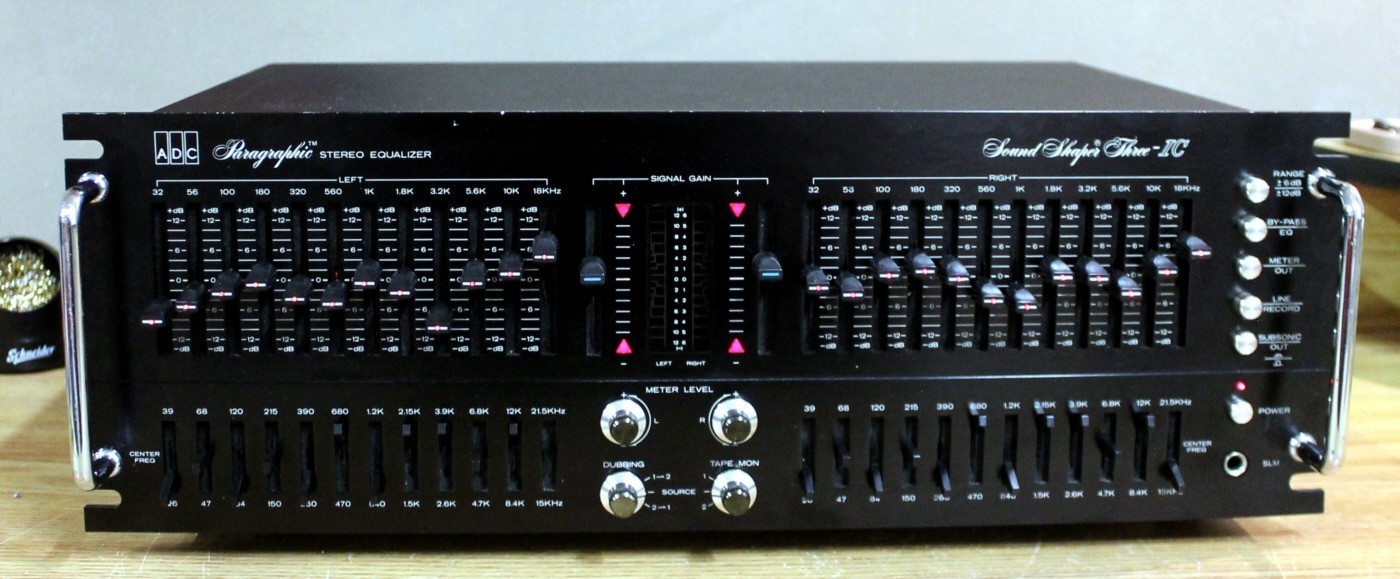
The ADC Sound Shaper III Paragraphic stands apart from the crowded marketplace of 1970s graphic equalizers by offering a hybrid control scheme that demands more from the operator. While standard graphic units fixed frequencies at standard ISO intervals, this model allows the user to select the center frequency for each band before adjusting gain. Documentation describes this architecture as paragraphic, blending the visual immediacy of a graphic interface with the surgical precision of a parametric design. Twelve bands per channel provide dense coverage across the spectrum, and each band possesses its own frequency selector knob alongside the vertical gain slider. This dual-layer control creates a tactile experience that slows down the adjustment process, forcing the listener to engage with specific problem areas rather than sweeping broad curves.
Collectors note that the circuitry varies significantly between production runs, creating a distinct sonic divergence within the same model family. Early units utilized inductor-based filtering networks, which owners report impart a warm, saturated character reminiscent of studio outboard gear from the same era. Later revisions switched to integrated circuit topology, prioritizing stability and cost over the magnetic warmth of the original design. The chassis houses a fluorescent display tube that reacts to signal level, providing visual feedback that many users find essential for setting gain structures without clipping. This combination of visual metering, frequency selection, and gain control positions the Sound Shaper III as a tool for correction rather than mere decoration, appealing to those who view equalization as a diagnostic process.
Market positioning during the late 1970s placed this unit above entry-level graphic equalizers but below professional rack-mounted analyzers. ADC leveraged their reputation from high-quality phonograph cartridges to suggest accuracy in signal processing, though the company faced financial shifts that eventually led to absorption by BSR. The Sound Shaper III remains a coveted piece for enthusiasts who prioritize room correction and speaker boundary compensation over simple tone shaping. Owners report that the unit excels at taming difficult mid-bass resonances and extending true bass response, tasks that require the frequency selection flexibility inherent to the paragraphic layout. The physical depth of the case often requires custom shelving or rack adaptation, as standard audio furniture rarely accommodates the chassis dimensions.
Specifications
| Manufacturer | Audio Dynamics Corporation (ADC) |
| Production Years | Late 1970s |
| Model Type | Paragraphic Stereo Frequency Equalizer |
| Channels | 2 (Stereo) |
| Frequency Bands | 12 per channel |
| Frequency Selection | 12 selectors per channel |
| Gain Control | Slider per band |
| Signal Gain | Master slider per channel |
| Display | Fluorescent meter tube |
| Level Control | Knob for meter sensitivity |
| Circuit Technology | Inductor (Early) / IC (Late) |
| Input Connections | RCA |
| Output Connections | RCA |
| Variant | Mark I / Mark II |
| Market Segment | Consumer High-Fi |
| Power Requirement | AC mains (Documentation varies) |
| Control Interface | Slider and Rotary Selector |
| Original Currency | USD / GBP |
| Current Market Value | $55 - $325 (Condition dependent) |
Key Features
Paragraphic Architecture
The defining characteristic of this unit lies in the ability to shift the center frequency of each equalization band. Standard graphic equalizers lock frequencies to fixed points like 100Hz, 1kHz, or 10kHz, which can miss the exact resonance of a room or speaker. The Sound Shaper III allows the operator to sweep the frequency selector to find the precise node causing interference before cutting or boosting gain. Service technicians observe that this requires more patience than typical graphic adjustment, as each of the twelve bands must be tuned individually. The result is a correction curve that fits the acoustic environment rather than forcing the environment to fit the equalizer. This flexibility makes the unit particularly effective for managing speaker placement issues and boundary effects in domestic listening spaces.
Inductor versus Integrated Circuit Topology
Production history reveals a split in component strategy that affects sonic performance. Early versions employ inductor-based filtering networks, which collectors describe as delivering a thicker, more saturated sound similar to vintage studio processors. Later revisions adopted integrated circuit designs to reduce manufacturing costs and improve reliability. Forum discussions highlight that the inductor versions are sought after for recording applications and critical listening, while the IC versions are praised for clean operation without added harmonic coloration. Owners report that the inductor models can introduce a subtle warmth that masks harshness in digital sources, whereas the IC models maintain transparency. Identifying the circuit type requires inspection of the internal boards, as external cosmetic changes between revisions are minimal.
Visual Metering and Gain Management
A fluorescent display tube provides real-time signal level feedback, governed by a dedicated sensitivity knob. This feature prevents accidental clipping when boosting multiple bands, a common failure mode in equalizer usage. Documentation shows that the meter responds to the output signal, allowing the user to set the master gain slider to maintain headroom. The visual interface adds a layer of engagement that many enthusiasts find absent in modern digital processing. Collectors note that the fluorescent tube itself can fail over decades of use, requiring replacement or bypassing of the display circuit. The meter level control allows the display to function even at low signal volumes, ensuring the visual feedback remains useful across different listening levels.
Historical Context
Audio Dynamics Corporation originated as a manufacturer of high-quality moving magnet phonograph cartridges and bookshelf loudspeakers during the 1960s and 1970s. Their ZLM and XLM cartridges achieved cult status among audiophiles, establishing a reputation for precision tracking and signal retrieval. As the hi-fi market expanded in the 1970s, ADC diversified into graphic equalizers, capitalizing on the consumer demand for room correction and tone customization. The Sound Shaper III emerged during a period when equalizers transitioned from professional studio tools to household components. Competitors like Phase Linear, Marantz, and Pioneer offered fixed-frequency graphic units, but ADC's paragraphic approach targeted users who demanded surgical control.
Industry shifts in the mid-to-late 1980s saw ADC acquired by BSR, a British manufacturer known for inexpensive automatic turntables. Under the BSR name, ADC equalizers continued production but often shed advanced features like spectrum analyzers to meet lower price points. The Sound Shaper III represents the peak of ADC's independent engineering before this consolidation. The unit reflects an era where analog signal processing was considered essential for optimizing speaker performance, particularly as high-excursion drivers became common in home audio. Documentation from the period suggests ADC marketed the equalizer as a means to improve the relationship between cartridges and speakers, addressing system-wide balance rather than simple tone adjustment.
Collectibility & Value
Market values fluctuate significantly based on circuit topology and cosmetic condition. Auction records show inductor-based units commanding prices upwards of $325, while later IC versions or units with cosmetic wear sell for approximately $55. The fluorescent display tube is a critical failure point; collectors note that a non-functioning display reduces value considerably unless the owner intends to bypass the metering circuit. Power transformers in ADC equipment from this era occasionally suffer from primary winding failures, as observed in related models like the SS315. Service technicians recommend checking for hum or overheating upon initial power-up, as a compromised transformer can damage rectifier components.
Buying advice centers on verifying slider functionality and frequency selector continuity. Scratchy controls are common due to age, but owners report that contact cleaner restores operation effectively. The physical depth of the chassis requires measurement before purchase, as standard audio racks may not accommodate the paragraphic layout. Enthusiasts seeking recording applications prioritize the inductor versions for their coloration, while home audio users often accept the IC variants for transparency. Documentation shows that original manuals are scarce, particularly service schematics for the IC version, which drives restoration costs higher for technicians attempting board-level repair. The unit remains a strong recommendation for those willing to engage with the adjustment process, offering capabilities that surpass fixed-frequency competitors from the same period.
eBay Listings


As an eBay Partner, we earn from qualifying purchases. This helps support our independent vintage technology research.
Related Models
- Heathkit AA-2010 (1975)
- Sony MDR-4 (1978)
- Sony MDR-80 (1975)
- Sony MDR-A60 (1975)
- Accuphase DG-28
- Accuphase G-18
- Altec 804A
- Alpine 3402
- Bang & Olufsen 900K (1975)
- Altec 288-16K (1975)