ADC Sound Shaper 303 (1970s–1980s)
A fluorescent-lit symphony of sliders and glowing bars that turns room acoustics into a fixable problem — if you’ve got the patience and the ears to survive the pink noise purge.
Overview
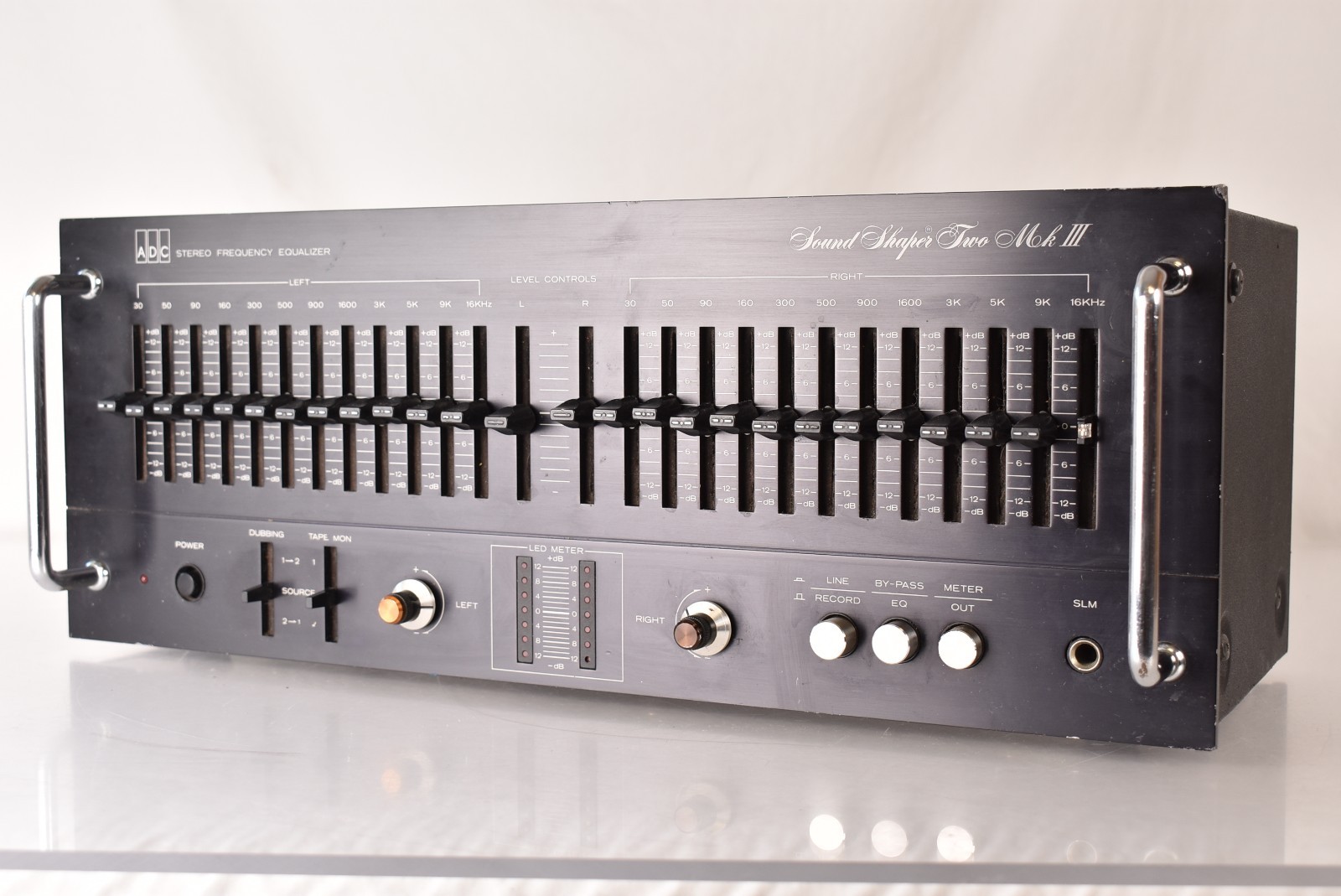
That first flicker of the fluorescent display—cool green bars rising and falling like a heartbeat in the dark—is what pulls you in. The ADC Sound Shaper 303 isn’t just an equalizer; it’s a ritual. Plug it in, flip the switch, and you’re not just adjusting frequencies, you’re negotiating with your room, your speakers, your entire system’s sonic soul. It hums with the quiet authority of gear built when "real-time analyzer" wasn’t a software plugin but a physical, blinking, occasionally temperamental box that demanded your full attention. This was the machine that brought professional-grade room correction into living rooms, dorm basements, and DIY studios at a time when most audiophiles still believed flat response was a myth or a marketing scam.
Manufactured by Audio Dynamics Corporation—later just ADC Sound—the Shaper 303 emerged in the late 1970s as part of a wave of consumer-friendly graphic EQs that democratized tuning. Before this, graphic equalizers were bulky, expensive, and mostly found in broadcast studios or high-end mastering facilities. ADC changed that by packaging a 10-band stereo EQ with a built-in pink noise generator and a real-time spectrum analyzer into a sleek, brushed-steel chassis that wouldn’t look out of place next to a Marantz receiver or a Technics turntable. The fluorescent display, a rare feature even among pro gear of the era, gave users instant visual feedback, making it possible to see, not just hear, the peaks and nulls in their listening environment. That display—bright, crisp, and hypnotic—is now both its most beloved feature and its Achilles’ heel, as aging tubes and dried-out phosphors have turned many into dim ghosts of their former selves.
In its family tree, the Shaper 303 sits just below the more advanced SS-315, which offered ±15 dB of adjustment per band and a more refined calibration system, but above the stripped-down SS-30, which lacked the analyzer and microphone input. The 303 struck a balance: enough control to make meaningful corrections, enough automation to avoid needing an engineering degree, and enough visual flair to feel like you were doing real science. It wasn’t the most precise tool—its 1/3-octave bands were coarse by modern standards, and the stock electret microphone was notoriously rolled-off at the extremes—but in the hands of a patient listener, it could transform a boomy, muddy setup into something approaching neutrality. And if you didn’t care about flat response? You could just crank the 125 Hz and 2 kHz sliders and make your Led Zeppelin records sound like they were being played through a van with blown speakers parked under a bridge—also a valid choice.
Specifications
| Manufacturer | Audio Dynamics Corporation (ADC Sound) |
| Production Years | 1975–1985 |
| Original Price | $295 (equivalent to ~$1,500 today) |
| Equalization Bands | 10-band per channel (stereo) |
| Frequency Bands | 31 Hz, 62 Hz, 125 Hz, 250 Hz, 500 Hz, 1 kHz, 2 kHz, 4 kHz, 8 kHz, 16 kHz |
| Adjustment Range | ±12 dB per band |
| Display Type | Fluorescent bar graph (dual-channel) |
| Signal-to-Noise Ratio | 80 dB (A-weighted) |
| THD | 0.05% at 1 kHz, 1 V output |
| Frequency Response | 20 Hz – 20 kHz ±1 dB (bypass mode) |
| Input Sensitivity | 250 mV for full output |
| Input Impedance | 47 kΩ |
| Output Impedance | 600 Ω |
| Inputs | 1 pair RCA (main), 1 pair RCA (tape in), 1/4" mic input (front panel) |
| Outputs | 1 pair RCA (main), 1 pair RCA (tape out) |
| Features | Built-in pink noise generator, real-time analyzer, mic calibration control, tape loop |
| Power Requirements | 120 V AC, 60 Hz, 25 W |
| Weight | 12.5 lbs (5.7 kg) |
| Dimensions | 19" x 5.5" x 14" (W x H x D) |
| Accessories | Electret condenser microphone (model ADC-M1), calibration instructions |
Key Features
The Fluorescent Display: Light Show or Diagnostic Tool?
The glowing green bars aren’t just for show—they’re the heart of the Shaper 303’s appeal. Unlike the LED meters on later units, the fluorescent display offers smooth, analog-like movement with minimal lag, making it easier to track rapid changes in frequency response. Each bar corresponds to one of the ten EQ bands, and when paired with the built-in pink noise generator and the included microphone, it forms a closed-loop system: play noise, measure response, adjust sliders, repeat. In theory, this lets you flatten your room’s response by eye. In practice, it’s more complicated. The display’s sensitivity and calibration depend heavily on the microphone’s placement, the room’s ambient noise, and whether the fluorescent tube has lost half its brightness over the last forty years. But when it works—when you see that 80 Hz hump finally come down after repositioning the subwoofer—it feels like magic.
Integrated Pink Noise & Calibration System
What sets the Shaper 303 apart from basic graphic EQs is its self-contained tuning ecosystem. The internal pink noise generator eliminates the need for external test tones, and the front-panel microphone input allows real-time feedback. The process is methodical: place the mic at the listening position, engage the noise, set the sensitivity so the loudest frequency band registers near the top of the display, then adjust each slider until all bars are level. It’s a slow, sometimes maddening process—especially since sustained pink noise at reference level can make your neighbors question your sanity—but it works. Owners report that even modest corrections can eliminate harshness, tighten bass, and improve imaging. The catch? The stock ADC-M1 microphone is mediocre at best, with a pronounced dip above 10 kHz and below 50 Hz. Serious users often replace it with a calibrated measurement mic, but the input circuit is designed for the low output of the original, so gain matching is essential.
Tape Loop & Signal Path Flexibility
Beyond room correction, the Shaper 303 functions as a full-featured line-level processor. The tape loop allows integration into a stereo chain with a preamp and power amp, or even a cassette deck for real-time EQ’d recordings. Some users bypass the analyzer entirely and treat it like a tone-sculpting tool—boosting presence for vocals, cutting boxiness in acoustic guitars, or adding air to dull recordings. The signal path is solid-state and clean, with minimal coloration in bypass mode, which means any sonic changes you hear are actually from the EQ, not the unit itself. That transparency was a selling point in an era when many consumer EQs added noticeable hiss or distortion.
Historical Context
The Shaper 303 arrived at a turning point in home audio. The early 1970s saw a surge in high-fidelity enthusiasm, fueled by better recordings, improved turntables, and the rise of quadraphonic sound. But as systems got better, listeners began to notice something uncomfortable: their rooms were the weakest link. No matter how expensive the speakers, bass would boom in one corner and vanish in another. ADC, which had previously made cartridges and bookshelf speakers, recognized this gap and pivoted hard into signal processing. They weren’t the first to make a consumer graphic EQ—dbx and Fostex had earlier models—but they were the first to bundle analysis tools into an affordable package.
Their main competition came from dbx, whose Model 100 and 120 offered superior performance but at nearly twice the price, and from BSR, which later acquired ADC and rebranded many of their units for mass-market distribution. The Shaper 303 landed in the sweet spot: professional enough to impress serious listeners, simple enough for hobbyists, and visually striking enough to justify its place on the rack. It also benefited from aggressive marketing through DAK Industries, a mail-order catalog that specialized in audio gear and helped bring ADC products into thousands of homes. By the early 1980s, the Shaper series had become synonymous with "home EQ" for a generation of tinkerers who wanted more control over their sound.
Collectibility & Value
Today, the ADC Sound Shaper 303 trades in a narrow but passionate market. Units in working condition with a bright display and included microphone sell for $250–$400 on Reverb and eBay, while non-working or dim-display models go for $100–$150 as restoration projects. Fully serviced units with upgraded mic preamps or modern LED retrofits can command up to $550, especially if bundled with original documentation. The real cost, however, isn’t the purchase price—it’s the repair bill. These units are aging, and several failure points are common.
The most critical is the fluorescent display tube. Over time, the phosphor degrades, the cathodes wear out, or the high-voltage inverter fails, leading to dim, flickering, or completely dead bars. Replacement tubes are scarce, and while some technicians rebuild them, it’s a delicate process. The power transformer is another weak link—several service reports note burned windings, likely due to prolonged use or voltage spikes. Recapping is almost always necessary; electrolytic capacitors from the 1970s rarely survive intact, and failing caps can cause hum, channel imbalance, or complete failure.
The stock microphone is often missing or damaged, and replacements are hard to find. Generic electret mics won’t work without modification—the input expects a specific impedance and sensitivity—so buyers should verify that the mic is present and functional. Cleaning the slider pots is also essential; vintage carbon tracks degrade, leading to crackling or dead spots. A full refurbishment, including recapping, pot cleaning, display testing, and mic verification, can run $150–$200, making it a significant investment for a niche tool.
For collectors, the Shaper 303 is more than a curiosity—it’s a snapshot of a moment when audiophiles began to understand that room acoustics mattered. It’s not as rare as a McIntosh tube amp or as iconic as a Nakamichi cassette deck, but it holds a special place among those who remember the first time they saw their room’s response laid bare in glowing green bars. If you’re buying one, prioritize units with a bright display, original case, and service history. Avoid anything with a cracked front panel or corroded jacks. And if you plan to use it for actual room correction, budget for a proper measurement mic—your ears (and your neighbors) will thank you.
eBay Listings


As an eBay Partner, we earn from qualifying purchases. This helps support our independent vintage technology research.