ADC Sound Shaper 100SL (1988)
A 31-band equalizer that lets you carve your sound with surgical precision—and watch it dance in real time on a glowing orange display.
Overview
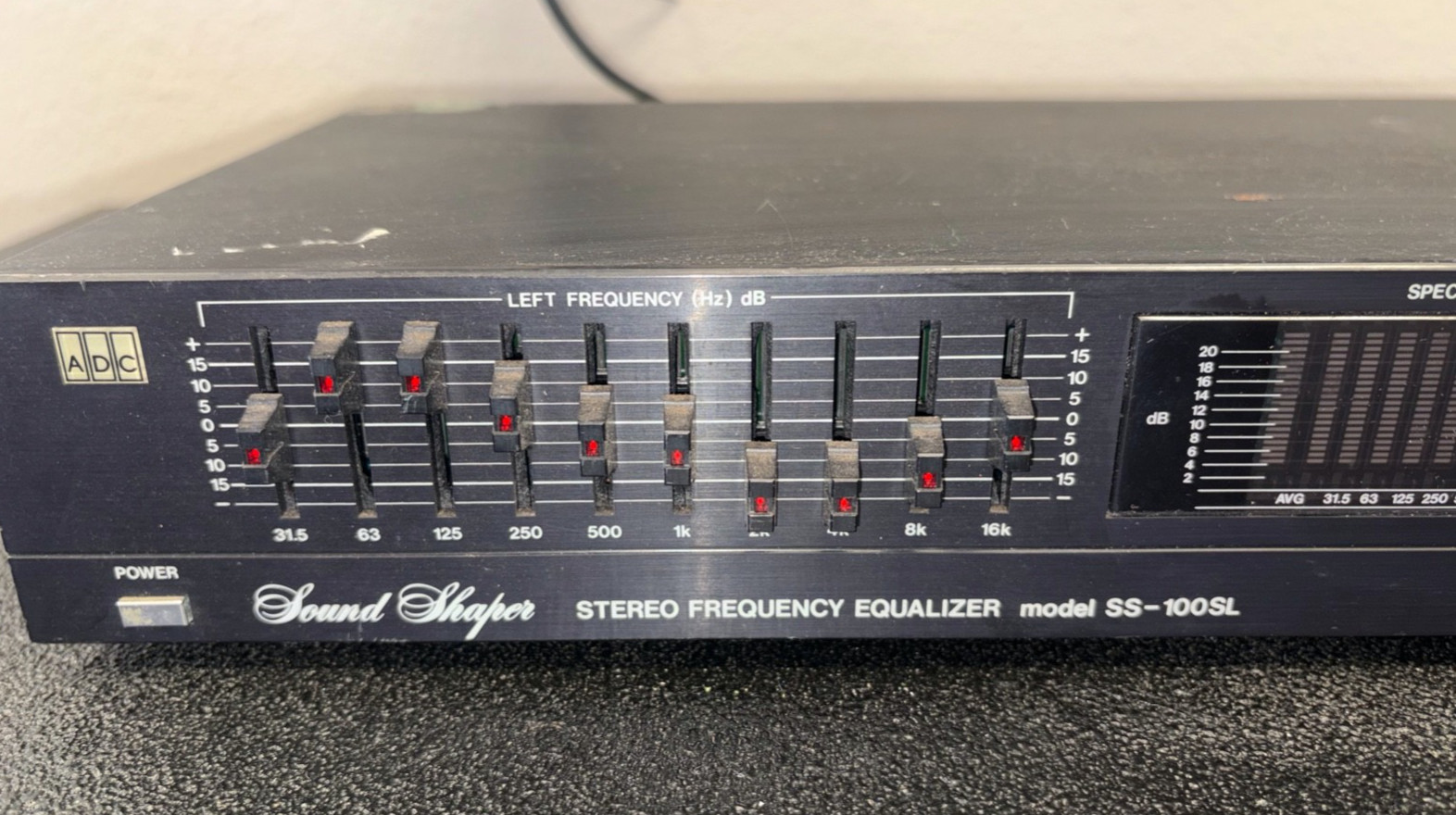
Flick it on, and the ADC Sound Shaper 100SL doesn’t just sit there—it comes alive. That curved FL display in the center glows like a vintage radar sweep, painting your music in real time with flickering orange bars that pulse to the beat. It’s not just for show, either. This is a full 31-band stereo graphic equalizer with independent left and right channel control, built for people who didn’t just want to tweak their sound—they wanted to dissect it, reshape it, and see exactly what they were doing as they did it. The front panel is a wall of sliders, 31 per channel, each one mapped to a precise frequency from 31.5 Hz all the way up to 16 kHz, with ±15 dB of cut or boost. That kind of resolution was rare in consumer gear in the late '80s, and even rarer with a real-time analyzer built in.
It wasn’t just an audiophile toy, either. The Shaper 100SL found a home in small studios, live sound setups, and high-end home systems where tonal balance mattered. The ability to A/B the EQ—switching it in and out with a single button—meant you could actually hear the difference you were making, not just assume you were improving things. And with a subsonic filter at 20 Hz cutting rumble at -18 dB per octave, it had the kind of practical engineering touches that suggest someone was thinking about real-world use, not just spec sheets. The frequency response is flat within ±0.5 dB when all sliders are centered, and distortion figures sit at a clean 0.05% THD and IM, which was competitive even among high-end preamps of the era.
But let’s be honest—most people didn’t buy this for the specs. They bought it for the *look*. That FL display is hypnotic. It’s not a crude LED bar graph; it’s a smooth, continuous spectrum analyzer that gives you a genuine visual representation of your audio’s energy distribution. It’s the kind of thing you leave on even when you’re not adjusting anything, just because it feels like your music is being translated into light. And while it’s not a processor in the modern sense—no presets, no memory, no MIDI—it doesn’t need to be. It’s a hands-on, immediate tool. You see a spike at 125 Hz? Pull it down. Too much harshness at 4 kHz? Tame it. It’s tactile, intuitive, and satisfying in a way that software EQs still struggle to replicate.
Specifications
| Manufacturer | ADC Sound |
| Production Years | 1988 |
| Original Price | ¥36,000 (Japan, c. 1988) |
| Type | Stereo Graphic Equalizer with RTA |
| Number of Bands | 31 per channel (L/R independent) |
| Center Frequencies | 31.5, 63, 125, 250, 500, 1k, 2k, 4k, 8k, 16 kHz |
| Adjustment Range | ±15 dB per band |
| Gain Accuracy | ±1 dB |
| Maximum Input/Output Level | 4 V RMS or more |
| Frequency Response | 20 Hz – 20 kHz ± 0.5 dB (sliders centered) |
| Total Harmonic Distortion | 0.05% |
| Intermodulation Distortion | 0.05% |
| Signal-to-Noise Ratio | 100 dB (1 V or less, A-weighted) |
| Subsonic Filter | 20 Hz, -18 dB/octave |
| Inputs | 2 x RCA (Line In, Tape In) |
| Outputs | 2 x RCA (Line Out, Tape Out) |
| EQ Bypass | Yes (A/B comparison switch) |
| Real-Time Analyzer | FL display (orange, center-mounted) |
| Level Meter | Bar meter for average signal level |
| Dimensions | 435 mm (W) × 70 mm (H) × 324 mm (D) |
| Weight | 3.3 kg |
Key Features
31-Band Surgical EQ with True L/R Independence
Most stereo graphic equalizers from the era shared a single set of sliders for both channels or offered only coarse 10-band control. The Shaper 100SL breaks that mold with fully independent left and right 31-band sections—meaning you can correct for room asymmetries, speaker imbalances, or even create deliberate stereo width effects by EQing each side differently. Each slider is detented, offering tactile feedback and consistent positioning, and the ±15 dB range gives serious corrective power without veering into gimmick territory. The result is a level of tonal control that was typically reserved for professional studio gear, not consumer rack units.
Real-Time FL Spectrum Analyzer
The centerpiece of the Shaper 100SL isn’t just functional—it’s mesmerizing. That orange FL (fluorescent) display in the middle isn’t a simple peak meter; it’s a real-time analyzer that graphs the frequency content of your signal across the entire audible spectrum. Unlike LED-based RTAs that approximate with stepped bars, the FL tube provides a smooth, continuous readout that responds fluidly to transients and sustained tones alike. It’s not perfectly calibrated for scientific measurement, but it’s accurate enough to identify problem frequencies, verify EQ adjustments, and—let’s admit it—just look incredibly cool while your music plays. The left-side bar meter shows average signal level, helping prevent clipping when boosting multiple bands.
Studio-Grade Signal Path and Build
ADC didn’t cut corners on the electronics. With a signal-to-noise ratio of 100 dB A-weighted and distortion figures pegged at 0.05%, the Shaper 100SL sits comfortably in the high-fidelity tier of its time. The 4 V RMS maximum I/O level means it can handle hot signals without breaking a sweat, making it a good match for prosumer and semi-pro gear. The subsonic filter is a thoughtful inclusion, allowing users to eliminate infrasonic rumble from turntables or tapes without affecting the audible bass. Input and output are via standard RCA jacks, with both line and tape loops—meaning you can patch it into a receiver’s preamp out or use it to condition a signal before recording to tape.
Historical Context
The late 1980s were a golden age for the “high-end” home audio enthusiast. CD players had arrived, receivers were getting more sophisticated, and people were finally able to hear the flaws in their rooms and speakers. That created a market for corrective tools—and the ADC Sound Shaper 100SL arrived right on time. While companies like Sony and Pioneer were pushing all-in-one systems, niche players like ADC catered to the tinkerers, the modders, the ones who wanted to optimize every link in the chain. The 31-band EQ was already a staple in professional environments, but consumer versions often compromised with shared channels or lower resolution. The Shaper 100SL refused to compromise.
It competed in a space that included the Sony ICF-C10T (a rare 31-band with RTA), the Yamaha EMR-1, and various offerings from US brands like Rane and Rane’s consumer cousin, RadioShack’s Realistic models. But few combined the visual drama of the FL display with full L/R independence at this price point. ADC, a lesser-known Japanese brand outside pro audio circles, managed to pack serious functionality into a sleek, minimalist black chassis that wouldn’t look out of place next to a Nakamichi or Denon flagship. It wasn’t a mass-market product—more of a cult favorite—but for those who found it, it became a centerpiece.
Collectibility & Value
Today, the ADC Sound Shaper 100SL trades quietly among vintage audio collectors, mostly on eBay and niche forums. Units in working condition with all sliders functional and the FL display intact typically sell between $250 and $400, depending on cosmetic condition and included accessories. Non-working units or those with dead displays can be found for $100–$150, often snapped up by technicians or tinkerers looking to restore them. The biggest failure points are the slide potentiometers—over time, they can become scratchy or intermittent, especially if the unit wasn’t stored properly. Cleaning with contact cleaner sometimes helps, but full replacement is a tedious, time-consuming job given the number of sliders.
The FL display is another known weak spot. These tubes can dim over decades, flicker, or fail entirely. When they go, replacements are scarce, and retrofitting with modern LED arrays loses the original character. The power supply is relatively simple, but aging capacitors can cause instability or noise, so a recap is often recommended for long-term reliability. Buyers should test every slider, check both the EQ bypass function and tape loop operation, and verify that the RTA responds to signal input. Units with missing or broken slider caps—especially around the 2 kHz and 4 kHz bands, which seem prone to physical damage—are common and should be priced accordingly.
Despite its age, the Shaper 100SL still has practical value. In a modern setup, it can be used as a tone-shaping tool before an ADC for recording, or as a retro-active room corrector in a vintage hi-fi stack. It’s not a replacement for digital room correction, but it’s more fun—and sometimes more musical—than a software EQ. For collectors, it’s a striking display piece, especially when lit up in a dark rack. It’s not rare enough to be a “holy grail,” but it’s uncommon enough that finding a clean, fully functional unit feels like a win.
eBay Listings


As an eBay Partner, we earn from qualifying purchases. This helps support our independent vintage technology research.