ADC Sound Shaper (1970s–1980s)
That rare piece of gear that makes you actually want to tweak your sound—slide pots gliding like butter, frequencies laid bare, and a build that says it was made to last.
Overview
If you’ve ever flipped on a graphic equalizer just to watch the sliders dance—even when the music’s off—you understand the tactile magic of the ADC Sound Shaper series. These weren’t just tone controls dressed up in a metal box; they were your first real shot at shaping sound with surgical precision, back when most receivers still offered “bass” and “treble” and called it a day. Made by Audio Development Company (ADC), a Connecticut outfit that started life in the early 1960s building high-compliance phono cartridges, the Sound Shaper line arrived in the 1970s and 1980s as one of the first affordable consumer graphic equalizers. And “affordable” didn’t mean “cheap”—at least not in spirit. Owners report these units sounding clean, transparent, and surprisingly quiet, with minimal hum or hiss, which was no small feat when you were routing your entire signal chain through a box full of slide pots and op amps.
But here’s the thing: “ADC Sound Shaper” isn’t a single model. It’s a whole ecosystem of equalizers, spectrum analyzers, and even speakers, all rolling under that same utilitarian name. Some models, like the 5-band SS-5 or the One-IC, kept things simple—perfect for dialing in a basic room correction or adding a little sparkle to your tape deck. Others, like the 12-band SS-3 or SS-22, went full pro, giving you surgical control across the spectrum. And then there were the beasts: the SS-110 MKII, the SS-315X, the SA-1—units that didn’t just equalize, they analyzed, with built-in pink noise generators and real-time spectrum displays that turned your living room into a makeshift studio. These weren’t for casual listeners. These were for people who measured phase drift and argued about harmonic distortion at dinner parties.
And yes, they were popular. Not just in home setups, but in semi-pro environments too. The SA-1, for instance, was used by engineers to check speaker response and adjust recording bias—serious work for a box that looked like it belonged under your turntable. But popularity didn’t mean perfection. Some users found the amp sections on later models a bit “anemic,” especially when compared to the earlier inductor-based designs. And while the IC-driven versions were cheaper and more reliable, they didn’t quite match the sonic heft of their coil-laden ancestors. Still, for the price and the era, the Sound Shaper series delivered. It was the democratization of tone shaping—no more guessing, no more “sounds about right.” You could see it, touch it, fix it.
Specifications
| Manufacturer | ADC (Audio Development Company) |
| Product type | Graphic Equalizer / Stereo Frequency Equalizer |
| Input Sensitivity | 1V |
| Output Level | 1V (9V max) |
| Gain | ± 1dB |
| Frequency response | 5Hz to 100kHz |
| Signal to Noise Ratio | 85dB |
| Total harmonic distortion | 0.02% |
| Control Range | ± 12dB |
| Frequency Bands | 30, 50, 90, 160, 300, 500, 900, 1.6K, 3K, 5K, 9K, 16KHz |
| Semiconductors | 12 x transistors, 20 x diodes, 2 x IC |
| Dimensions | 416 x 172 x 159mm |
| Weight | 6kg |
| Type | 5-band per channel graphic equalizer |
| Boost/cut range | +/- 12dB |
| Frequencies (5) | 60Hz, 240Hz, 1kHz, 3.5kHz, 10kHz |
| Frequency centers | 25, 40, 63, 100, 250, 500, 1k, 2.5k, 6.3k, 16k Hz |
| Input impedance | 100k ohms |
| Output impedance | 600 ohms |
| Maximum input level | 8V RMS |
| THD | 0.05% |
| Dimensions | 19" W x 3.5" H x 8" D |
| Weight | 8 lbs |
| Model Number (MPN) | SS-215 |
| Color | Black |
| Dimensions | 15 x7¾ x6" s |
Key Features
Slide Pots That Mean Business
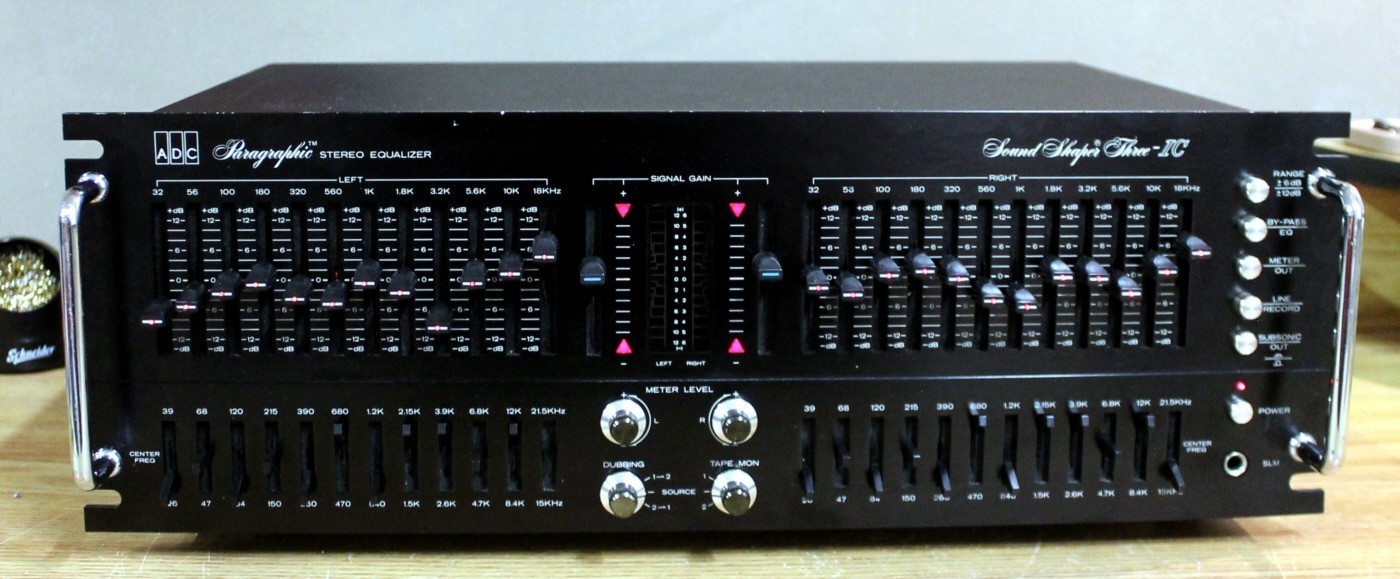
The first thing you notice when you lay hands on a Sound Shaper—any Sound Shaper—is the sliders. They’re not flimsy plastic sticks that wobble when you sneeze. These are heavy-duty slide potentiometers, machined to glide smoothly, with enough resistance to feel deliberate. It’s the kind of tactile feedback that makes you want to tweak, to experiment, to push the 3kHz band up just to hear what happens. And because they’re real pots—not digital emulations—what you see is what you get. No latency, no menu diving, no “apply” button. Just analog control, laid out like a piano keyboard for your ears.
Inductors vs. Gyrators: The Great EQ Divide
Not all Sound Shapers are created equal. The early models—like the vaunted Sound Shaper Three and the One Ten—used actual inductors in their filter circuits. That’s right: coils of wire wrapped around cores, doing the filtering the old-school way. These units were “built like a tank,” as one manual puts it, and audiophiles still swear by their warmth and clarity. But inductors were expensive, and by the time ADC rolled out the IC-based versions—like the One-IC—they’d made the switch to gyrator circuits, which use op amps to simulate inductance. The trade-off? Lower cost, better reliability, but, according to users, a noticeable drop in sonic authority. “The IC version is still a good EQ,” one engineer admitted, “but the earlier inductor-based Sound Shaper Three is vastly (I mean vastly) superior in sound quality.” So if you’re shopping, know what you’re getting: coil or chip.
Bypass Switch: Because Sometimes You Need Truth
Every model seems to include a bypass switch—a small but crucial detail. It lets you A/B your EQ settings instantly, so you can hear exactly what you’re doing to the signal. And sometimes, that’s a humbling experience. That massive 100Hz boost you thought was “punchy”? Turns out it’s just muddy. The bypass switch keeps you honest. It’s also a relief when the sliders get scratchy (and they will), because you can route around the unit entirely while you clean the pots with contact cleaner.
Spectrum Analyzers: For the Truly Obsessed
Then there are the SA-1 and SS-315X—models that don’t just shape sound, they diagnose it. These are 10-band graphic equalizers with real-time frequency spectrum analyzers, complete with a built-in pink noise generator. To use them properly, you need the matching electret condenser microphone (and the manual for the SS-315 warns against using a standard dynamic mic). You place the mic in the listening position, fire up the pink noise, and watch the sliders dance in response to your room’s acoustics. It’s not just cool—it’s functional. Engineers used these to flatten speaker response, tune monitor setups, and even calibrate tape bias. It’s rare to find consumer gear that doubles as a pro tool, but the SA-1 pulled it off.
Historical Context
ADC started in the early 1960s in Connecticut, making phono cartridges for the booming hi-fi market—low-tracking-force, high-compliance designs that were a step up from the standard issue. But by the 1970s, they’d branched out, sensing a gap in the market: people wanted control. Tone controls weren’t enough. So ADC launched the Sound Shaper series, one of the first low-cost consumer graphic equalizers. It wasn’t just a gadget—it was a statement. You weren’t just listening; you were curating.
The line expanded fast: 5-band, 10-band, 12-band, spectrum analyzers, even speakers (the SoundImage line, with dual 10" woofers, a midrange, a tweeter, and a super-tweeter). But by the late 1980s or early 1990s, ADC was bought by BSR, which continued selling equalizers under its own name. The ADC brand faded, but the Shapers lived on. Today, they’re remembered not just for their functionality, but for their role in making audio adjustment accessible. This was the gear that taught a generation how room acoustics work, how frequency masking happens, and why sometimes, less EQ is more.
Collectibility & Value
Prices for ADC Sound Shapers vary wildly—anywhere from $40 for a beat-up SS-5 sold “for parts or repair” to over $1,500 for a pristine SS-110 MKII. The rarest models, especially those with spectrum analysis or inductor-based filters, command top dollar. But even the common ones have fans. They’re simple, serviceable, and—when cleaned up—still effective. The most frequent complaint? Scratchy sliders. It’s almost universal, but usually fixable with a good contact cleaner. Missing slider caps and untested units are also common, so buyers should inspect carefully. And while original pricing hasn’t been confirmed for most models, the fact that people still hunt for these decades later says something. They weren’t just trendy—they were useful.
eBay Listings


As an eBay Partner, we earn from qualifying purchases. This helps support our independent vintage technology research.