ADC SA-1 (1981–1983)
A box of 120 glowing LEDs that turns sound into light — and your living room into a lab.
Overview
Flick the power switch, and the SA-1 wakes up like a dormant console in a 1970s sci-fi bunker — rows of amber LEDs flicker to life, the front panel glows with clean white lettering, and suddenly you’re not just listening to your system anymore, you’re interrogating it. This isn’t an amplifier or a preamp you tweak by ear; it’s a real-time spectrum analyzer, a rare breed of gear that lets you *see* sound. For $230 in 1982, ADC dropped a full-featured octave-band RTA into the hands of audiophiles and tinkerers, complete with a built-in pink noise generator, a calibrated electret mic, and a display sharp enough to catch room modes before they ruin your night. It’s the kind of tool that makes you question every speaker placement, every cable swap, every “this amp sounds warmer” assumption — because now you have proof, or at least colored lights that pretend to be.
And yes, they’re hypnotic. 120 individual LEDs — 12 per band across 10 octave frequencies from 31 Hz to 16 kHz — march in tidy columns, each one a tiny soldier reporting the amplitude of its slice of the sonic spectrum. There’s even an “average” LED row that sums up the overall energy, plus a peak-hold function that freezes the highest transient levels so you don’t miss a spike. You can watch bass notes bloom in the lower bands, see sibilance flare in the 8 kHz column, or catch a tweeter that’s shouting over its siblings. It’s not laboratory-grade — this is consumer gear from the early '80s, not a Brüel & Kjær rig — but for its price and era, it punches way above its weight.
The SA-1 wasn’t ADC’s first detour into audio tools. Before this, they were known for their high-end MM cartridges like the XLM and ZLM, and even a cult-favorite programmable turntable called the Accutrac. But by the late '70s and early '80s, they pivoted hard into equalization and measurement, sensing a market of DIY audiophiles who wanted to *tune* their systems, not just assemble them. The SA-1 was the diagnostic half of that vision — the eyes before the hands. Pair it with one of their graphic EQs, and you had a feedback loop: generate pink noise, measure the response, adjust the EQ, measure again. In theory, you could flatten your room. In practice, you’d learn just how much your listening space fights back.
It’s not a musical device, not in the traditional sense. It doesn’t color sound, enhance detail, or make your records sound “warmer.” It’s brutally neutral — a mirror, not a filter. And that’s its power. You might buy it to fix a boomy bass, but you’ll keep it because it reveals truths: your expensive speakers dip at 2 kHz, your subwoofer overdrives at 40 Hz, your room has a null at 63 Hz that no amount of repositioning seems to fix. It turns subjective complaints into objective data. Or at least, data that looks convincing on a wall of blinking lights.
Specifications
| Manufacturer | Audio Dynamics Corporation (ADC) |
| Production Years | 1981–1983 |
| Original Price | $230 (1982) |
| Type | Real-Time Spectrum Analyzer (RTA) |
| Frequency Response (Line In) | 31 Hz to 16 kHz ±0.5 dB |
| Frequency Response (Mic In) | 31 Hz to 16 kHz ±3 dB |
| Filter Center-Frequency Accuracy | 31 Hz to 1 kHz: ±10%; 2 kHz to 16 kHz: ±5% |
| Amplitude Accuracy | ±1 dB (12 dB range), ±2 dB (24 dB range), ±3 dB (36 dB range) |
| Input Sensitivity (Line) | 150 mV |
| Input Sensitivity (Mic) | 0.5 mV |
| Input Impedance (Line) | 100 kΩ |
| Input Impedance (Mic) | 33 kΩ |
| Pink Noise Output Level | 150 mV |
| Display Type | 120 LEDs (10 bands × 12 LEDs) + 12 Average Response LEDs |
| Display Range | 12 dB, 24 dB, 36 dB (switchable, 1/2/3 dB per LED) |
| Metering Modes | Peak Hold, Slow/Normal Response |
| Channel Selection | Left, Right, Both |
| Microphone Type | Electret condenser (included) |
| Microphone Power | 1.5V UM-5/N battery |
| Microphone Pickup Pattern | Omnidirectional |
| Microphone Cable Length | Approx. 16 feet |
| Back Panel Attenuation | -26 dB switch for line inputs |
| AC Outlet | Unswitched accessory outlet |
| Power Requirements | AC 100V/120V/220V/240V, 50/60 Hz |
| Power Consumption | 18W |
| Dimensions | 17 in (435 mm) W × 3.375 in (86 mm) H × 9.5 in (240 mm) D |
| Weight | 6.5 lbs (2.9 kg) |
Key Features
A Display That Tells Stories in Light
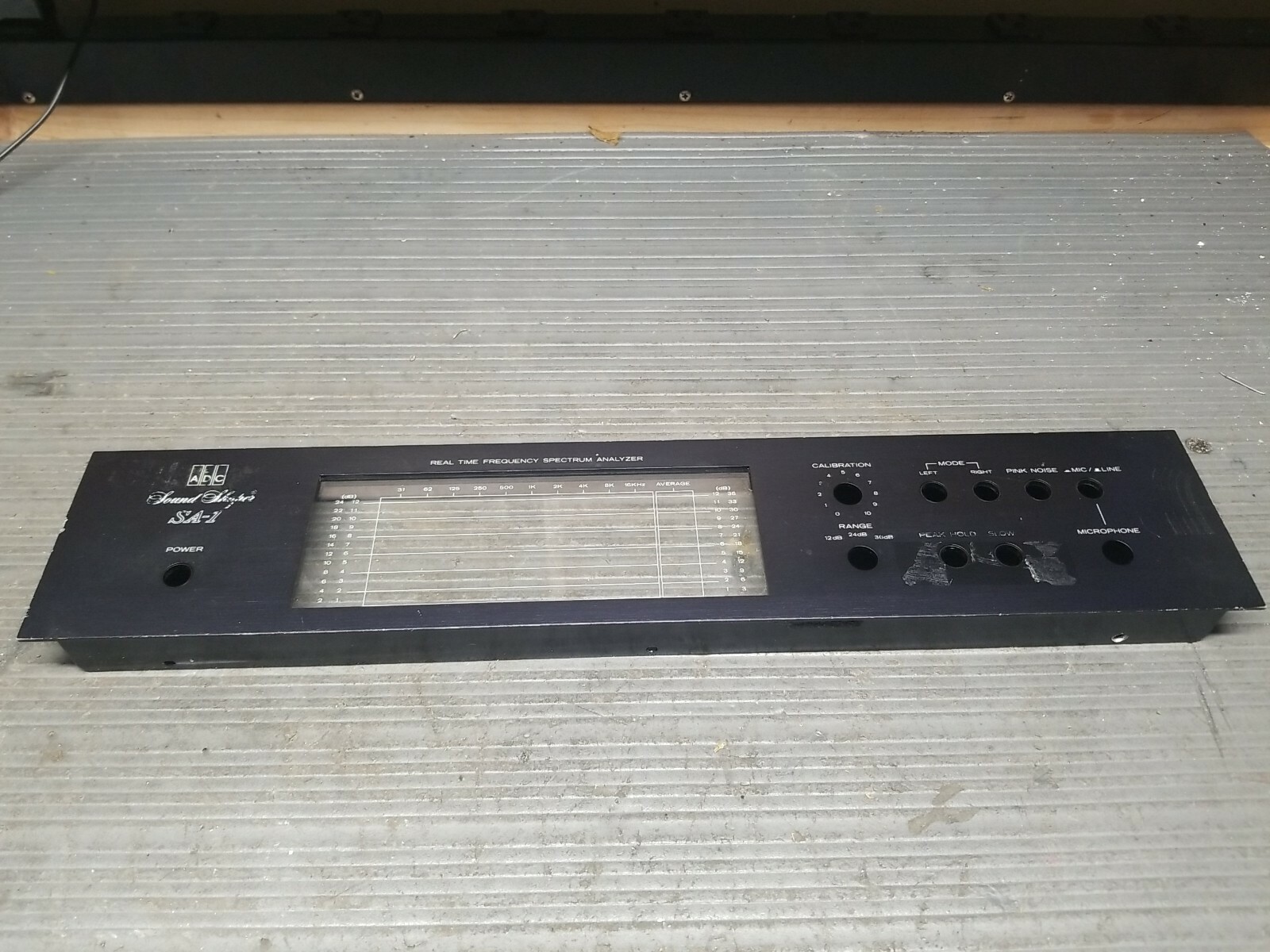
The SA-1’s front panel is its soul. Ten vertical LED bars, each representing an octave band — 31 Hz, 63 Hz, 125 Hz, 250 Hz, 500 Hz, 1 kHz, 2 kHz, 4 kHz, 8 kHz, 16 kHz — climb like seismographs tracking sonic tremors. Each LED is worth 1, 2, or 3 dB depending on the range switch, and a backlit graticule with 2 dB horizontal lines makes it easy to read levels at a glance. It’s not a high-resolution display by modern standards, but in 1982, this was visual fidelity you could trust. The “average” row across the top gives a quick summary of overall energy, useful for spotting gross imbalances. And the peak-hold function? It’s not just a gimmick — it captures transient peaks that your eye might miss, letting you see the loudest moment in each band even after the signal drops. Want to know if your subwoofer clips on kick drums? Hold the peak, then walk away and check.
Built-In Pink Noise and Calibration Logic
The SA-1 doesn’t just measure — it generates. Flip the pink noise switch, and the unit outputs a calibrated 150 mV signal through its rear RCA jacks, perfect for driving your system while the mic listens. This turns the whole chain into a test bench: preamp, power amp, speakers, room — all exposed. The calibration pot isn’t a true calibration in the metrology sense; it’s a level trim to align the mic sensitivity with the display. But it’s essential for consistent readings, especially when comparing sessions. And that -26 dB pad on the back? A quiet hero. It lets you connect directly to power amp outputs without overloading the line inputs — a feature most budget analyzers of the era skipped.
A Mic That’s Both Included and Flawed
ADC included a custom electret condenser mic, powered by a single AA-sized battery (UM-5/N), with a 16-foot cable. It’s omnidirectional, which is good for room averaging, but service technicians observe that its frequency response is uneven — rolled-off at the extremes, with a slight 2–3 dB bump in the upper mids. Owners report that while it’s usable for basic room tuning, serious users often swap it for a flatter measurement mic like the RadioShack 33-3013 or a modern unit like the miniDSP UMIK-1. The mic input is designed for electret types only; dynamic mics won’t work and could damage the input stage, as warned in the manual. But if you’re using the SA-1 casually, the stock mic gets you in the ballpark.
Historical Context
The early 1980s were a golden age for audio measurement tools — not because consumers suddenly cared about flat response, but because graphic equalizers went mainstream. Companies like BSR, Sony, and Pioneer started selling affordable 10-band EQs, and audiophiles wanted a way to use them *correctly*. The SA-1 arrived at that inflection point: a time when “tuning” your system wasn’t just for studio engineers. ADC, already known for their high-quality cartridges and later their SS-series EQs, saw the gap. They weren’t the first to make a consumer RTA — there were pro units from Crown and others — but they were among the first to bring one to the home market at a sane price.
It competed in a space that barely existed: the DIY audiophile with a soldering iron, a stack of gear, and too much time. Magazines like *Stereophile* and *Audio* ran articles on room acoustics and EQ correction, and the SA-1 fit right in. It was advertised in catalogs like DAK Industries, often bundled or sold alongside ADC’s own graphic EQs. By the mid-'80s, ADC’s identity had shifted — they were no longer just a cartridge company, but a one-stop shop for system tuning. That didn’t last. By the late '80s, ADC was absorbed by BSR, and their products were rebranded. The SA-1 vanished, but its DNA lived on in later budget analyzers and, eventually, in the software-based tools we use today.
Collectibility & Value
The SA-1 isn’t rare, but it’s not common either. It’s the kind of unit that either got tossed when digital audio arrived or cherished by the guy who still adjusts his system with test tones. Today, working examples in good condition sell for $150–$250 on the secondary market, with units that include the original mic and cables at the higher end. Non-working or “for parts” units go for $50–$100, often bought by tinkerers who want the LED display for a custom project.
The biggest failure points are predictable. The power supply is simple — just a transformer and rectifier — but after 40+ years, the solder joints can crack, and the transformer windings may degrade. The most common issue is the mic battery compartment: corrosion from old batteries can eat through contacts, and replacement UM-5/N holders are hard to find. The front-panel switches and potentiometers usually survive, but the pink noise oscillator can drift, causing inaccurate output levels. And while the LED arrays are robust, individual LEDs do fail — usually the bottom ones, which are on most during testing.
Before buying, test the following:
- Does the pink noise generator output a signal?
- Do all 120 LEDs light up in a sweep (use peak hold and play noise)?
- Does the mic produce a response when spoken into?
- Is there battery corrosion in the mic?
- Are the RCA jacks tight and free of oxidation?
Restoration is doable but not trivial. Recapping the power supply is wise. Cleaning the switches and pots with contact cleaner helps. And if the mic is dead, sourcing a modern electret mic with similar sensitivity (around -70 dBV/Pa) can restore functionality — just don’t plug in a dynamic mic unless you want to fry the input.
It’s not a “must-have” for every collector, but it’s a significant artifact — a bridge between the analog tweak era and the digital measurement age. It’s also a conversation piece. Plug it in at a vintage audio meet, and someone will inevitably say, “I had one of those in college — drove my roommate nuts with pink noise.”
eBay Listings



As an eBay Partner, we earn from qualifying purchases. This helps support our independent vintage technology research.