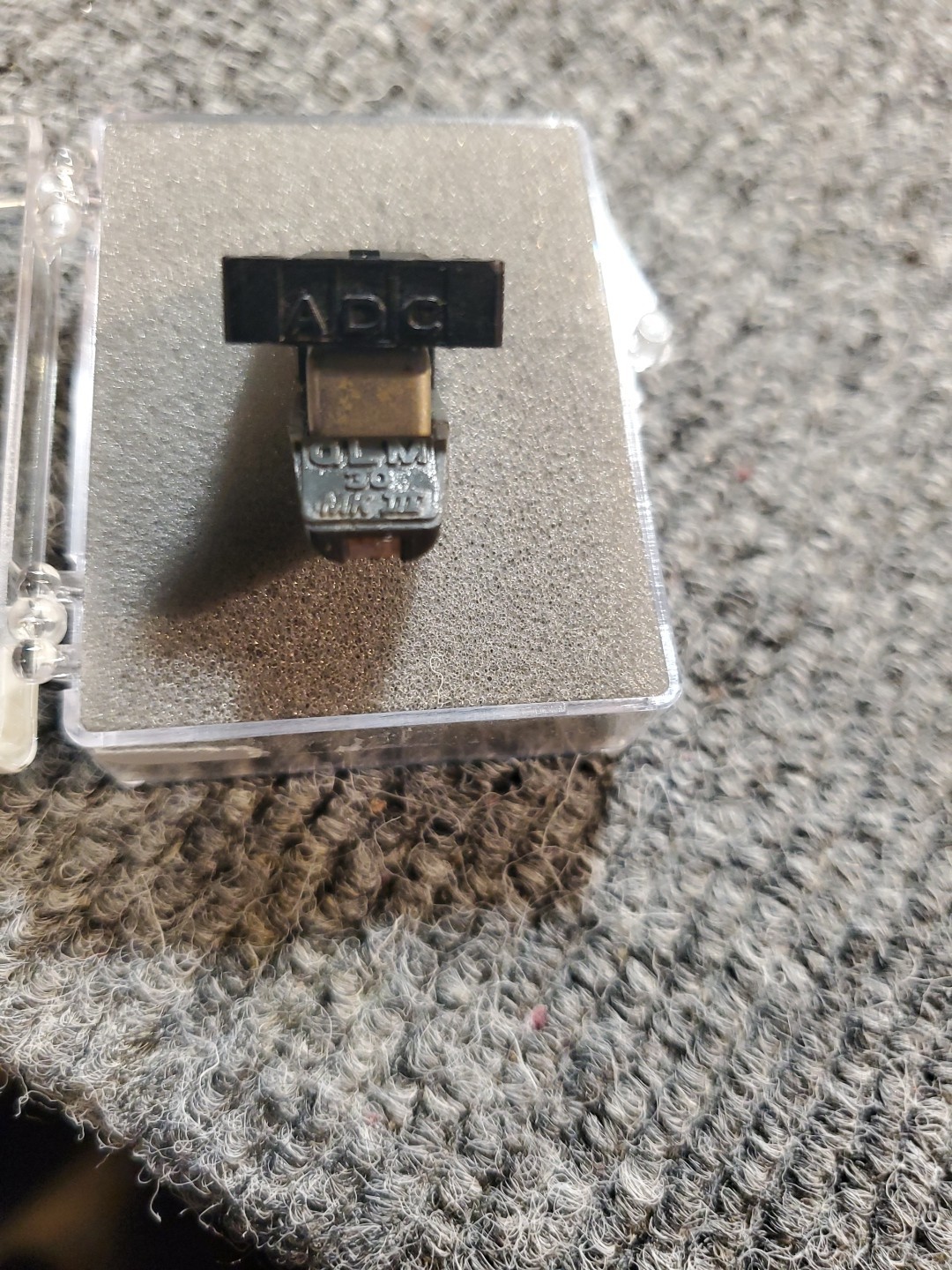
ADC QLM33 MKII ()
That crisp, detailed analog snap you’re hearing? Chances are, it’s being carved by a tiny elliptical diamond riding in a cult-favorite ADC shell.
Overview
If you’ve ever flipped through a pile of used cartridges at a flea market or scrolled through a labyrinth of eBay listings looking for something that just works, you’ve probably stumbled across an ADC—often without realizing what you had. The QLM33 MKII isn’t the flashiest name in the vintage cartridge game, but it’s one of those quiet workhorses that shows up again and again in decks from the '70s and '80s, especially in systems where someone cared enough to upgrade from the stock AT95 but didn’t want to mortgage the house for a Shure V15. ADC, or Audio Dynamics Corporation, built a reputation on two pillars: their moving magnet cartridges—particularly the revered XLM series—and their quirky but effective Sound Shaper equalizers. The QLM33 MKII slots into that first category, not as a flagship, but as a solid-tier performer that punched above its weight when new and still holds up if treated right.
It’s not all glory, though. One of the quirks of writing about the QLM33 MKII is how little we actually know about it as a standalone model. Most of what surfaces online isn’t about the cartridge itself, but about its replacement stylus—specifically the MKIII variant. That’s where most of the current market activity lives. Listings routinely bundle the QLM33 MKII and MKIII together, treating them as compatible siblings, and sellers focus on the stylus upgrade path. That makes sense: the stylus is the wear item, the part that drags across your records, and the thing that, when worn, can do irreversible damage to your collection. But it also means the cartridge body, its internal coils, magnet structure, compliance, and output—all the things that define how it really performs—are shrouded in silence. No frequency response curves. No tracking force specs. No weight or dimensions. It’s like knowing the tires on a classic car but never seeing the engine.
Still, owners who’ve kept these running swear by them. There’s a consistency to the reports: clean midrange, good channel separation (assumed, given ADC’s rep), and a top end that doesn’t shout but reveals. The “special elliptical diamond” stylus—highly polished, bonded, and shaped to dig into groove walls with precision—is where the magic supposedly happens. A replacement stylus marketed for the MKIII claims to deliver “finer detail and harmonically complete sound quality,” which sounds like marketing fluff until you’ve heard a fresh tip pull textures out of a side-two fade that you never noticed before. That’s the promise: not boom, not brightness, but clarity. The kind that makes you lean in, not turn down.
And let’s be honest—part of the appeal is the nostalgia of the thing. That grey or black body, the clean labeling, the way it mounts just right in a SME or Grace headshell—it’s analog theater. But it’s not just cosmetic. ADC cartridges were built during a time when moving magnet designs were maturing, and brands were refining stylus profiles to extract more from vinyl without shredding it. The elliptical tip was a big step up from the conical types that dominated earlier, offering better contact with the groove modulations. The “special” elliptical here might hint at a proprietary grind or polish—ADC was known for tight tolerances—but without factory docs, we’re left reading between the lines of third-party sellers and old ads.
One thing’s clear: if you’re picking up a QLM33 MKII today, you’re not doing it for specs. You’re doing it because it’s a known quantity in the used market, it fits a lot of arms, and it’s part of that golden era when cartridges weren’t disposable, but serviceable. You could—*theoretically*—swap the stylus, keep it aligned, and run it for decades. Whether that’s practical now is another story. NOS (new old stock) complete units are rare. Most listings are for used cartridges with unknown stylus hours, which is a gamble. And while ADC made replacement styli available back in the day, today’s options are third-party, often rebranded, and vary in quality. But for the tinkerer, the budget-minded audiophile, or the restoration purist, that’s part of the charm. It’s not plug-and-play. It’s a project with a payoff.
Specifications
| Manufacturer | ADC (Audio Dynamics Corporation) |
| Product type | Phono cartridge |
| Stylus tip shape | special elliptical diamond |
| Stylus tip finish | highly polished |
| Stylus type | Original Bonded Diamond Stylus |
Collectibility & Value
The ADC QLM33 MKII lives in the shadow of its stylus. Most of what you’ll find on the market isn’t the cartridge as a complete unit, but replacement styli or used bodies with unknown wear. The current price for a new replacement stylus—marketed for the MKIII but compatible with the MKII—is $39.95 from LP Gear. That’s a solid value if you’re maintaining an existing cartridge, but it also tells you something: this isn’t a high-end collector’s item commanding hundreds. It’s a functional part for people keeping older systems alive.
Complete used cartridges pop up on the secondhand market, especially in Europe and the UK, with prices ranging from £35 to £65 for a unit with stylus. That’s a wide spread, and condition is everything. A cartridge with a worn or damaged stylus is essentially scrap—worse than scrap, because a bad tip can ruin records. One eBay listing offered a NOS (new old stock) bundle—QLM30 MKIII stylus, cartridge, and headshell—for $106.54, suggesting that complete, untouched setups do exist but are rare and priced accordingly. Another French site lists a new QLM33 MKIII stylus with cartridge for €80, which feels steep unless you’re restoring a system to factory spec.
The biggest red flag? No one’s talking about failures, repairs, or serviceability of the cartridge body itself. Unlike, say, a Shure or Denon, where you can find rebuild guides and suspension replacement tutorials, the ADC QLM33 MKII vanishes once the stylus is off. If the coils go, the magnet weakens, or the cantilever binds—good luck. There’s no aftermarket support for internals, no known rebuilders, and no data on expected lifespan. That makes buying a used unit a bit of a leap of faith. You’re betting that the stylus is good and the generator inside hasn’t been knocked around.
And that’s where the warning from Scott Nangle Audio hits home: “A worn stylus can cause serious (Irreversible Damage) to your records, and provide poor sound quality.” It’s not just a sales pitch. It’s a reminder that with vintage cartridges, especially ones this obscure, you’re not just buying a part—you’re taking on responsibility. If you’re not willing to check tracking force, alignment, and stylus wear with a microscope, you might be better off with something more documented. But if you’re in it for the hunt, the repair, the quiet satisfaction of bringing an old system back to life, the QLM33 MKII is a worthy candidate. Just treat it like the precision instrument it is.
eBay Listings


As an eBay Partner, we earn from qualifying purchases. This helps support our independent vintage technology research.
Service Manuals, Schematics & Catalogs
- Catalog (1989) — archive.org
- Catalog — archive.org
- Catalog — archive.org