ADC QLM 36 Mk III Improved
A forgotten gem that punches way above its price tag, delivering XLM-level engineering in a humble package — if you can find a real one.
Overview
You know that feeling when you dig through a pile of old cartridges, expecting another budget relic, and pull out something that just feels different? That’s the ADC QLM 36 Mk III Improved. It’s not flashy, doesn’t have a cult following like the Shure V15, and you won’t see it on audiophile shrine lists — but owners who’ve used it swear it delivers “maximum stereo performance with minimum record wear,” and does so with “high quality sound for a low investment.” And that’s not marketing fluff; that’s straight from the documentation. It’s the kind of cartridge that was clearly designed by people who knew what they were doing but were told to keep the price down. The result? A smart, no-nonsense performer that borrows heavily from ADC’s high-end XLM Mk II Improved, just without the price tag or the collector hype.
It’s a phono cartridge, yes, but calling it just that undersells the engineering tucked into its 5.75-gram body. This isn’t some stamped-out, mass-market moving magnet with a generic elliptical tip. No, this thing uses ADC’s patented Induced Magnet design — a clever magnetic induction system that keeps effective tip mass ultra low, which in real terms means it tracks detail without gouging your records. It’s the same principle used in the pricier XLM models, and that’s no accident. The QLM 36 Mk III shares the same core DNA: the long life Omni-Pivot System, a low-mass Diasa diamond tip, and a hollow cantilever. It’s like ADC took the blueprint for their flagship and said, “Now make it affordable.” And somehow, they pulled it off.
Specifications
| Manufacturer | ADC |
| Product type | Phono cartridge |
| Frequency Response | 15 Hz - 20 kHz ±2dB |
| Channel Separation | 24 dB at 1 kHz; 15 dB at 10 kHz |
| Tracking Force | 1.2g ±0.3g |
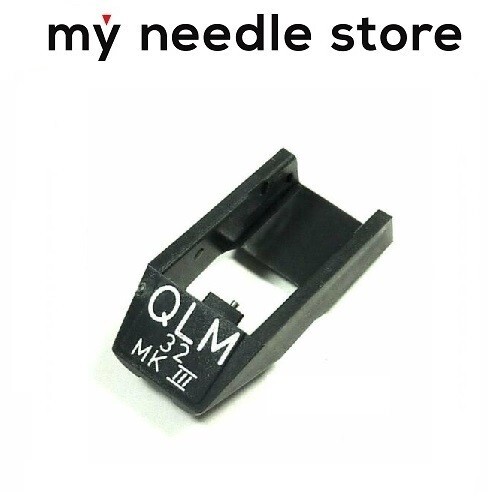
| Stylus Assembly | Nude Diasa, Elliptical .0003" x .0007" Diamond, mounted to a hollow cantilever. |
| Cartridge Weight | 5.75 grams |
| Tracking force range | 1.5-3g |
Key Features
Induced Magnet Design: The Real Deal
ADC didn’t just slap a magnet on a coil and call it a day. The QLM 36 Mk III uses their patented Induced Magnet design, which is fundamentally different from standard moving magnet (MM) or moving coil (MC) systems. Instead of a coil or magnet moving with the stylus, the system relies on a stationary coil and a magnet that induces current through magnetic flux changes. The result? Ultra-low effective tip mass, which means the stylus can dance over high-frequency grooves without skipping or dragging. It’s the same tech used in the XLM Mk II Improved, and it’s a big reason why this cartridge feels so much more refined than its price suggests. One owner noted that even when setting up a replacement stylus at 1.26g — “about the low limit” of their tonearm — tracking remained stable. That’s not luck; that’s good engineering.
Omni-Pivot System & Hollow Cantilever
The long life Omni-Pivot System isn’t just a fancy name. It’s a precision bearing system designed to reduce wear and maintain consistent alignment over time. Paired with a hollow cantilever — lighter than solid rods, more responsive than aluminum tubes — it helps the stylus stay in the groove with minimal inertia. The stylus assembly itself is a bushed, elliptical diamond tip, nude-mounted (meaning no metal shank adds mass), with dimensions of .0003" x .0007". That’s a serious contact profile for a cartridge in this class, and it shows in the detail retrieval. Users report that original VLM MKII styli are “virtually identical” to the QLM 36’s, which says a lot about parts commonality and build quality across ADC’s lineup.
Shared DNA with the XLM Series
Don’t let the “QLM” badge fool you. This isn’t a stripped-down, cut-rate version of the XLM. It’s more like a sibling — one that inherited most of the same features but skipped the gold plating and the premium packaging. It uses the same core technologies: the Induced Magnet design, the Omni-Pivot System, and the low-mass Diasa tip. Even the cartridge body reportedly has the same inductance as the better models like the XLM, which means it plays nice with standard MM phono stages without needing special loading. That’s a big deal. You’re getting high-end electrical characteristics in a mid-tier body. It’s like finding a Porsche engine in a Volkswagen chassis.
Collectibility & Value
Here’s the catch: the ADC QLM 36 Mk III itself doesn’t have a robust secondhand market with clear pricing. There’s no verified original MSRP, no production years, and no widespread collector demand — yet. But the clues are in the replacement parts. An “Original Stylus - 1391” replacement sells for $50.75, while an “Aftermarket Elliptical 1068-DE” option goes for $32.21. On mrstylus.com, an “Original ADC QLM 36 MK III” stylus is listed at 128.90 €, with another option at 39.90 € — a huge spread that suggests authenticity matters. And it should. Because, as users on Vinyl Engine warn, aftermarket replacements can be “iffy at best.” Worse, some units sold under brands like Pfanstiehl and EVG are outright fakes — they slap a gold sticker on a standard MM cartridge and call it an ADC, but they’ve replaced the real magnetic induction system with a moving magnet setup and a button magnet on the cantilever. They look similar, but they’re not the same animal.
If you’re hunting for a full cartridge, your best bet might be a vintage turntable bundle. One JVC deck with a factory-installed QLM 36 MK III recently listed for $345.00 on US Audio Mart — a fair price if the stylus is original and in good shape. But be cautious. The real value here isn’t in flipping it for profit; it’s in finding a working example with a genuine stylus and using it. Enthusiasts mention LPG ViVidLine and Shibata options from LP Gear as viable upgrades, and one user even scored a “new old stock” QLM33 stylus from turntableneedles.com — proof that the ecosystem still has life.
eBay Listings



As an eBay Partner, we earn from qualifying purchases. This helps support our independent vintage technology research.