ADC QLM 34 MkIII (1978–1984)
That first deep note from a well-tracked vinyl groove—warm, full, and alive—this little moving magnet helped define it for a generation.
Overview
The ADC QLM 34 MkIII isn’t flashy, but if you were building a serious turntable setup in the late '70s and didn’t want to mortgage your house, this cartridge was on your shortlist. Made by ADC (Audio Dynamic Corporation), a name that carried quiet respect among those who knew their cartridges, the QLM 34 MkIII landed right in the sweet spot between performance and price. It’s a moving magnet design, which meant easy alignment, reliable output, and no need for exotic preamps—just plug it into a standard MM input and go. Weighing in at 5.75 grams, it played nice with the higher-mass tonearms that were still common at the time, especially on British and Japanese decks that favored stability over featherlight tracking.
What really set the QLM 34 MkIII apart wasn’t raw specs, but its sound: a rich, balanced presentation that didn’t fatigue. Owners describe it as having a "good rich bass, transparent flat midrange and gently rolled off treble above 15–18kHz"—in other words, a classic '70s warm vintage sound. That’s not a euphemism for dull; it’s a deliberate voicing that smoothed out worn pressings and bright recordings without sacrificing presence. It wasn’t trying to be clinical. It was trying to make you forget you were listening to a machine.
Production ran from 1978 to 1984, a period when cartridges were getting more refined but still built to last. The QLM 34 MkIII was part of a broader family—the QLM series—that included the 30, 32, 33, and later the 36. While the hierarchy between models isn’t explicitly documented, the progression from MkI to MkII to MkIII centered on one key improvement: the stylus tips got progressively finer. That meant better groove tracing, more detail, and less wear on your records. For a time, that subtle evolution was enough to keep ADC competitive in a market crowded with Shure, Stanton, and Empire.
Specifications
| Manufacturer | ADC |
| Type | Moving Magnet |
| Stylus type | 0.3x0.7 mil elliptical |
| Recommended tracking force | 1.5 - 3.0 g |
| Mass | 5.75 g |
| Freq Response | 20Hz - 20kHz |
| Channel Separation | 24 dB |
| Load Impedance | 47k Ω |
| Output Impedance (body) | 800ohm |
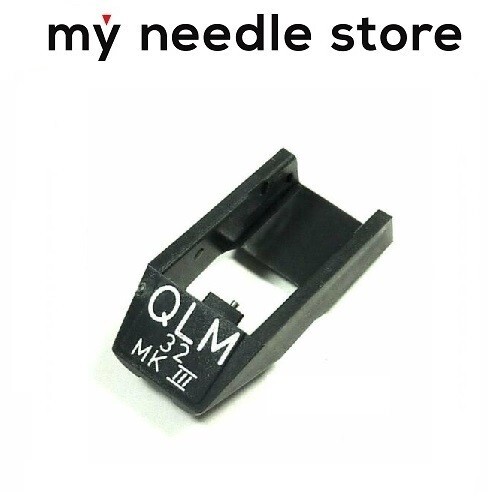
| Compatible stylus replacement reference | RSQ34 |
| Compatible stylus replacement part number | 1232 |
Key Features
Progressively Finer Stylus Tips Across MkI–MkIII
The main difference between the MkI, MkII, and MkIII versions of the ADC QLM series was the refinement of the stylus tip. Each iteration brought a finer point, improving high-frequency detail retrieval and groove contact. By the time the MkIII rolled around, the 0.3x0.7 mil elliptical stylus was offering noticeably better tracking than its predecessors—especially on complex passages and inner grooves. It wasn’t a radical redesign, but a focused evolution that mattered to listeners who wanted more from their records without jumping to exotic line contact or Shibata profiles.
Replacement Stylus Performance
Today, the LP Gear RSQ34 replacement stylus keeps the QLM 34 MkIII alive and relevant. It features a "highly polished Nude special elliptical diamond for superb tracking and tracing of record grooves," delivering what many describe as exceptional detail, nuance, and harmonically rich sound. That’s not just marketing fluff—users report clean tracking even at lower forces, like 1.25 grams, with no distortion. But here’s the catch: while the stylus tip can be replaced, the suspension system—the tiny rubber grommets and damping elements inside the cartridge body—isn’t replicable by third parties. As one owner put it, “The suspension is just as important as the stylus tip,” and companies like Pfanstiehl can’t reproduce the original compliance characteristics. That means a re-stylused QLM 34 MkIII might track well, but it may not quite *feel* like the original.
Historical Context
In 1977, just before full production began, the ADC QLM 34 MkIII was awarded 'best-buy' status by Hi-Fi Choice—a significant endorsement in the UK market. At £18, it undercut the Empire 500 ID, a popular competitor priced at £23, while delivering comparable performance. That value proposition helped it gain traction among audiophiles who wanted high fidelity without overspending. The QLM 36 came later, designed for lighter tonearms as effective mass trends shifted toward lower values by the end of the decade. But the 34 MkIII remained a favorite for those sticking with traditional, higher-mass arms—especially on decks like the SME 3009 or ADC’s own partnered tonearms.
Collectibility & Value
If you’re looking at a used ADC QLM 34 MkIII, plan to replace the stylus. It’s not optional. Even if the cartridge looks clean, the rubber in the suspension can degrade over time, and the stylus is almost certainly worn. A new RSQ34 replacement stylus (part number 1232) costs $67.34 from DaCapo Audio. There’s also an alternative—AN4983, priced at $47.82—that claims to replace both RSQ32 and RSQ34 models. Some users report buying working units with original styli for as little as $20, but that’s a gamble unless you’re getting it just for parts. A NOS (New Old Stock) cartridge recently sold on eBay for $166.91, which gives a sense of the upper end of the market. The real value, though, is in knowing that with a fresh stylus, this cartridge can still deliver a musical, engaging sound that holds up against modern budget offerings—just don’t expect it to match today’s ultra-low-mass tracking or laser-measured compliance.
eBay Listings


As an eBay Partner, we earn from qualifying purchases. This helps support our independent vintage technology research.