ADC QLM 30 MkII (1970s–1980s)
A workhorse moving magnet cartridge that never made headlines. If your turntable came from a department store in the '70s, there's a good chance this little black bullet was riding the groove.
Overview
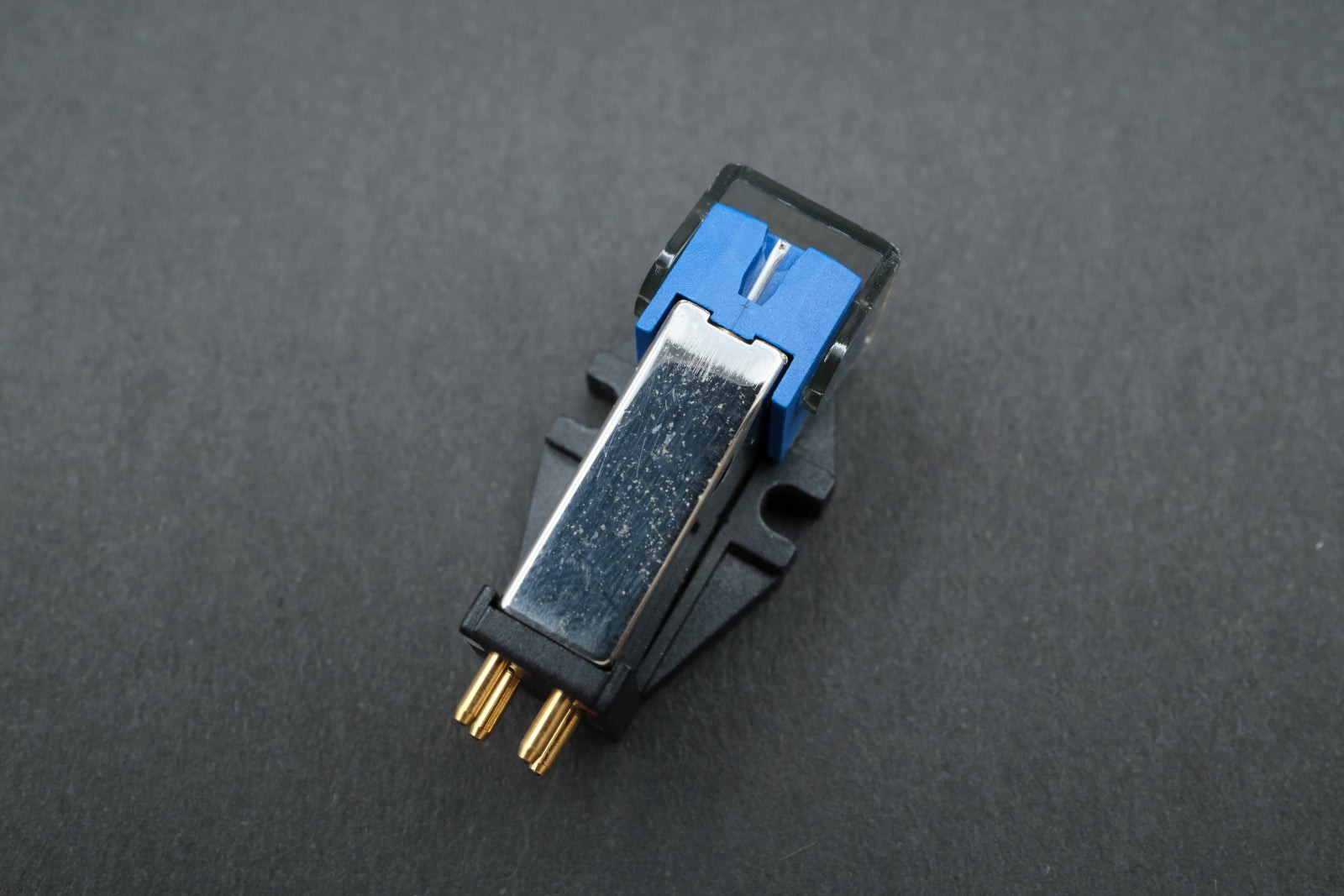
Nobody buys an ADC QLM 30 MkII for audiophile reasons. It's what came on a Realistic, BSR, or Zenith turntable, and now the stylus is worn, the highs are harsh, and old records sound like they're playing through a tin can. It's not glamorous, but it's honest. This was the engine inside thousands of budget to mid-tier turntables during the height of the stereo boom, and it did its job - adequately. The MkII follows the original QLM 30 and precedes the MkIII, in the middle of a long-running family of cartridges that ADC (Audio Dynamics Corporation) designed to be reliable, replaceable, and just good enough to keep people listening without breaking the bank.
The QLM 30 MkII is a moving magnet design, also described in period materials as ADC's proprietary Induced Magnet system. Output is healthy. Research sources don't list an exact figure for the MkII, but the closely related MkIII produces 7.6 mV, and the MkII likely falls in the same neighborhood. That makes it a natural fit for standard MM phono preamps with no extra gain. Frequency response runs from 10Hz to 20kHz, which looks impressive on paper for its class, though real-world performance tends to roll off at the extremes, especially as the stylus ages. Tracking force is 1.0 to 2.0 grams, with 1.5 g typical. The later MkIII wants 3.0-5.0 grams, so the MkII was probably tuned for the lighter-tracking tonearms common in mass-market changers and auto-return decks. At just 5.75 grams it's featherlight, which helps reduce record wear on lower-quality turntables with less rigid suspension systems. The low mass has a cost in resonance control. In medium- to high-mass tonearms, the QLM 30 MkII can ring like a bell, adding a slight metallic glare to vocals and cymbals. It's not unlistenable, but it's a far cry from the smooth integration of a higher-end cartridge like a Shure M97xE or a Denon DL-103.
Key Features
Induced Magnet Design and Replaceable Stylus
ADC's proprietary Induced Magnet system, as described in period materials, offers lower effective tip mass for improved tracking and reduced record wear compared to conventional designs. The real innovation wasn't sound quality, though. It was serviceability. Many budget cartridges of the era were sealed units, meant to be thrown away when worn. The QLM 30 MkII had a user-replaceable stylus, so owners could swap a worn needle without buying a whole new cartridge. That mattered on a tight budget, when all you wanted was your copy of Dark Side of the Moon to stop sounding like it was recorded in a parking garage. The stylus assembly uses a rubber damping mount, which helps absorb high-frequency feedback. Over time that rubber can dry out, harden, or even disintegrate, especially in cartridges stored in hot or dry environments. A dried-out suspension degrades the sound, and it can also cause mistracking and record wear.
Elliptical vs. Spherical: What's Actually in There?
One quirk of the QLM 30 MkII is that stylus type varies across production runs. Some units shipped with a spherical tip, others with an elliptical. Later MkIII models standardized on elliptical, but the MkII appears to straddle the line. LP Gear describes the stylus as a "highly polished special elliptical diamond" for superb tracking and tracing of record grooves, resulting in finer detail and harmonically complete sound quality. An Amazon/Durpower replacement needle listing describes a "Diamond .7 mil conical tip needle" - the two sources conflict on tip shape. The stylus tip radius is listed as 0.7 mil for spherical, or special elliptical in later versions. An elliptical tip traces the groove more accurately, especially in the high frequencies, and generally offers better channel separation and detail retrieval. If you're buying a used MkII today, you can't assume which type you're getting, especially if the stylus has been replaced. Aftermarket replacements vary widely: some are genuine ADC parts, others are third-party copies with questionable geometry. A misaligned or poorly shaped stylus can do more harm than good, even if it looks shiny and new.
Built for the Mass Market, Not the Listening Room
The QLM 30 MkII wasn't designed for critical listening. It was designed to survive in a Realistic turntable stacked on a wood-paneled receiver in a basement rec room, playing 45s for kids and background music for dinner parties. The rugged plastic body, simple mounting screws, standard 1/2-inch mount, and forgiving output make it tolerant of mediocre tonearms and less-than-ideal setup. That durability costs some sound quality. The plastic housing does little to dampen resonance, and the internal magnets and coils aren't shielded against external interference. Place it near a power transformer or an old CRT TV, and you might hear a faint hum in the background.
Electrical Specifications and Load Matching
The cartridge wants a load impedance of 47,000 ohms resistance with 275 pF capacitance. That's standard MM territory that any decent phono stage will provide. Channel separation is listed at 20 dB at 1 kHz, with channel balance of 2.0 dB at 1 kHz, though both figures are inferred from the MkIII rather than confirmed for the MkII. Tracking ability is listed at 80 µm at 315 Hz, also inferred from the MkIII. These are respectable numbers for a budget cartridge of the era, but since they're inferred, treat them as approximate rather than measured. The replacement stylus is designated RSQ30, shared with the MkIII, and third-party vendors list an alternate part number D1210. Original price isn't documented. These typically came included with turntables rather than sold separately at retail.
Historical Context
The ADC QLM 30 MkII emerged during the 1970s, when home audio was booming and record sales were at an all-time high. Turntables were no longer niche hobbyist gear. They were living room furniture, sold at department stores, catalog outlets, and electronics chains. Companies like BSR, Dual, and Technics were turning out automatic changers and semi-automatic decks by the millions, and they needed cartridges that were cheap, reliable, and easy to service. ADC, based in the U.S. but with manufacturing ties overseas, filled that gap. The QLM 30 series wasn't competing with the likes of Stanton, Shure, or Ortofon in the high-end space. It was competing with no-name OEM parts and disposable designs.
ADC's real innovation wasn't in sound quality—it was in serviceability. By making the stylus replaceable and using a standard 1/2-inch mount, they gave consumers and repair shops a way to extend the life of a turntable without sending it back to the factory. That approach resonated with retailers like Radio Shack, which sold ADC cartridges under the Realistic brand. The QLM 30 MkII became a quiet backbone of the analog ecosystem: not the star of the show, but the stagehand keeping everything running.
Its main competitors weren't exotic Japanese imports but other budget-friendly moving magnet cartridges: the Audio-Technica AT95E, the Pickering VX-15, and various OEM units from BSR and JVC. Compared to those, the QLM 30 MkII held its own, offering slightly better tracking and a more consistent output than many of its peers. By the 1980s, as CD players began to erode the record market, ADC shifted focus, and the QLM line gradually faded into obsolescence, surviving mostly as a replacement part for aging turntables.
Collectibility & Value
The ADC QLM 30 MkII is not a collectible in the traditional sense. No one is bidding up NOS (New Old Stock) units on collector forums, and mint-in-box examples don't fetch hundreds of dollars. It is valuable to one specific group: people restoring vintage turntables who want to keep things original. For them, originality matters more than audiophile performance, and the QLM 30 MkII is often the only cartridge that matches what came with the deck from the factory.
Today, a working QLM 30 MkII with a good stylus sells for $25 to $50 on eBay. NOS units with unmounted styli can go for $60 - $80, especially if they're still in the original packaging. One observed listing for an "ADC Audio Dynamics Corporation QLM30 MKII Cartridge W/ Stylu" was priced at $31.20. Many "new" units are actually old stock, and the rubber damping in the stylus assembly may have degraded even if the cartridge was never used. A hardened or cracked damper will ruin tracking performance and should be replaced before use.
Common failures include worn or misshapen styli (the most frequent issue), dried-out suspension rubber, loose mounting screws, and demagnetized generator coils. The stylus is the easiest fix. Replacement RSQ30 styli are still available from specialty vendors like LP Gear and Thakker, though quality varies. The suspension is harder: once it's gone, there's no practical repair. Some technicians attempt to re-damp with silicone, but results are inconsistent. If the coils are dead, the cartridge is essentially scrap, since there's no economically viable rewind service for a $50 cartridge.
When buying a used QLM 30 MkII, check the stylus under magnification. Look for rounding, chipping, or asymmetry. Wiggle the stylus tip gently. If it moves side-to-side or feels stiff, the suspension is compromised. Play a clean, well-mastered record and listen for sibilance, mistracking on loud passages, or channel imbalance. If it sounds thin, harsh, or erratic, it's probably time for a new stylus, or a new cartridge altogether.
eBay Listings


As an eBay Partner, we earn from qualifying purchases. This helps support our independent vintage technology research.