ADC PSX-20 (1970s–1980s)
A little red stylus that promised high fidelity on any turntable, from the bargain-bin P-mount to the high-end half-inch tonearm—so long as you didn’t mind hunting for its vanishing needles.
Overview
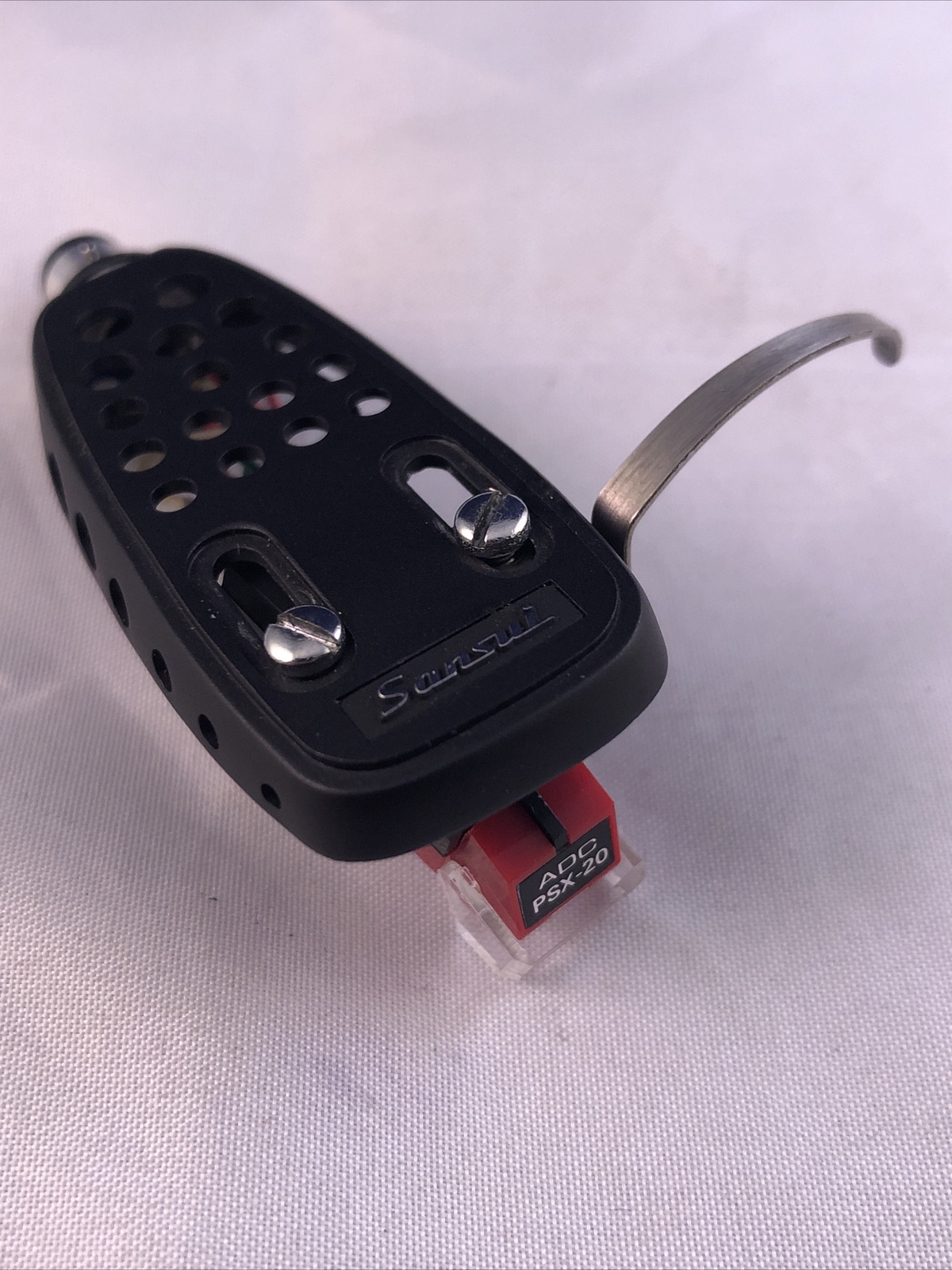
Pull one out of a drawer today and it still looks like it means business: that bright red stylus housing, the clean black body, the subtle “ADC” badge like a quiet flex of engineering pedigree. The PSX-20 wasn’t flashy, but it wasn’t supposed to be. It was the middle child of ADC’s PSX line—a step up from the PSX-10, a step below the PSX-30 and 40—but it hit a sweet spot that made it a quiet workhorse across decades of turntable setups. It showed up in mass-market consoles, yes, but also in serious rigs where someone wanted a decent upgrade without going full reference. The magic was in its flexibility: it came with a P-mount (T4P) base and a removable adapter for standard half-inch mounting, which meant it could slide into anything from a Sears Silvertone to a Technics SL-1200. That universality wasn’t just marketing fluff—it worked, and it worked well.
Sonically, the PSX-20 splits the difference between warmth and clarity in a way that feels very of its era. It doesn’t have the lush midrange bloom of a moving coil or the hyper-detailed attack of a modern elliptical, but it delivers a balanced, listenable presentation that never feels fatiguing. The bonded elliptical tip (RPSX-20) tracks respectably at 1.1 to 1.5 grams, which was light for its time, and it handles worn or slightly warped records without tantrums. It won’t extract every last whisper of detail from a pristine pressing, but it won’t punish you for playing a $1 used copy of a 1970s rock LP either. There’s a forgiving quality to its sound—slightly rounded highs, a midrange that doesn’t shout, and bass that’s present but not bloated. It’s the kind of cartridge that makes you forget you’re listening to gear and just enjoy the music, which, let’s be honest, is the whole point.
But here’s the catch: finding a good one now is a game of chance. The PSX-20 itself is relatively common, but the original RPSX-20 stylus is long out of production, and NOS (new old stock) units are drying up. Generic replacements exist, but they’re hit-or-miss in tracking accuracy and durability. Owners report that when a fresh, genuine RPSX-20 stylus is installed, the cartridge sings—but once it’s worn, the sound turns dull and tracking issues creep in. There’s no rebuild path like with higher-end ADC models; you can’t just send it to a specialist for a new coil or cantilever. It’s a replaceable-part device, and once the parts are gone, the cartridge becomes a paperweight. That’s the quiet tragedy of the PSX-20: it was built to be serviceable, but time has made it disposable.
Specifications
| Manufacturer | Audio Dynamics Corporation (ADC) |
| Production Years | 1970s–1980s |
| Original Price | Not listed (sold as OEM and replacement) |
| Type | Induced Magnet (moving magnet derivative) |
| Output Voltage | Not specified in research |
| Channel Separation | Not specified in research |
| Frequency Response | Not specified in research |
| Tracking Force | 1.1 – 1.5 grams |
| Tracking Ability | Not specified in research |
| Stylus Type | RPSX-20 |
| Stylus Tip | Bonded Elliptical |
| Tip Radius | 0.3 x 0.7 mil |
| Cantilever | Not specified in research |
| Compliance | Not specified in research |
| Coil Impedance | Not specified in research |
| Load Impedance | Not specified in research |
| Recommended Load Capacitance | Not specified in research |
| Mounting | P-Mount (T4P) with 1/2" adapter |
| Weight | Not specified in research |
| Replacement Stylus | ADC RPSX-20, Pfanstiehl 116-DEM (generic) |
Key Features
Universal Mounting Design
ADC didn’t just slap an adapter on and call it a day—the PSX-20’s dual-mount system was engineered for stability. The P-mount base clicks securely into compatible turntables, while the half-inch adapter screws in firmly and maintains proper overhang and alignment when used with a standard headshell. This wasn’t common at the time; most budget cartridges were locked into one format. The PSX-20’s flexibility made it a favorite among both casual listeners and technicians doing console repairs. It also meant manufacturers could standardize on one cartridge across multiple product lines, from portable record players to high-fidelity systems. That universality helped it survive in the market long after more specialized designs had faded.
Bonded Elliptical Stylus
The RPSX-20 stylus uses a bonded elliptical tip—diamond mounted to a metal shank—which was a cost-effective way to achieve better groove contact than a spherical tip. The 0.3 x 0.7 mil profile allows it to trace high-frequency modulations more accurately than the PSX-10’s conical tip, reducing distortion and inner-groove smearing. It’s not a nude elliptical like those found on higher-end models, so ultimate resolution is limited, but for a mid-tier cartridge, it punches above its weight. The red housing isn’t just for looks; it helps technicians quickly identify the model during servicing, a small but thoughtful touch in an era when repairability still mattered.
Induced Magnet Technology
ADC’s “Induced Magnet” design, a variation on the variable reluctance principle developed under GE patents, gave the PSX-20 a robust output and stable performance over time. Unlike moving magnet cartridges where the magnet moves, ADC’s system used a fixed magnet and moving iron elements, which reduced moving mass and improved transient response. The result was a cartridge that was less microphonic and more durable than many of its contemporaries. While the PSX-20 didn’t use the exotic materials of ADC’s flagship XLM or LMA lines, it inherited the same fundamental engineering philosophy: high compliance, low tracking force, and a focus on long-term wear protection for records. It’s a design that prioritized practicality without sacrificing too much in the way of sound quality.
Historical Context
The PSX-20 emerged during the golden age of the integrated turntable console and the rise of the affordable stereo system. In the 1970s and early 1980s, record players were everywhere—living rooms, dorms, bedrooms—and manufacturers needed reliable, mass-producible cartridges that could perform adequately across a wide range of tonearms and record conditions. ADC, founded by Peter Pritchard in the early 1960s, had already built a reputation with high-end models like the ADC-1 and XLM, but the PSX series brought that engineering down to the middle market. Competitors like Shure, Audio-Technica, and Pickering were also pushing dual-mount and budget elliptical designs, but ADC’s reputation for compliance and low wear gave the PSX-20 an edge in longevity-focused circles.
The P-mount format, which the PSX-20 embraced fully, was both a blessing and a curse. It simplified installation—plug and play, literally—but often came at the expense of rigidity and alignment precision. ADC’s solution was to treat the P-mount as a legitimate platform rather than a compromise, engineering the PSX series to perform as well in a P-mount as in a half-inch mount. That commitment to cross-compatibility set it apart from brands that treated P-mount as an afterthought. By the late 1980s, as CD players began to dominate and vinyl entered its first decline, the PSX-20 faded from production, but it remained a staple in repair shops and secondhand systems for years.
Collectibility & Value
Today, the ADC PSX-20 is neither rare nor particularly valuable, but it’s not worthless either. A complete cartridge with a genuine ADC RPSX-20 stylus in good condition might fetch $40–$60 on the used market, while units with worn or generic styli sell for $15–$25. NOS (new old stock) styli, when they appear, can command $30 or more—sometimes more than the cartridge itself. The problem for buyers is verification: many sellers list “PSX-20” cartridges with generic or mislabeled styli, and without testing, it’s hard to know what you’re getting. The red 116-DEM stylus from Pfanstiehl is the most common OEM replacement, but third-party versions vary wildly in quality.
The biggest failure point isn’t mechanical—it’s obsolescence. The cartridge body is robust, and the induced magnet system is less prone to coil failure than moving magnet designs, but once the stylus wears out and no proper replacement exists, the unit is done. There are no rebuild services for the PSX-20, unlike ADC’s higher-end models, which can be re-tipped or rewound by specialists. Collectors looking for a functional piece should prioritize condition of the stylus above all else. Check for tip wear under magnification, and if possible, test tracking performance with a known-good record. Avoid units with cracked or discolored bodies, which may indicate age-related material degradation.
For those restoring vintage consoles or seeking an authentic upgrade for a 1970s turntable, the PSX-20 remains a logical choice—if you can find one with a good stylus. It won’t transform a cheap system into a high-end rig, but it will deliver a noticeable improvement over original equipment, especially on P-mount players where modern cartridge options are limited. Just don’t count on it being a long-term solution. This is gear with an expiration date, and we’re well into its twilight years.
eBay Listings

As an eBay Partner, we earn from qualifying purchases. This helps support our independent vintage technology research.