ADC K8C (Years Unknown)
It’s not flashy, it won’t dissect every layer of a 1970s prog epic, but it’ll make your records sound warm, easy, and surprisingly alive—especially if you’re not chasing perfection.
Overview
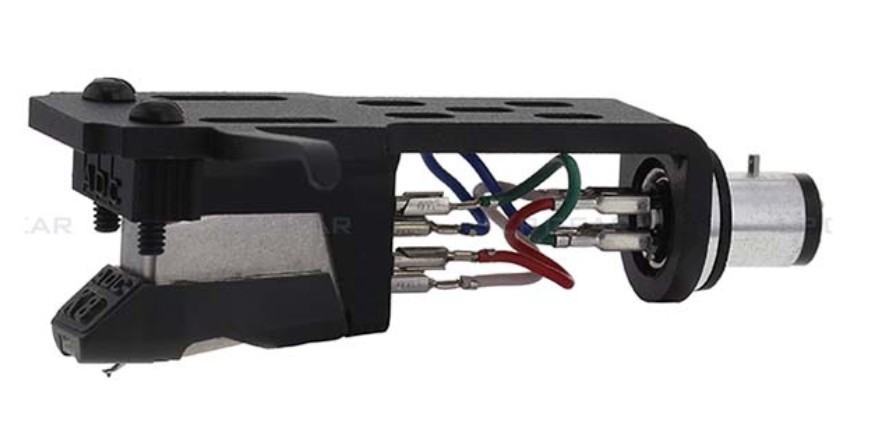
If you’ve ever unboxed a turntable cartridge and immediately panicked at the thought of aligning a needle under a microscope, the ADC K8C might just be your kind of machine. This isn’t a boutique audiophile relic or a museum piece with a six-figure grail status—it’s a humble, premounted phono cartridge that shows up ready to work. Sold fully assembled on a black (RC398-D) or silver (RC398D) headshell, it’s the kind of plug-and-play solution that makes sense when you want vinyl warmth without the alignment spreadsheet. And honestly? That’s kind of its charm.
Manufactured by Audio Dynamics Corporation (ADC), a company founded by Peter Pritchard in the early 1960s, the K8C carries the DNA of a brand that punched above its weight in the magnetic cartridge game. ADC wasn’t trying to beat Denon or Shure at their own high-end game—instead, they leaned into high compliance and low tracking force, which made their cartridges forgiving on less-rigid tonearms and budget turntables. The K8C fits right into that philosophy: it tracks at a featherlight 1.0 to 2.0 grams, so it won’t wear down your records fast, and it’s designed to play nice with a standard 47k ohm input load—the default on nearly every receiver and preamp made since the 1970s.
Owners report it delivers a sound that’s “easy going and quite smooth,” which tells you everything you need to know. This isn’t a cartridge that shouts. It doesn’t sparkle like a high-mass moving coil on a $5,000 tonearm. But for the price, it offers a balanced, relaxed presentation that makes 90% of records sound just right. One user put it perfectly: “There will be a bit of IGD with super complicated music on SOME records.” Translation: on dense, dynamic passages—think Mahavishnu Orchestra or late-period Beatles—it might get a little fuzzy at the edges. But for jazz, soul, classic rock, and most pop? It’s more than capable.
And let’s not overlook the practical side: it’s sold premounted, which is a quiet act of mercy in a world where replacing a stylus can mean buying a new alignment protractor, a magnifying lamp, and three hours of your weekend. One buyer noted they chose the full cartridge assembly specifically because “there are so many fakes amongst the stylus replacement offerings for the ADC cartridges”—a real issue in this niche. Buying it whole sidesteps that mess entirely.
Specifications
| Manufacturer | ADC (Audio Dynamics Corporation) |
| Product type | Turntable Cartridge, Phonograph Cartridge |
| Frequency Response | 15hz-20khz |
| Channel Separation | 24 dB at 1 kHz/10 kHz |
| Vertical tracking force (grams) | 1.0-2.0 |
| Recommended load impedance (ohms) | 47k |
| Output | 5 mv |
| Mounting | Half-inch |
Key Features
Precision conical diamond stylus
The K8C uses a precision conical diamond stylus—specifically the ADC RK8, with an optional upgrade to the RK8E. Conical tips are the workhorses of the vinyl world: less detailed than elliptical or fine-line profiles, but more durable and forgiving on worn records. That makes this cartridge a solid choice for someone digging through thrift-store bins or playing older pressings that have seen a few spins. It won’t extract every last nuance from a pristine 1960s mono pressing, but it also won’t punish you for playing a scratched copy of Tapestry on a Sunday morning.
Induced Magnet design
Under the hood, ADC cartridges—including the K8C—are based on what’s known as the “Induced Magnet” design, a variation on the older GE variable reluctance cartridges. It’s a magnetic system where the stylus movement alters the magnetic field in a fixed coil, generating signal without needing a powered magnet. This design is known for reliability and moderate output—here, 5 mV, which is plenty for standard MM (moving magnet) inputs. It’s not a radical innovation, but it’s a proven, stable architecture that doesn’t demand exotic preamp stages or impedance matching gymnastics.
High compliance, low tracking force
ADC built its reputation on high compliance, meaning the stylus suspension is soft and responsive. Paired with a low tracking force (1.0–2.0 grams), this makes the K8C gentle on records and tolerant of less-than-perfect tonearm geometry. That’s a big deal if you’re using a vintage console or a budget turntable with a basic arm. High-compliance carts like this can track well without needing ultra-precise anti-skate or VTF adjustments—though you should still set it properly. Just don’t sweat perfection.
Premounted on a headshell
The K8C is typically sold preinstalled on a half-inch mount headshell, either black (RC398-D) or silver (RC398D). This isn’t just convenience—it’s a hedge against the murky aftermarket for ADC styli. As one buyer wisely noted, “Currently there are so many fakes amongst the stylus replacement offerings for the ADC cartridges” that buying the full assembly is the smarter move. You know what you’re getting: a matched cartridge and headshell, aligned at the factory, ready to drop onto your tonearm. For casual collectors or second-system setups, that’s a real win.
Historical Context
Audio Dynamics Corporation (ADC) was founded by Peter Pritchard in the early 1960s, a time when magnetic cartridges were transitioning from niche audiophile gear to standard equipment on mid-tier turntables. ADC carved out a space by focusing on high-compliance designs that offered good tracking at low cost. The company was later sold to BSR in the late 1970s, a British manufacturer best known for mass-market turntable mechanisms. After the sale, Pritchard went on to form Sonus, continuing his work in audio design.
Where the K8C fits exactly in ADC’s lineup remains unclear—there’s no official hierarchy documented in the sources. However, a forum user familiar with ADC’s 1973 product spec sheet speculated that the K8C was “pretty near the bottom of ADC’s line at the time.” That tracks with its specs and current positioning: it’s not a flagship, but a value-oriented, entry-level cartridge built for reliability and ease of use. It likely shared design elements with other K-series models, though specific lineage details aren’t available.
Collectibility & Value
Today, the ADC K8C is available new-old-stock (NOS) or as a new premounted assembly, with prices hovering around $49.95 from LP Gear—the most frequently cited vendor. Other retailers list it slightly higher: $52.91 at My Needle Store for a blue headshell version, and $69.99 on PicClick for a NOS set including the RK8 stylus and universal headshell. These aren’t collector’s-market prices; they reflect a functional, affordable cartridge for people who want vintage gear without vintage headaches.
There’s no documented data on common failures, internal wear points, or maintenance quirks—no one’s reporting burnt coils, magnet decay, or fragile leads. That silence might actually be a good sign: if it’s not breaking, it’s not making noise. And given that it’s still being sold as a functional replacement part, it’s clearly holding up well over time.
The lack of original pricing or production years makes it hard to judge its value trajectory, but its current role is clear: it’s a practical, honest cartridge for people who want to play records, not spend weekends tweaking VTF and azimuth. It’s celebrated not for its specs, but for its “sound quality and value”—a rare combo in the vintage audio world. As one seller cheerfully puts it: “You’ll really like this one!”
eBay Listings

As an eBay Partner, we earn from qualifying purchases. This helps support our independent vintage technology research.