ADC K8 (Unknown Years)
It hums along without fanfare—no glitter, no hype—just a workhorse cartridge that kept record changers spinning through the 1980s.
Overview
If you’ve ever flipped open a record changer from the early '80s and found a little blue cartridge nestled in the tonearm, chances are it was an ADC K8. This isn’t the kind of gear that gets audiophiles writing sonnets, but it’s the kind that actually played the records—night after night, stack after stack. Built for durability and simplicity, the ADC K8 was a no-frills, entry-level phonograph cartridge made specifically for BSR record changers during a time when convenience mattered more than flat frequency response. It’s the audio equivalent of sensible shoes: not flashy, but reliable when the dance floor gets crowded.
ADC, or Audio Dynamics Corporation, didn’t design this one to win awards. They built it to do a job: track grooves on a budget changer without skipping when the next record dropped. And it did that well enough that decades later, people are still swapping in replacement styli instead of tossing the whole thing. The K8 was part of a larger ecosystem—ADC was owned by BSR in the 1980s, and this cartridge was made in Japan under that joint-venture arrangement. You won’t find museum plaques for the K8, but you will find it buried in service manuals and still listed on niche parts sites, which says something about its quiet persistence.
Owners report it delivers a sound best described as “relaxed, smooth, and balanced”—a profile that flatters worn vinyl and aging ears. It won’t dazzle you with sparkling highs or deep soundstage imaging, and some note a bit of inner-groove distortion on longer sides, but for background listening or reviving an old changer, it’s more than capable. At its core, the K8 was never about fidelity; it was about function. And in that narrow lane, it earned its keep.
Specifications
| Manufacturer | ADC (Audio Dynamics Corp.) |
| Product type | Turntable Cartridge, Phonograph Cartridge |
| Frequency Response | 20 Hz - 20 kHz ± 2 dB |
| Channel Separation | 22 dB at 1 kHz |
| Vertical tracking force range | 1.5 - 3.0 g |
| Recommended tracking force | 2.25 g |
| Recommended load impedance | 47 kΩ |
| Optimum load | 47 kΩ resistance in parallel with 275 pF total capacitance. |
| Output voltage | 5.8 mV per channel at 1 kHz, 5 cm/sec. peak recorded velocity |
| Channel balance @ 1 kHz | 2.0 dB |
| Tracking ability | 80 µm at 315Hz at recommended tracking force |
| Stylus type | Elliptical |
| Stylus tip radius | 0.4 x 0.7 mil (elliptical) |
| Tracking angle | 20° |
| Net Cartridge weight | 5.75 g |
| Mounting | Standard ½" (12.7mm) Mounting Centers |
Key Features
Moving Magnet Simplicity
Though the factory never published internal schematics, the specs and era strongly suggest the K8 is a moving magnet (MM) design—unsurprising, since that was the dominant architecture for affordable cartridges by the 1980s. With a healthy 5.8 mV output, it pairs easily with any standard MM phono preamp, no step-up transformer or extra gain stage needed. That high output comes in handy on older changers with underpowered electronics, and it means the K8 can drive even basic integrated amps without breaking a sweat.
Elliptical Tracking, Polished Precision
The original stylus came with a highly polished elliptical diamond tip—smaller contact area than a conical tip, which means better high-frequency response and improved groove tracing. The 0.4 x 0.7 mil radius was modest by high-end standards, but for a budget cartridge, it offered a noticeable upgrade over the spherical tips common in even cheaper models. That elliptical shape helps it dig into the inner grooves where modulation gets tighter, though some users report noticeable distortion near the end of long LP sides—likely a trade-off of the tracking force range and suspension design.
Built for the Changer Life
One of the K8’s quiet superpowers is its compatibility with record changers. Replacement styli for this model are often described as slightly firmer than typical MM replacements, designed to handle the mechanical bump when a new record drops onto the platter. That extra stiffness isn’t just about durability—it ensures the stylus doesn’t jump or mistrack during the transition. It’s a small engineering detail, but one that kept thousands of BSR changers running without constant service.
Blue or Grey? Take Your Pick
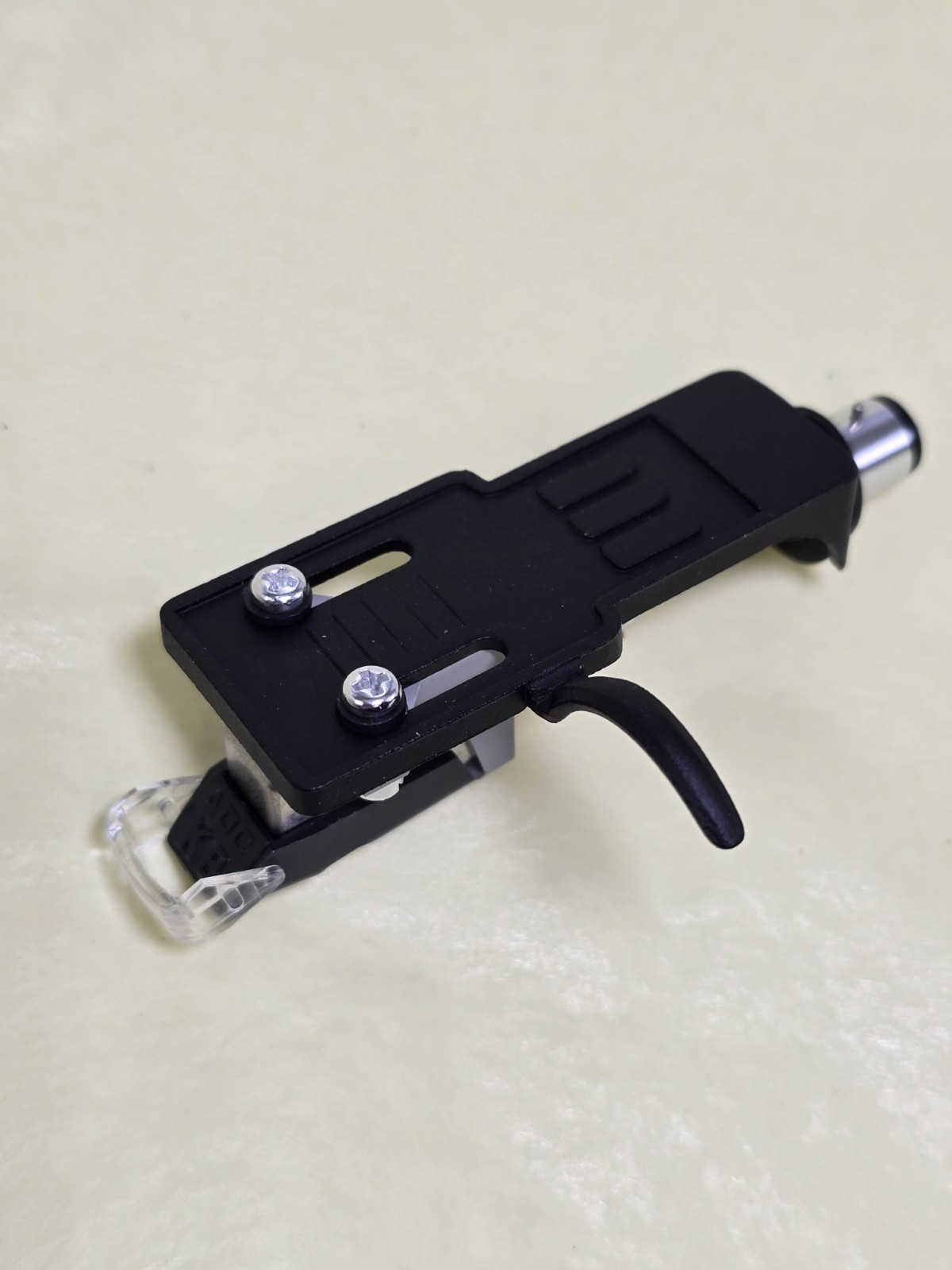
Visually, the K8 usually shows up with a bright blue body—cheery, almost toy-like—which makes it stand out against the sea of black and silver cartridges from the era. But some units shipped with a dark grey body, likely depending on production batch or OEM order. Either way, it’s a compact, lightweight unit at just 5.75 grams, so it plays nicely with lightweight tonearms without requiring heavy counterweights or anti-skate adjustments.
Historical Context
The ADC K8 emerged during a time when record changers still ruled living rooms across America and Europe. , had been acquired by BSR in the late 1970s, and by the 1980s, BSR owned ADC outright. The K8 was a product of that corporate marriage—a cartridge made in Japan specifically for BSR’s lineup of stack-playing turntables. It wasn’t marketed as a high-fidelity component; it was a functional part, like a timing belt or a drive belt, meant to be reliable and replaceable. Its design reflects that: standardized mounting, high output, and a stylus built to take mechanical abuse. While audiophiles were chasing low-mass arms and Shibata tips, the K8 was quietly doing the work of keeping mainstream listeners connected to their vinyl collections.
Collectibility & Value
Today, a complete ADC K8 cartridge lists at $44.95 USD, while the RK8E replacement stylus goes for $39.95. That’s not cheap for a vintage entry-level cartridge, but scarcity and demand for compatible parts keep prices elevated. The aftermarket is active, with replacement styli ranging from €23 to over €159 depending on tip shape—some vendors even offer upgraded nude elliptical or hyper-elliptical options for those wanting better performance from an old changer. Most of these styli are labeled as "New Old Stock," suggesting they’ve been sitting in drawers since the 1980s.
Collectors don’t seek out the K8 for its sonic glory, but for its utility. If you’re restoring a BSR, Dual, or other auto-changer from the era, the K8 or its stylus is often the most authentic and mechanically appropriate upgrade. There’s no data on common failures or repairability—no one’s dissecting these in forums—but the availability of styli implies the guts are either durable or not worth fixing. For under $50, you’re buying peace of mind: a known-working part that keeps a vintage machine spinning records the way it did when new.
eBay Listings


As an eBay Partner, we earn from qualifying purchases. This helps support our independent vintage technology research.