ADC Accutrac +6 (1976–1979)
The turntable that promised a robot butler for your record collection—and almost delivered.
Overview
You can still feel the 1970s optimism radiating off the ADC Accutrac +6: a turntable that didn’t just play records, but promised to *think* about them. Stack six albums, program your favorite tracks via a mushroom-shaped infrared remote, and let the machine sort out the rest. It wasn’t magic, but for 1976, it was close. This wasn’t some stripped-down changer for background music—it was a statement piece, a living-room robot with a platter, aimed squarely at the buyer who wanted their stereo to *do things*. And if the execution sometimes lagged behind the ambition? Well, that’s part of the charm now.
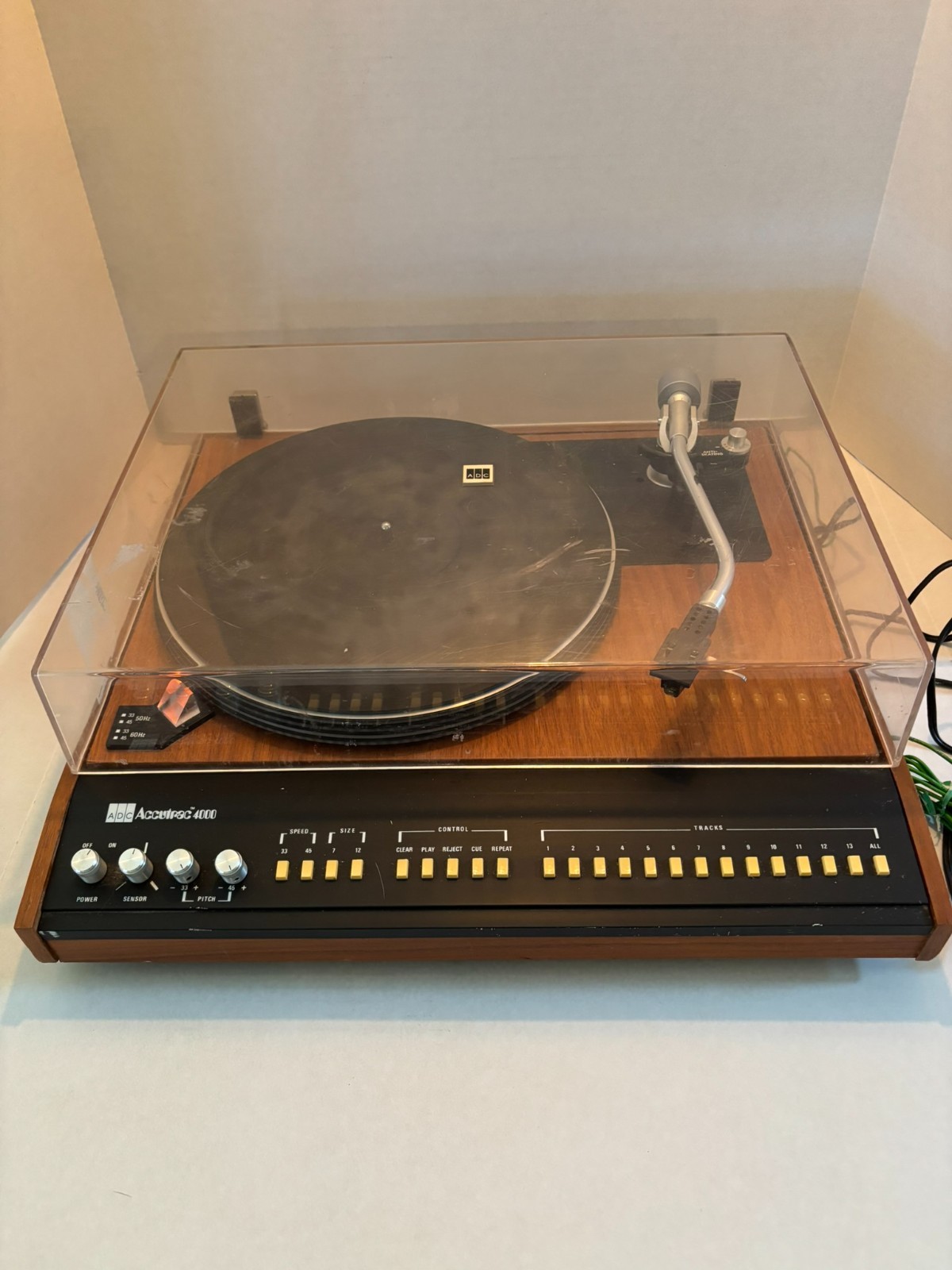
Built by British manufacturer BSR for American brand ADC (Audio Dynamis Corporation), the +6 was the evolution of the legendary Accutrac 4000. Where the 4000 dazzled with its glowing orb remote receiver and single-play precision, the +6 added the practicality of a six-record changer—hence the name—while retaining the same infrared control system. It wasn’t a flagship in the traditional sense; instead, it carved out a niche as the “smart” changer, a bridge between audiophile aspirations and living-room convenience. It sat above basic changers from Voice of Music or RCA, but below true high-end manual turntables. Its sweet spot? The buyer who wanted automation without sacrificing too much fidelity.
The +6 used a belt-drive system with a two-speed platter (33⅓ and 45 RPM), a far cry from the direct-drive tech emerging from Japan at the time. The tonearm was a static-balance S-shaped design, decoupled to reduce resonance, and it came standard with ADC’s LMA1 cartridge—a low-mass, high-output moving magnet with an elliptical stylus. That cartridge was no afterthought; it tracked well for its era and could extract decent detail from vinyl, provided the system was set up properly. The real novelty, though, was the track selection logic: using optical sensors and a memory bank, it could skip to specific tracks on each record, a feature that felt like science fiction in the mid-70s. You could program it to play track 3 from record one, then jump to track 1 on record four—something no other changer offered at the time.
But let’s be honest: this was still a record changer. The mechanism, while clever, involved lifting and lowering multiple records via a concentric spindle and a rising platform that minimized drop distance. It worked—often impressively—but it wasn’t silent, and it wasn’t fast. The sequence of clunks, whirs, and soft thuds as the machine cycled through records is now part of its character, but back then, it was just part of the show. And like all changers, it demanded care: warped records could jam the system, and dust buildup in the spindle mechanism could cause misfeeds. Still, when it worked, it worked with a kind of theatrical flair that modern streaming can’t replicate.
Specifications
| Manufacturer | ADC (Audio Dynamis Corporation), manufactured by BSR |
| Production Years | 1976–1979 |
| Model Number | 3500/1-RVC |
| Turntable Type | Belt-drive, automatic, six-record changer |
| Speeds | 33⅓, 45 RPM |
| Platter | Aluminum alloy, dynamically balanced |
| Tonearm Type | S-shaped, static balance, decoupled counterweight |
| Effective Length | 237 mm |
| Overhang | 15 mm |
| Offset Angle | 21° |
| Cartridge | ADC LMA1 (moving magnet) |
| Output | 3.5 mV at 5.5 cm/s |
| Stylus Type | Elliptical diamond (0.0003" x 0.0007") |
| Tracking Force Range | 0.75–1.5 grams |
| Frequency Response | 10 Hz – 24 kHz (±2 dB) |
| Channel Separation | 28 dB |
| Wow and Flutter | < 0.03% (DIN 45507) |
| Rumble | –70 dB (DIN 45539B), –50 dB (DIN 45539A) |
| Remote Control | Infrared, mushroom-shaped receiver, model TX-1 |
| Dimensions | 470 x 441 x 152 mm |
| Weight | 9 kg |
Key Features
The Mushroom That Listened
The +6 didn’t just come with a remote—it came with a *character*. The infrared receiver, a bulbous, translucent “mushroom” perched on a stalk, became an icon of 1970s tech whimsy. It wasn’t just for show: the unit used optical sensors to detect commands from the handheld remote, allowing full control over track selection, play, pause, and record changing without touching the turntable. The receiver had a confirming LED that flashed when a command was received, giving instant feedback in an era when most electronics offered none. Owners report that the system was surprisingly reliable, though line-of-sight was essential, and sunlight could sometimes interfere. Replacement remotes and receivers are still available from specialty vendors, but originals—especially with intact rubber keypads—are prized.
Programmable Track Selection
This was the +6’s party trick: the ability to skip to specific tracks on stacked records. Using a memory bank, the user could program sequences across multiple albums—say, side two of a Beatles record, followed by a single track from a Stevie Wonder LP, then the rest of a jazz album. The system used optical sensors to detect lead-in grooves and track starts, then counted revolutions to determine position. It wasn’t perfect—deeply modulated grooves or inner-groove distortion could confuse it—but for the time, it was revolutionary. No other changer offered this level of control, and even high-end manual turntables couldn’t match it without human intervention. The programming interface was simple: a numeric keypad on the remote let you enter track numbers, and the system would execute the sequence automatically.
Gentle Record Handling
BSR’s engineering team solved one of the changer’s oldest problems: the clattering drop. Instead of letting records fall freely, the +6 used a concentric spindle with a rising platform. As each record finished playing, the entire stack would rise slightly, then the played record would be lowered gently onto the stack below. This minimized impact and reduced the risk of damage—especially important when stacking six LPs. The mechanism was complex, involving multiple solenoids and limit switches, but when maintained, it operated with a satisfying, deliberate rhythm. Service technicians observe that dried grease is the most common failure point, leading to misalignment or incomplete lowering cycles.
Historical Context
The mid-1970s were a golden age of automation in consumer audio. The idea wasn’t just to play music—it was to *manage* it. The ADC Accutrac 4000, launched in 1976, was one of the first turntables to advertise its computerized logic and remote control as core features. Its tagline—“Its mother was a turntable, its father was a computer”—wasn’t just marketing fluff; it reflected a cultural moment when home electronics were becoming intelligent, responsive, even playful. The +6 arrived shortly after, building on that legacy by adding multi-record capability without sacrificing the smart features.
It competed in a crowded field: Technics offered high-end direct-drive decks, Sony and Pioneer pushed compact all-in-one systems, and cheaper changers from BSR’s own house brands flooded department stores. But the +6 stood apart by blending audiophile-grade components (like the LMA1 cartridge) with genuine innovation. It wasn’t trying to be a purist’s table, nor was it a disposable appliance. It was a hybrid—a thinking machine for the record lover who also wanted convenience. And while Toshiba had experimented with optical track detection earlier, ADC brought it to the mainstream with better marketing and more reliable execution.
The +6 also reflected BSR’s dual identity. As a British company building for an American brand, it combined European engineering with U.S. market savvy. The wooden base and clean lines gave it a more serious look than the space-age 4000, appealing to buyers who wanted automation without the gimmickry. Yet it kept the mushroom receiver—a nod to its roots—and the same core logic board. It was, in many ways, the mature evolution of the Accutrac concept.
Collectibility & Value
Today, the ADC Accutrac +6 is a cult favorite—less common than the 4000, but equally loved for its blend of brains and charm. Fully functional units in good condition typically sell between $250 and $450, with restored models reaching $600 or more. The presence of the original remote and receiver adds significant value; missing or nonfunctional remotes can knock $100 or more off the price. Units with original manuals, especially the service manual, are rarer and command premiums among tinkerers.
Common failures include dried belt syndrome (the rubber belt degrades over time, causing speed instability), worn motor brushes (in the changer mechanism), and failed capacitors in the control board. The infrared receiver’s LED often burns out, and the remote’s rubber keypad can disintegrate. LP Gear still stocks replacement belts and cartridges, but the original LMA1 stylus is discontinued—though compatible replacements exist. Recapping the power supply is recommended for any unit that’s been stored for decades, as leaking capacitors can damage the logic board.
When buying, test the full cycle: stack records, program a sequence, and watch the changer execute. Listen for smooth motor operation, proper tracking, and clean remote response. Check the dust cover hinges—many have cracked—and inspect the platter for warping. A unit that powers on and spins is only the beginning; the real test is whether it can *think* like it used to. And if it does? You’re not just owning a turntable—you’re hosting a little piece of 1970s futurism in your living room.
eBay Listings


As an eBay Partner, we earn from qualifying purchases. This helps support our independent vintage technology research.
Service Manuals, Schematics & Catalogs
- Catalog — archive.org
- Catalog (1989) — archive.org
- Catalog — archive.org