ADC Accutrac 4000 (1976–1979)
It doesn’t just play records — it “sees” them, remembers your playlist, and takes orders from a wireless wand that looks like it belongs in a 1970s sci-fi prop closet.
Overview
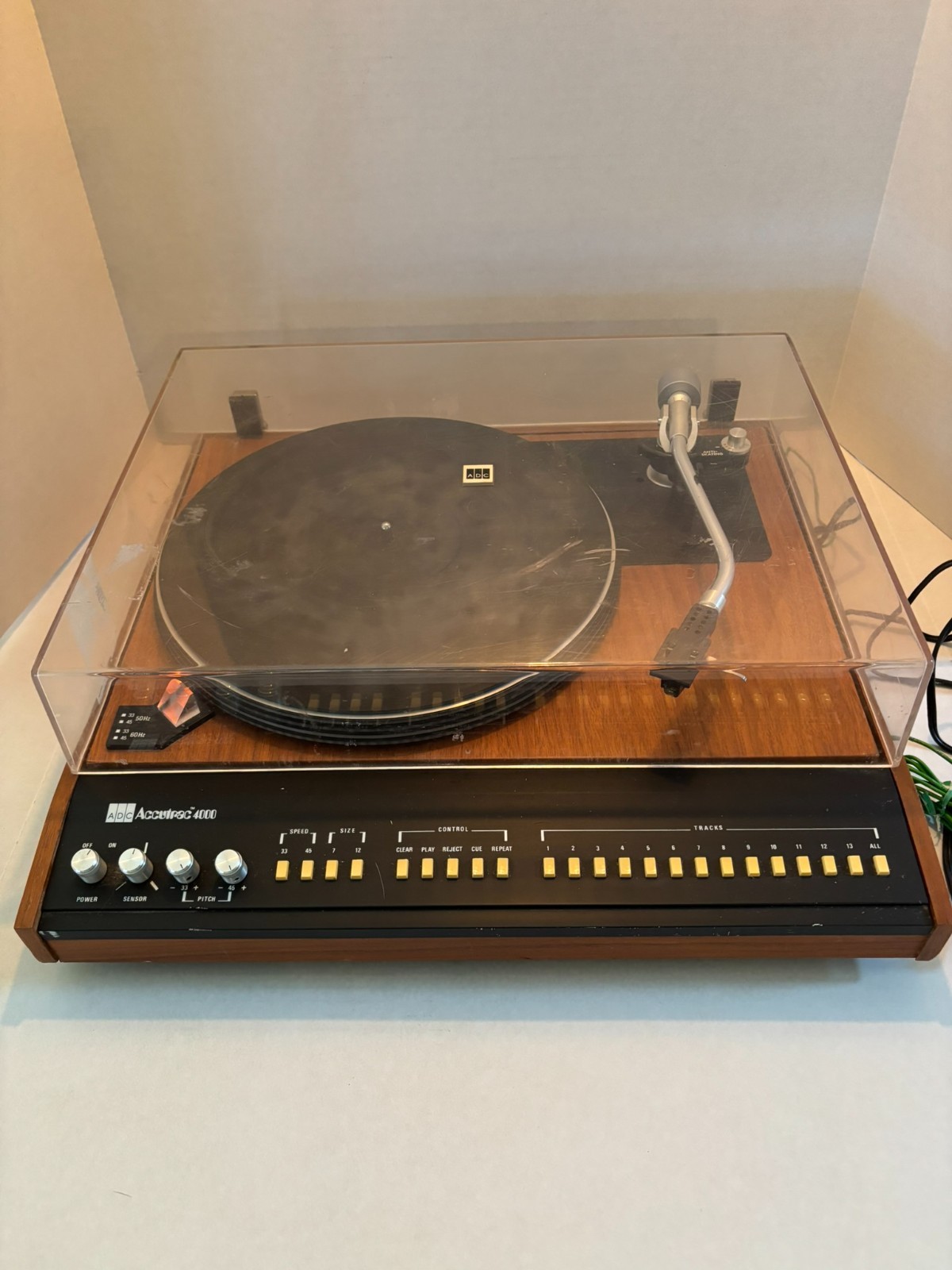
You don’t so much set up the ADC Accutrac 4000 as boot it up. The first time you press a button on that infrared remote and watch the tonearm glide silently to a specific groove, ignoring the rest of the record like a robot butler serving only the entrée you requested, you get it: this turntable isn’t trying to be better than your old belt-drive — it’s trying to be something entirely different. Launched in 1976, when “automatic” was the sexiest word in hi-fi marketing, the Accutrac 4000 wasn’t the first to promise computerized control, but it was the first to make it feel like magic. Its tagline — “Its mother was a turntable, its father was a computer” — wasn’t just clever advertising; it was a mission statement. And while Toshiba had dabbled in optical tracking a few years earlier, ADC, backed by British giant BSR, brought the concept to American living rooms with a full theatrical production: glowing receptors, memory banks, and a chrome “mushroom” receiver that looks like it could summon a UFO.
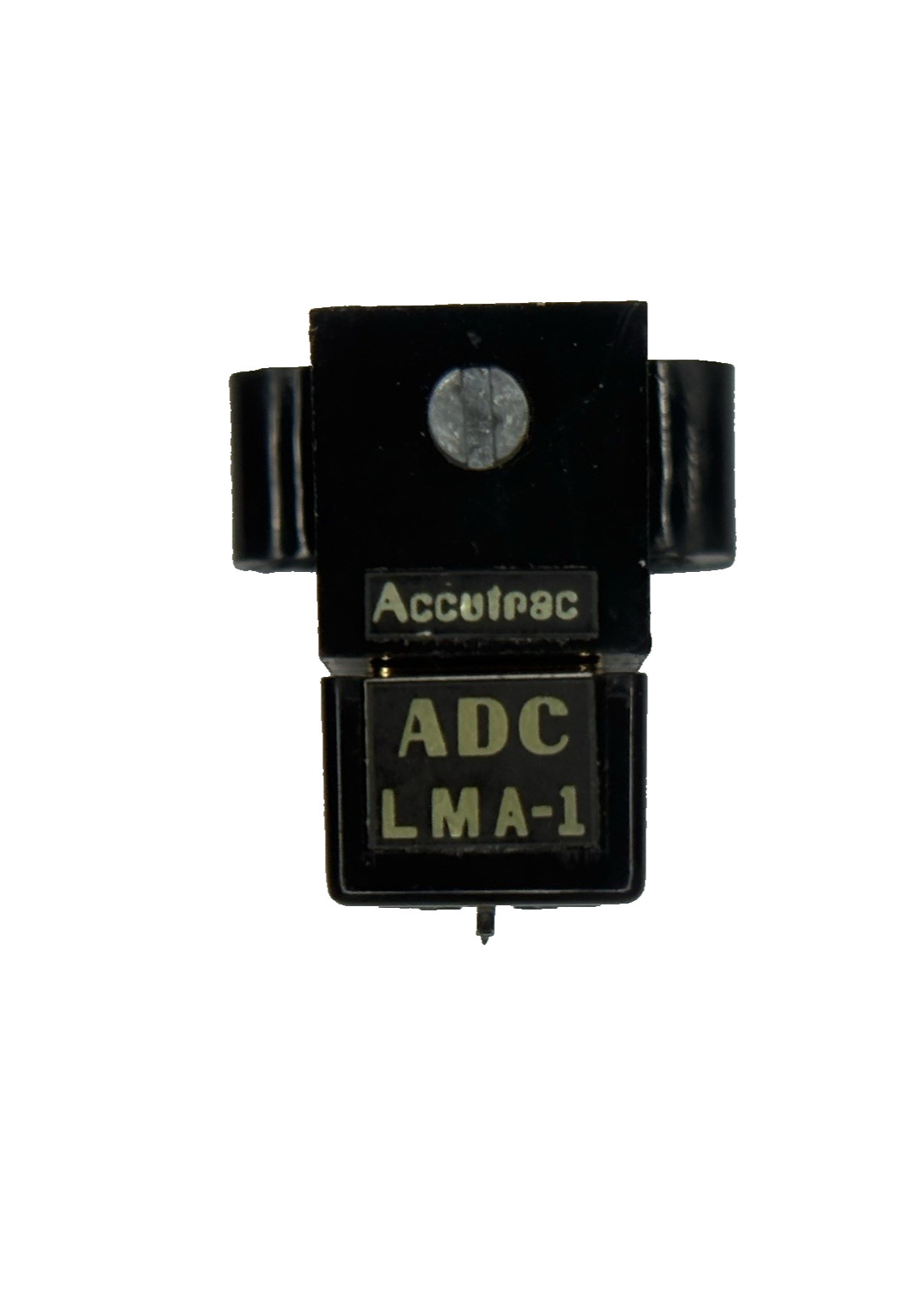
At 9 kilograms and nearly half a meter wide, the Accutrac 4000 doesn’t sneak into your rack — it announces itself. The wooden enclosure, all warm walnut and brushed steel, feels more 1970s console than precision deck, but that’s part of its charm. This is analog gear dressed in digital drag, a transitional artifact from the moment when audiophiles started wondering if their record players should be smart. And smart it was: capable of programming up to 24 track selections in any order, with repeat functions and full remote control. You could, in theory, curate a side-long playlist before dropping the needle — a novelty in an era when most people still flipped records manually. The direct-drive motor, a low-speed brushless unit, delivered rock-solid speed stability with wow and flutter under 0.03%, and the aluminum platter felt substantial without being overbuilt. But the real star was the LMA1 cartridge, an oddball moving magnet design with electro-optical groove detection — a system that used infrared light to “see” the spaces between tracks, allowing the arm to jump to specific songs without counting grooves mechanically.
Of course, “seeing” grooves sounds cooler than it works in practice. The system relies on the contrast between the shiny vinyl and the darker groove walls, which means it can struggle with heavily modulated passages, deep bass cuts, or records that aren’t perfectly clean. Dust or wear can confuse the sensor, leading to misreads or missed tracks. And while the specs boast a tracking force range of 0.75 to 1.5 grams — reasonable for the era — the LMA1 cartridge is not exactly a StylusTechnika. Its elliptical diamond stylus delivers decent clarity and separation (28 dB between channels), but it’s no match for the best cartridges of the late ’70s in terms of detail or dynamic range. Still, for what it does, it’s surprisingly musical. The frequency response stretches to 24 kHz, and with a 47 kOhm load, it plays well with most preamps of the time. It won’t knock your socks off with a well-recorded jazz trio, but it won’t embarrass itself either.
Specifications
| Manufacturer | Audio Dynamics Corporation (ADC); New Milford, CT |
| Production Years | 1976–1979 |
| Original Price | 140,000 ¥ (Japan, 1976) |
| Type | Two-speed direct drive turntable |
| Motor Drive System | Low-speed, brushless direct drive |
| Speeds | 33 1/3 rpm, 45 rpm |
| Full Speed Ahead | 2 seconds |
| Pitch Adjustment | ±5% |
| Platter | Aluminum alloy, dynamically balanced |
| Diameter | 30.64 cm |
| Weight | 1.4 kg |
| Wow & Flutter | < 0.03% (DIN 45507), ±0.042% (weighted) |
| Rumble | –70 dB (DIN 45539B), –50 dB (DIN 45539A) |
| Tonearm Type | “S” shaped, static compensation, decoupled counterweight |
| Effective Length | 237 mm |
| Overhang | 15 mm |
| Horizontal Friction | 5–7 mg |
| Vertical Friction | 5–7 mg |
| Offset Angle | 21° |
| Resonance | 8–10 Hz (with LMA1 cartridge) |
| Tracking Force | 0–4 g |
| Cable Capacitance | < 20 pF per channel, CD4 compatible |
| Cartridge | LMA1, low-weight, high-energy induction magnet |
| Output | 3.5 mV (5.5 cm/s) |
| Tracking Range | 0.75–1.5 g |
| Frequency Response | 10 Hz – 24 kHz (±2 dB) |
| Separation | 28 dB |
| Load Resistance | 47 kOhm |
| Stylus | Elliptical diamond (0.0003" x 0.0007") |
| Remote Control | Wireless infrared with confirming LED on receptor |
| Memory Bank | 24 track selections, programmable repeat |
| Dimensions (WHD) | 470 x 441 x 152 mm (18.5 x 17.4 x 6 inches) |
| Weight | 9 kg (19.8 lb) |
Key Features
The Mushroom That Listened
Sitting on the right front corner of the plinth like a chrome toadstool, the infrared receptor is the Accutrac 4000’s most unforgettable feature. It’s not just a receiver — it’s a confirmation system. When you press a button on the remote, the mushroom’s LED flashes, letting you know the command was received. This wasn’t just for show; in a pre-digital-feedback world, it was reassuring to know your track selection had registered. The remote itself, a sleek wand with a brushed metal finish, feels more like a TV clicker from the future than a hi-fi accessory. It controls everything: start, stop, track advance, programming, even pitch adjustment. No wires, no mechanical linkage — just invisible light zipping through the air. It’s the kind of thing that made people in 1977 feel like they were living in the future, even if the actual performance was a little more earthbound.
Optical Track Selection: Genius or Gimmick?
The LMA1 cartridge doesn’t just read the groove — it watches it. Using an infrared LED and sensor mounted in the headshell, it detects the transition between land and groove, counting spaces to determine track position. This allows the tonearm to move directly to a programmed track without physically scanning the record. It’s a clever workaround to the mechanical limitations of auto-changers, and it avoids the wear caused by back-cueing arms. But it’s not foolproof. Records with wide intro grooves, locked grooves, or deep bass passages can confuse the sensor. And if the lens gets dusty — which it will, given its exposed position — accuracy drops fast. Collectors report that cleaning the optical window with a cotton swab and isopropyl alcohol is essential for reliable operation. Still, when it works, it’s mesmerizing. The arm lifts, swings to a precise point, and drops — not randomly, but exactly where you told it to go. It’s not perfect, but it’s undeniably cool.
Build and Reliability: BSR’s Handprint
Though branded ADC, the Accutrac 4000 was built under BSR’s ownership, and that shows in the construction. The mechanism is robust, if not exactly precision-engineered. The direct-drive motor is quiet and stable, but the overall feel is more “appliance” than “instrument.” The wooden base gives it gravitas, but the internal layout is crowded, with little room for service access. The infrared system, while innovative, adds complexity — and potential failure points. The remote batteries can leak, corroding contacts, and the mushroom receptor’s wiring is delicate. Service technicians observe that the most common failures involve the motor control board and the optical sensor circuitry, both of which rely on aging capacitors and discrete transistors. A full recap is almost always recommended for units that have been stored for decades.
Historical Context
The mid-1970s were a golden age of automation in consumer audio. Turntable manufacturers raced to out-feature each other: auto-return, auto-lift, pitch control, even built-in cassette dubbing. ADC, founded by Peter Pritchard in the early ’60s and known for low-mass cartridge designs, was in a unique position. When BSR acquired the company in the mid-’70s, they gained access to ADC’s R&D while bringing their own manufacturing muscle. The result was the Accutrac 4000 — a machine that combined ADC’s cartridge expertise with BSR’s mass-production capabilities and a dash of Japanese engineering (Micro-Seiki reportedly contributed to the mechanism design). It arrived just as home computing was entering the cultural imagination, and the idea of a “computerized” turntable resonated. Competitors like Sony and Technics were focusing on speed accuracy and low rumble; ADC was selling a vision. The included demo LP, “Seeing Is Believing,” wasn’t just a test record — it was a manifesto. This wasn’t just a player. It was a promise.
Yet for all its ambition, the Accutrac 4000 didn’t dominate the market. It was expensive, bulky, and — let’s be honest — a little gimmicky. Audiophiles who cared about sound above all else gravitated toward the cleaner, more transparent decks from Japan. The Accutrac found a niche among tech enthusiasts and early adopters who valued novelty and convenience. A later model, the Accutrac +6, refined the concept with a more subdued design and optional six-disc changer, but the magic had faded. By the early ’80s, the dream of the “smart turntable” had given way to the CD.
Collectibility & Value
Today, the ADC Accutrac 4000 is less a high-end collectible than a conversation piece — a quirky relic from the dawn of digital control. Units in working condition with the remote and mushroom receptor intact typically sell for $150 to $300, though mint examples with the original demo LP can fetch more. Non-working units, especially those missing the remote, often go for under $100. The real value lies in completeness: the remote, the receptor, and the demo record are all key to maximizing resale. But buyers beware — this is not a plug-and-play vintage turntable. The LMA1 cartridge stylus is hard to find, though Jerry Raskin’s Audio is reportedly still supplying replacements (Silver for $30, Gold for $50). The internal electronics, especially the motor control and optical circuits, are prone to capacitor failure and transistor degradation. A full service — including recapping, cleaning the optical path, and checking the motor bearings — can easily cost $200 or more, depending on the technician.
What breaks? First, the capacitors. They’re old, and they leak. Second, the remote — batteries eat the contacts, and the IR LED can fail. Third, the optical sensor window gets dirty, leading to tracking errors. Fourth, the tonearm lift mechanism can become sluggish or sticky from dried lubricant. And fifth, the direct-drive motor, while generally reliable, can develop bearing noise if the unit was stored improperly. Before buying, insist on a video of the unit in operation: watch the arm move, test the remote, and listen for motor noise. If it powers on but doesn’t respond to commands, the control board is likely kaput. And if the arm drifts or misses tracks, the optical system needs cleaning or recalibration.
eBay Listings


As an eBay Partner, we earn from qualifying purchases. This helps support our independent vintage technology research.