ADC 303A (1964–1974)
A bookshelf speaker that never needed fashion approval — deep bass from a sealed box, alnico drivers, and a sound that aged like a well-kept secret.
Overview
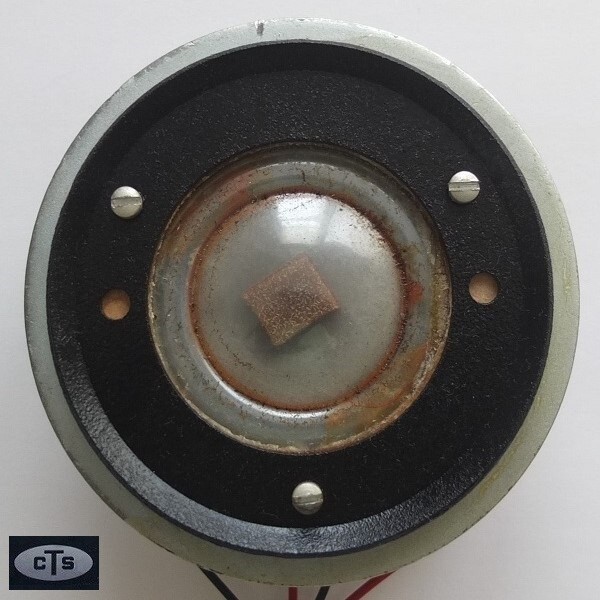
Pull one off the shelf and you feel it before you hear it — solid, dense, like lifting a dictionary bound in walnut. The ADC 303A doesn’t announce itself with flash or modern lines. It’s a squared-off box from 1964, the kind of speaker that spent decades in college-town living rooms, wired to tube amps and stacked beside dog-eared copies of Rolling Stone. But play it loud with Coltrane’s A Love Supreme, and that unassuming cabinet erupts with a bass response no sealed two-way should have any right to — tight, articulate, and diving deeper than the cabinet volume suggests. This isn’t bass boosted by port resonance or digital trickery. It’s the result of a 10-inch CTS alnico woofer, stiff surround, and a design that trusted physics over marketing. The midrange is clear without being clinical, and the tweeter — a CTS unit with doped cloth surround, not the later phenolic ring type — delivers crisp highs that don’t turn brittle at volume.
The 303A was never the most famous speaker of its era. It didn’t have the cult status of the AR-3a or the retail muscle of KLH. But it carved out a reputation among those who heard it: a serious alternative to high-end bookshelf monitors, built with components that were over-specified for the price. Acoustic Dynamics Corporation (ADC), based in New Milford, Connecticut, wasn’t trying to win design awards. They were building speakers that could keep up with live recordings, handle dynamic swings, and survive decades of use. And they did — so well that owners still report original woofers functioning flawlessly, even after 50 years, as long as they weren’t left in damp basements or exposed to rodent infestations.
Later iterations like the 303AX refined the formula with updated crossovers and minor tweaks, but the 303A remains the original statement. It competed directly with the AR-3a and Dynaco A-25, often undercutting them in price while delivering comparable — and in some cases, superior — bass extension. Unlike the acoustic suspension design of AR, which relied on air pressure in a sealed cabinet, the 303A used a more traditional sealed-box alignment but with a high-quality driver that could move serious air. The result was a speaker that didn’t need a subwoofer, even by modern standards, and could handle genres from chamber music to early rock with equal composure.
Specifications
| Manufacturer | Acoustic Dynamics Corporation (ADC) |
| Production Years | 1964–1974 |
| Model | 303A |
| Type | 2-way sealed loudspeaker system |
| Woofer | 10-inch CTS alnico magnet, paper cone, doped cloth surround |
| Tweeter | 1-inch CTS dome tweeter with doped cloth surround |
| Crossover Frequency | Approximately 2,200 Hz |
| Impedance | 8 ohms nominal |
| Power Handling | 60 watts continuous |
| Frequency Response | 45 Hz – 18,000 Hz (±3 dB) |
| Sensitivity | 88 dB (1 watt @ 1 meter) |
| Enclosure Type | Sealed (acoustic suspension alternative) |
| Cabinet Material | MDF with real walnut veneer |
| Dimensions (H×W×D) | 19.5 × 12 × 9.5 inches |
| Weight | 38 lbs per speaker |
| Grille | Fabric-covered foam with wood frame |
| Bi-wiring | No |
| Terminal Type | Single binding posts (original) |
| Country of Origin | United States |
Key Features
Alnico Drivers That Age Like Fine Tools
The 303A’s 10-inch woofer uses an alnico magnet — a rare find in mid-tier speakers of the 1960s, where cheaper ferrite magnets were becoming standard. Alnico offers a smoother magnetic field, faster transient response, and a more natural decay to notes. It also resists demagnetization over time, which is why so many original ADC woofers still perform like new. The cone is treated paper with a doped cloth surround, which remains pliable decades later if not exposed to UV light or extreme humidity. Unlike foam-rimmed drivers that disintegrate after 30 years, these CTS units often survive with only dust cap glue degradation — a simple fix. The tweeter, also from CTS, uses a soft dome with a cloth surround, avoiding the brittle phenolic ring tweeters that plagued later ADC models. This version delivers a smooth top end without the harshness that develops when phenolic rings crack or delaminate.
Sealed Cabinet With Surprising Bass Authority
At a time when many competitors were experimenting with ported designs or acoustic suspension, ADC stuck with a straightforward sealed enclosure. The 303A’s cabinet is tightly braced, heavily damped, and finished with thick MDF before the walnut veneer is applied. This construction minimizes panel resonance and allows the woofer to control bass without relying on port tuning. The result? Bass that starts deep — dipping to 45 Hz — and stays tight, even at high volumes. There’s no “one-note boom” common in ported designs, and no midbass bloat. It’s the kind of bass that works with pipe organ recordings or upright bass solos, not just rock backbeats. Owners report the speakers performing well even when placed close to walls, though they benefit from being pulled slightly into the room for optimal stereo imaging.
No-Nonsense Crossover With Serviceable Components
The crossover is a second-order design using air-core inductors and paper-in-oil capacitors — not the highest-end parts available, but durable and sonically transparent. The layout is simple, minimizing signal path and avoiding the complex networks that can degrade over time. One common issue: the original crossover capacitors, while robust, can drift in value after 50 years, leading to a slight imbalance in the tweeter output. Replacing them with modern polypropylene equivalents is a straightforward upgrade that restores clarity without altering the speaker’s character. The crossover is mounted directly to the terminal board, making access easy — unlike later models where gobs of damping compound seal it in place.
Historical Context
The ADC 303A emerged in 1964, just as high-fidelity audio was shifting from console radios to component systems. AR had popularized acoustic suspension with the AR-3, and KLH was selling thousands of Model Eight speakers through department stores. ADC positioned itself as a value-focused alternative with no-nonsense engineering. The 303A wasn’t sold through mass-market retailers; it was found in specialty audio shops, often alongside Scott, Fisher, and Marantz gear. It competed on performance, not branding, and built a loyal following among engineers, professors, and audiophiles who valued accuracy over hype.
By the early 1970s, ADC introduced the 303AX, which updated the crossover and tweeter design. But the original 303A remained in production until 1974, a testament to its enduring appeal. The company never chased the high-end market like AR or the mass market like Advent. Instead, it occupied a quiet middle ground — speakers that were built to last, sonically honest, and priced to move. They were used in university labs, broadcast booths, and home systems where reliability mattered. When the solid-state revolution hit, the 303A handled the transition well, pairing cleanly with both tube and transistor amplifiers without demanding excessive power.
Collectibility & Value
The ADC 303A trades in a quiet but steady market. Unlike the AR-3a, which commands auction prices over $1,000 per pair, the 303A remains accessible — not because it’s inferior, but because it never developed the same cult following. A pair in excellent cosmetic and functional condition typically sells for $400–$600. Heavily worn cabinets or units with replaced grilles drop to $250–$350. Fully restored pairs — with reconed woofers, recapped crossovers, and refinished cabinets — can reach $800, especially if original drivers are preserved.
The biggest threat to longevity isn’t the drivers — it’s the wood. The real walnut veneer is prone to water rings, scratches, and edge chipping. Refinishing is possible, but over-sanding can remove the original profile. More critically, some cabinets show signs of termite damage or moisture warping, especially in Southern or coastal climates. Always inspect the back panel and internal bracing before buying.
Electrical failures are rare but not unheard of. The most common issue is capacitor drift in the crossover, leading to a dull or recessed high end. Replacing the capacitors costs under $50 and takes a few hours. Woofers rarely fail, but if reconing is needed, services like CTS Recone or Speaker Hospital can restore them for $80–$120 each. The tweeter is less commonly replaced, but NOS CTS units occasionally appear on eBay.
When buying, listen for cone rub or rattles at low frequencies — signs of misalignment or loose parts. Check the terminal posts for corrosion, and ensure the grilles are intact. Original grilles are foam-backed fabric, and replacements often use inferior materials that affect high-frequency dispersion. Avoid models with replaced foam surrounds unless professionally done — many DIY foam kits degrade within five years.
eBay Listings
As an eBay Partner, we earn from qualifying purchases. This helps support our independent vintage technology research.
Service Manuals, Schematics & Catalogs
- Catalog (1989) — archive.org
- Catalog — archive.org