Acoustic Research AR-11 (1977)
Take the AR-10π, strip out the woofer servo, and what's left is the most honest speaker AR knew how to build.
Overview
The first thing you notice lifting one AR-11 onto a bookshelf is the mass. It weighs 22.6 kg, nearly fifty pounds of sealed cabinet. AR designed it to sit against a wall or a shelf rather than out in open space, and the manual says so. There's no port to chuff and no reflex tuning to second-guess. It's a 305 mm woofer pushing against 41.9 liters of trapped air, behaving the way the math predicts.
AR brought the AR-11 to market in 1977, though one reference dates actual production to around 1978, so treat the year as approximate. The company's own literature called it the most accurate speaker system Acoustic Research had ever made. That line appeared in Audio (August 1976, p.15) and got repeated in dealer advertising for years afterward. Read it as marketing. The design story underneath is more useful: the AR-11 shares its drivers and crossover with the AR-10π, and the only substantive difference is that the AR-11 omits the Woofer Environmental Control and the crossover components that support it. No motorized relays. No thermistors. Nothing to drift, stick, or fail decades down the road. What's left is a three-way, three-driver acoustic suspension system.
That omission defines the AR-11. Owners who've lived with both versions report the simpler speaker can sound more coherent, and the logic is plain enough: fewer parts in the signal path, fewer chances for coloration. The 1.5-inch hemispherical dome midrange - 38 mm - is the same unit found in the AR-3a, and collectors tend to single it out as the reason to own this speaker. Above it sits a newly designed 3/4-inch (19 mm) dome tweeter built on the high-frequency dome radiator AR introduced back in 1959. It has new diaphragm materials, a new voice coil, and revised construction that AR says extends response with greater efficiency and lower resonance than earlier versions. The company's documentation describes the combination as producing uniformly dispersed flat energy output to the highest audible frequencies. By most owner accounts, the drivers deliver on that.
Key Features
12-Inch Acoustic Suspension Woofer
The 305 mm woofer is a substantially improved version of the driver AR used to introduce acoustic suspension to home listeners in the first place. Free-air resonance sits at 18 Hz and the magnet assembly carries 200,000 maxwells of flux. Those numbers explain how a sealed box this size reaches a 42 Hz system resonance without a port. The 41.9-liter enclosure is the spring, and the trade is the familiar one: efficiency surrendered for control. Bass notes start and stop rather than lingering. The surround is foam, and it is the single most important thing to inspect on any pair under consideration.
AR-3a Dome Midrange and the 1959-Lineage Tweeter
The 38 mm hemispherical dome midrange is carried over from the AR-3a, and it's the driver AR collectors talk about first. Above it, the 19 mm dome highrange descends directly from AR's original 1959 dome radiator, rebuilt with new diaphragm materials and a redesigned voice coil. Per owner reports, the midrange stays lush without turning thick and the tweeter reaches up without turning harsh. One source goes further and calls the AR-11 midrange "magic," claiming it appeared in no other AR model. That's a single-source claim, so use caution, but spare 200010-1 dome mids do get scavenged from unsalvageable cabinets and resold on their own.
Three-Position Mid and High Level Switches
Two switches on the rear panel trim the midrange and highrange in 3 dB steps - 0, -3 dB, and -6 dB. Start flat in a normal room. The attenuation exists for reflective spaces with bare floors and hard walls, where the top end can get ahead of itself. It's a crude tool by modern standards, but it's a mechanical one, and mechanical switches can be cleaned rather than replaced. Owners note they get noisy with age, and a dose of contact conditioner usually settles them.
Half-Section LC Crossover with Air-Core Chokes
The crossover is a half-section LC network using air-core chokes and computer-grade electrolytic capacitors, with resistive attenuation feeding the mid and high drivers. Air-core inductors avoid the saturation behavior of iron-core parts, and the topology is simple enough that a competent tech can service it. The electrolytics are the weak point after several decades. If a pair sounds dull or flat, dried capacitors are the usual suspect, and recapping is a common and well-documented maintenance step.
Precision-Machined Foam Grille
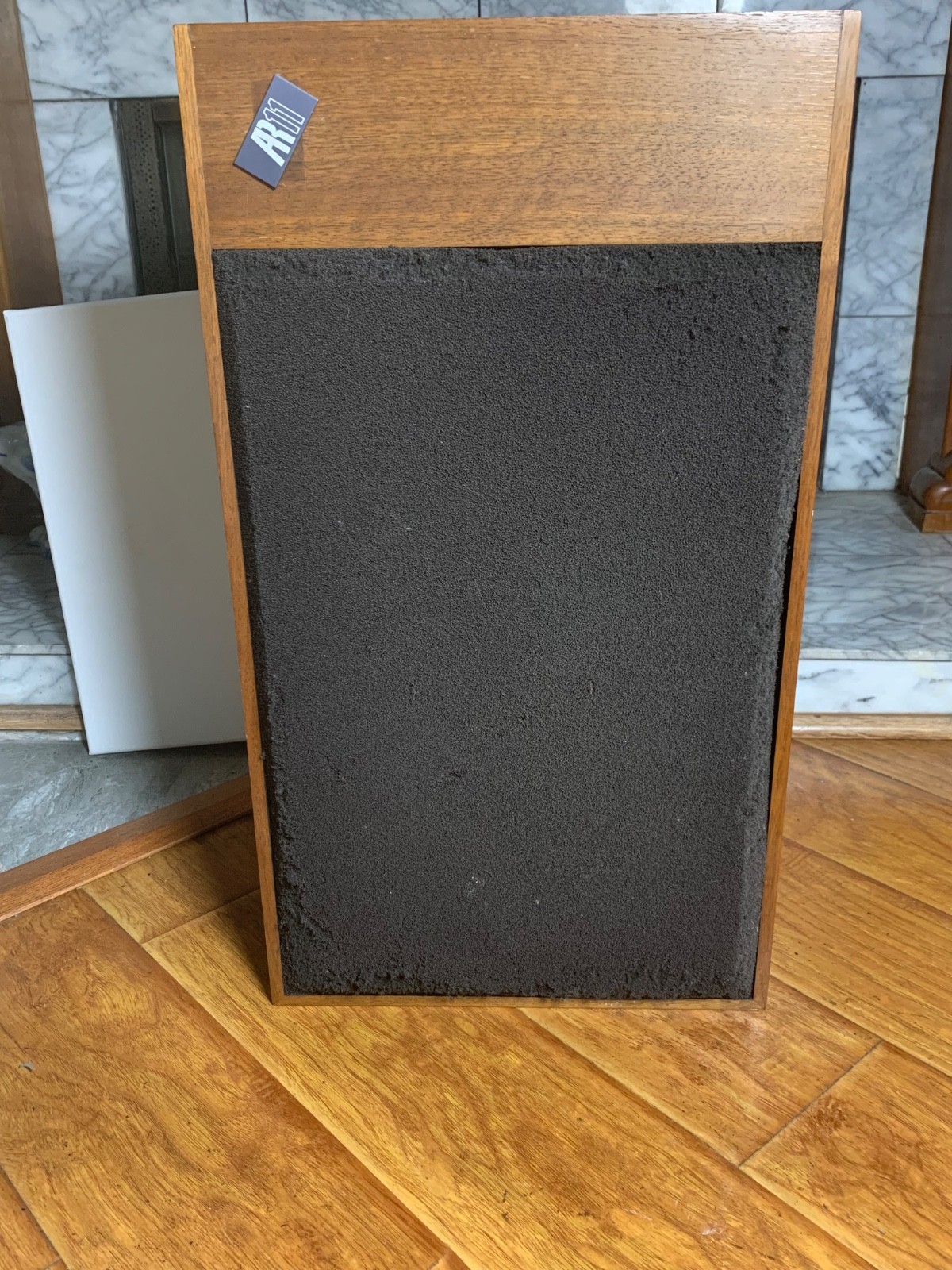
The grille is a removable precision-machined foam panel, chosen for near-perfect acoustical transparency. The AR-11 shares this detail with the AR-10. It isn't cosmetic. Foam that transparent lets you leave the grille on without paying for it in the treble, which is more than can be said for a lot of fabric-and-frame designs of the period. Original grilles in good condition are worth preserving. Replacements exist but rarely match.
Historical Context
The AR-11 landed in 1977 into a market full of large, inefficient horns and boomy bass-reflex boxes. AR's answer was to keep refining the sealed-box approach it had pioneered and position the AR-11 as the passive counterpart to the AR-10π, which used electronic room correction instead. Same drivers, same crossover philosophy.
At roughly $1,200 per pair in 1977, the AR-11 was not a casual purchase. The competition it was measured against included the JBL L100, which was flashier and louder but less accurate; the KLH Model Eleven, a similar sealed design that most listeners found less refined; and the Advent Large, which took a transmission-line approach. None matched the AR-11's combination of measured flatness, build quality, and long-term reliability, which is why the speaker still has a following. AR backed the workmanship and performance with a five-year guarantee.
Collectibility & Value
These speakers are approaching fifty years old, and the foam surrounds on the woofers degrade. Refoaming isn't optional. A pair with original, deteriorating foam will rattle, lose bass, and can damage the drivers if pushed. Professional refoaming runs roughly $300 - $500 per pair through shops like Millersound or Audio Classics, and that cost belongs in any purchase math.
Unrestored pairs trade around $400 - $700, which is a project, not something to play right away. Fully refoamed working pairs with clean cabinets land in the $1,200 - $1,800 range, and exceptional examples - original finish, no repairs, upgraded internal wiring - can reach $2,200. External market data points cluster lower: a $650 Reverb sale in December 2025 and a $750 Audiogon listing. The walnut veneer is thin and the corners chip easily, so inspect cabinet edges closely. Check for spider degradation by gently pressing the center of the cone. There should be no scraping or rubbing. Never buy untested, ask for sound clips, and verify the foam is fresh.
Matching amplification matters. At 86 dB efficient and 4 ohms, the AR-11 wants current. A solid 50-plus watts per channel of good solid-state is the safe pairing, and tube amps work only if they're current-capable. One reference quotes power handling at 100 W with a recommended amplifier range of 25 to 225 W, a single-source figure worth hedging. Parts surface occasionally - used 200010-1 dome mids, NOS 1200084AB tweeters, crossover boards and inductors - so a damaged driver isn't necessarily a death sentence.
eBay Listings


As an eBay Partner, we earn from qualifying purchases. This helps support our independent vintage technology research.