Acoustic Research LST (1972–1979)
The moment you hear one, you understand why engineers once called it “the ruler” — clinical, revealing, and utterly unforgiving in a way only the best studio monitors can be.
Overview
Standing in front of a pair of Acoustic Research LSTs feels like stepping into a control room that time forgot — not because they look flashy, but because they demand attention through sheer presence and purpose. These aren’t speakers built to disappear into your living room; they’re lab instruments disguised as loudspeakers, hewn from dense particleboard with angled baffles that slice through reflections like a surgeon’s blade. When AR introduced the LST in 1972, they weren’t chasing audiophiles with deep pockets — they were giving broadcast studios, mastering engineers, and serious researchers a reference tool so accurate it bordered on cruel. This wasn’t about warmth or euphony. It was about truth, even if the truth hurt your favorite recordings.
The LST sits at the absolute apex of Acoustic Research’s golden era, a period when Edgar Villchur and Henry Kloss had already rewritten the rules of acoustic suspension and direct-radiating drivers. Where the AR-3a became the darling of home listeners for its balanced, lifelike midrange, the LST took that DNA and pushed it into uncharted territory. It uses the same 12-inch acoustic suspension woofer as the 3a, but instead of one midrange and one tweeter, it multiplies them — four 1.5-inch hemispherical midrange radiators and four 0.75-inch tweeters, arranged in a tightly packed array across the front baffle. The result? A massive increase in power handling, dispersion control, and dynamic headroom. It’s like taking the 3a’s voice and giving it a megaphone powered by precision.
But the real magic — and the real challenge — lies in its six-position spectral energy switch. This isn’t a tone control or a preset EQ. It’s a calibrated, passive network that adjusts the overall tonal balance of the speaker to match different acoustic environments or program material. Think of it as a primitive but effective room compensation system, decades before digital room correction became commonplace. Flip it to “Bright,” and the upper mids snap into focus like a microscope dialing in. Switch to “Bass Boost,” and the 12-inch woofer digs deeper with surprising authority for an acoustic suspension design. Each setting changes the character just enough to make you question whether your amplifier, your room, or your ears are the weak link.
Specifications
| Manufacturer | Acoustic Research |
| Production Years | 1972–1979 |
| Original Price | $600 per pair (equivalent to ~$4,500 today) |
| System Type | Three-way, acoustic suspension |
| Woofer | 1 x 12-inch acoustic suspension woofer (same as AR-3a) |
| Midrange | 4 x 1.5-inch hemispherical radiators |
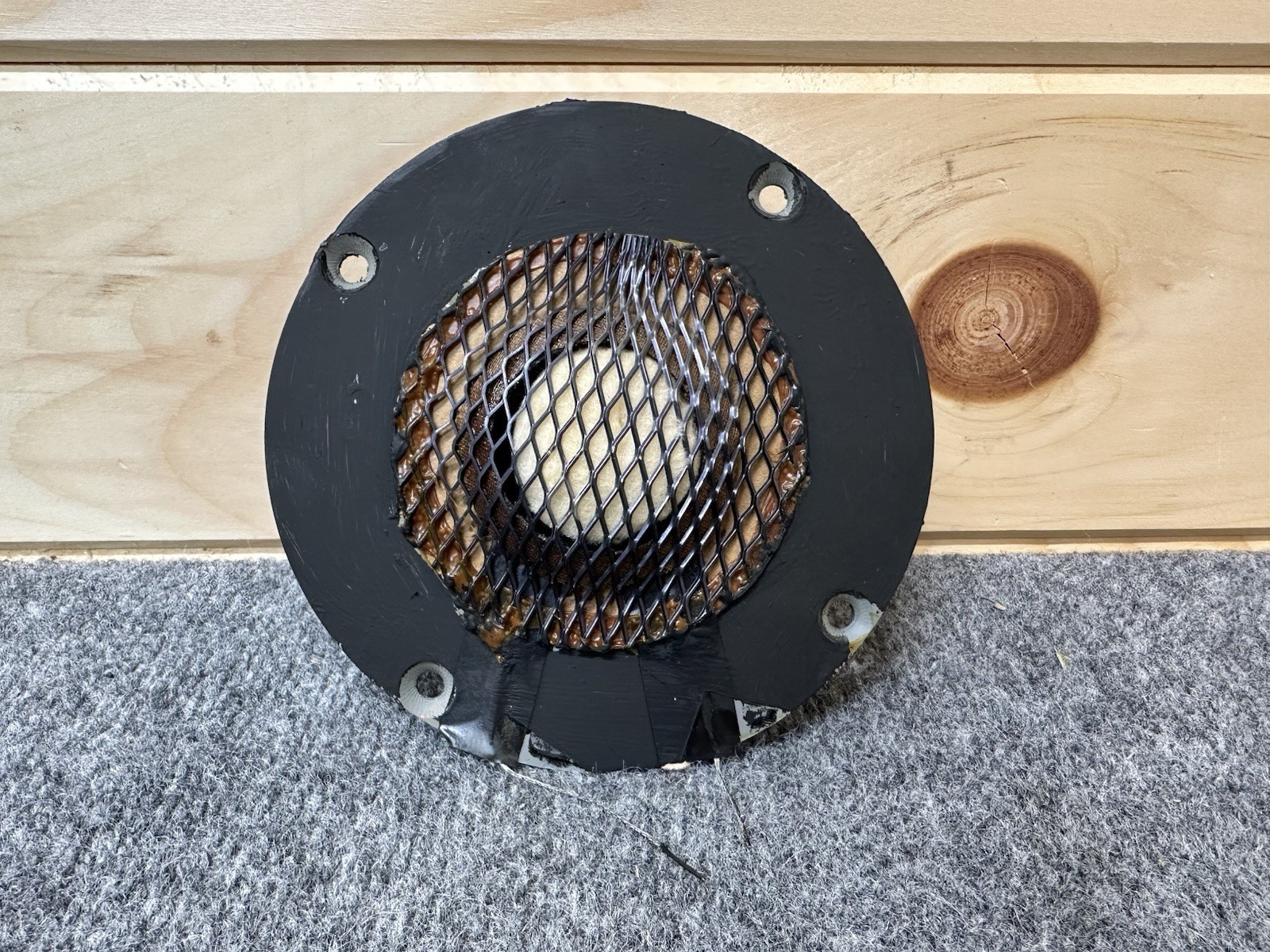
| Tweeter | 4 x 0.75-inch hemispherical tweeters |
| Frequency Response | 45 Hz – 18 kHz (±3 dB) |
| Power Handling | 100 watts (continuous) |
| Sensitivity | 88 dB (1W/1m) |
| Crossover Frequencies | 500 Hz (woofer/midrange), 3.5 kHz (midrange/tweeter) |
| Impedance | 8 ohms nominal |
| Dimensions (H×W×D) | 27 × 20 × 9.75 inches |
| Weight | 90 lbs (40.8 kg) per speaker |
| Grille | Fabric-covered foam, removable |
| Enclosure Material | Particleboard with walnut veneer |
| Connections | Single pair of 5-way binding posts |
| Adjustments | 6-position spectral energy switch on rear panel |
Key Features
A Reference Built to Measure
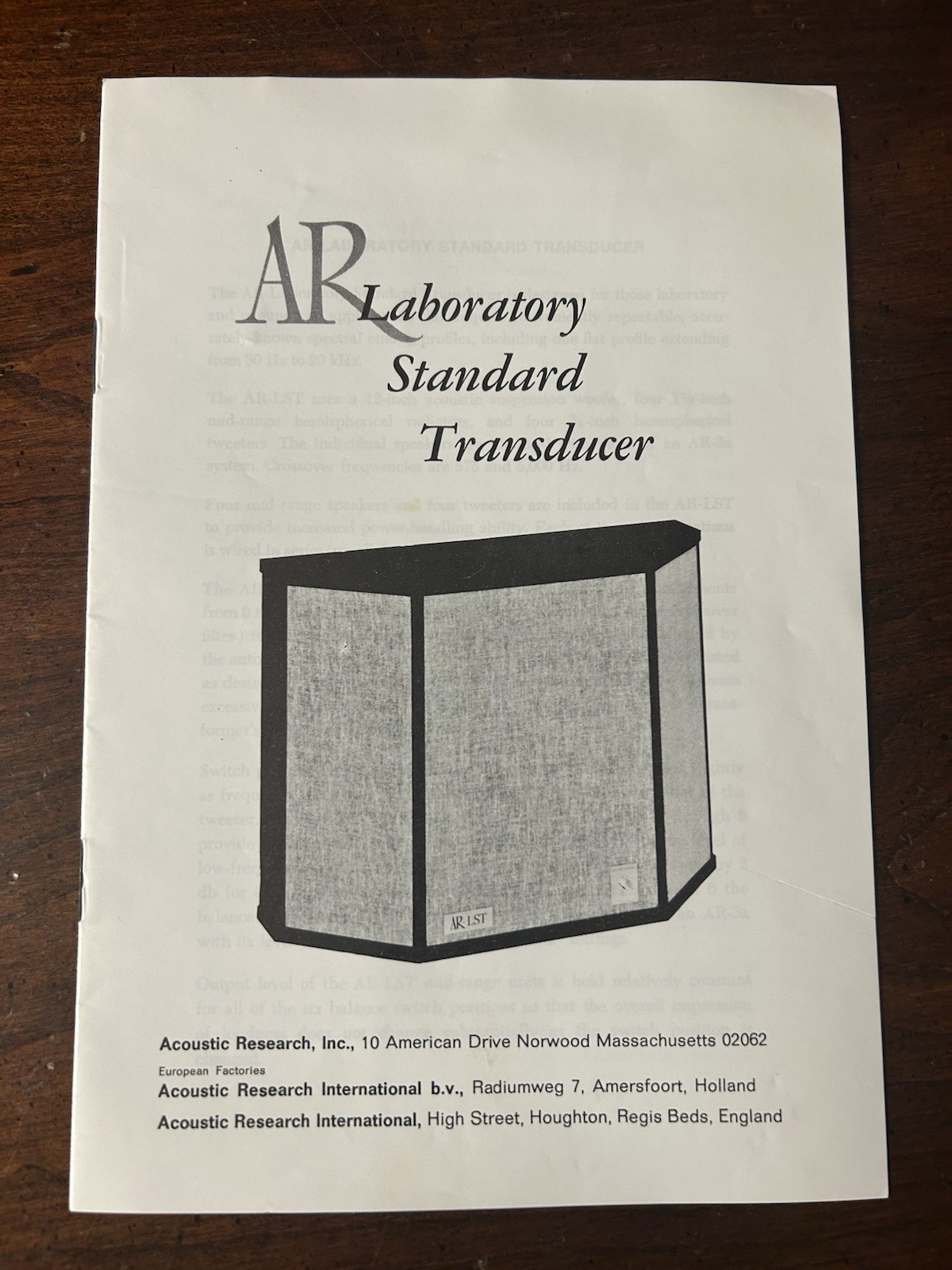
The LST wasn’t marketed as a luxury item — it was sold as a measurement-grade transducer, hence the full name: Laboratory Standard Transducer. That’s not marketing fluff; it’s a mission statement. AR designed these to be used in environments where consistency and neutrality mattered more than emotional impact. Broadcast stations, university acoustics labs, and high-end mastering facilities adopted them because they revealed flaws in recordings and electronics that other speakers glossed over. If a mix had a muddy low midrange or a harsh 6 kHz spike, the LST would expose it instantly. That made them unpopular with some producers, but revered by those who needed to hear exactly what they were working with.
Modular Driver Array
The decision to use multiple small midrange and tweeter drivers instead of single larger ones wasn’t just about power handling — though that was a major benefit. It was also about dispersion control and reducing distortion. By spreading the acoustic load across four midranges and four tweeters, each driver operates at lower excursion and thermal stress, allowing the system to play louder with less compression. The hemispherical diaphragms, made of doped paper with a phase plug, are rigid and well-damped, minimizing breakup modes that plague conventional domes. The tight vertical array also creates a more coherent wavefront, improving off-axis response — a rare consideration in consumer speakers of the era.
Spectral Energy Switch
Mounted on the rear panel, the six-position switch is one of the LST’s most distinctive and misunderstood features. Each setting applies a different passive EQ curve, altering the balance between bass, midrange, and treble. The positions are labeled with functional names like “Flat,” “Bass Boost,” “Treble Cut,” and “Voice,” allowing users to tailor the speaker’s response to room acoustics or content type. In a small, reflective space, “Treble Cut” might tame brightness. In a dead room, “Bright” could restore air. It’s not a substitute for proper room treatment, but it’s a remarkably effective analog solution for real-world listening environments — especially in an era when few people measured their rooms or used equalization.
Historical Context
The early 1970s were a turning point for high-fidelity audio. Quadraphonic sound was hyped as the next big thing, multitrack recording was becoming standard in studios, and the demand for accurate monitoring equipment was rising. Competitors like JBL (with the 4310 and 4311) and Altec (with the 604 and 605) dominated professional spaces with horn-loaded designs that were efficient but often colored. AR took a different path — one rooted in the acoustic suspension principle that had made their name in the 1950s. The LST was the culmination of that philosophy: a full-range, direct-radiating speaker with flat response, low distortion, and wide dispersion, all without horns or exotic materials.
It arrived at a time when AR was still revered but beginning to feel pressure from newer, flashier brands. The LST wasn’t meant to outsell the AR-3a — it was meant to outperform it in every technical metric. And it did. But its $600 price tag (over $4,000 today) put it out of reach for most consumers, and its clinical sound didn’t charm casual listeners the way the 3a did. As a result, production numbers were low, and the LST remained a niche product — rare even in its heyday. Roy Allison, the engineer behind many of AR’s greatest designs, reportedly left the company shortly after the LST-2 launched, going on to found his own brand. That transition marked the end of AR’s engineering golden age.
Collectibility & Value
Today, the LST is one of the most sought-after AR models among serious collectors and studio restoration enthusiasts — not because it’s flashy, but because it represents the peak of AR’s engineering ambition. Finding a pair in good condition is difficult; many were used hard in professional settings, and their weight and size made them prone to cabinet damage during moves. Original grilles are especially rare, often lost or damaged over time.
Market prices reflect their scarcity. A well-maintained pair typically sells between $1,800 and $2,800, with fully restored examples — including reconed woofers, refreshed foam surrounds on midranges, and cleaned terminals — commanding $3,000 or more. These aren’t speakers to flip for profit; they’re long-term projects for owners who value accuracy over nostalgia. Service technicians observe that the woofers are the most common failure point — the foam surrounds degrade after 40+ years, and replacement reconing requires skilled hands. The midrange and tweeter arrays are generally more durable, but water damage or prolonged exposure to sunlight can delaminate the hemispherical diaphragms.
Buyers should inspect the spectral energy switch carefully — decades of use can lead to crackling or intermittent connections. Cleaning the switch with contact cleaner often helps, but replacement parts are not readily available. Rewiring with modern cable is common, as the original cloth-covered wire can become brittle. Despite their age, the LSTs respond well to careful restoration, and many owners report that a full service brings them back to — or even beyond — their original performance.
eBay Listings


As an eBay Partner, we earn from qualifying purchases. This helps support our independent vintage technology research.