Acoustic Research AR-5 (1968–1971)
A speaker that splits the difference with soul—bass that breathes deep, mids that speak plainly, and highs that shimmer without sting.
Overview
Turn the lights down, cue up a late-night jazz trio, and let the AR-5s fill the room with something that feels less like playback and more like presence. These aren’t flashy boxes built to impress at a glance—they’re serious listening instruments from the golden age of acoustic engineering, when Edgar Villchur’s vision of accurate, uncolored sound still drove every design decision at Acoustic Research. The AR-5 arrived in 1968 as a deliberate compromise, but not a cheap one: it was engineered to satisfy listeners who admired the legendary AR-3a’s refinement but found its bass-heavy balance overwhelming, or who balked at its premium price. Priced at $430 a pair—nearly $3,500 in today’s money—it landed squarely between the modest AR-2ax and the flagship AR-3a, offering 80% of the top model’s magic at 60% of the cost.
What makes the AR-5 special isn’t just what it borrowed, but how it recombined. It uses the same sophisticated second-order crossover network as the AR-3a, a design known for its smooth handoffs and phase coherence. The midrange and tweeter are essentially the same hemispherical dome units found in the AR-3a—38mm (1.5") for the mid and 19mm (0.75") for the highs—giving it that signature AR clarity and dispersion. But instead of the AR-3a’s 12-inch woofer, the AR-5 steps down to a 10-inch acoustic suspension driver, shared in concept with the AR-2ax but with subtle refinements in cone formulation and suspension. The result? Bass that extends down to 56Hz in-room—respectable for its size—with the taut, articulate quality of acoustic suspension, but without the overhang that could make the AR-3a feel bloomy in smaller spaces.
Owners often describe the AR-5’s sound as “honest” or “unforced.” There’s no hyped upper midrange to grab attention, no artificial sparkle in the highs. Instead, vocals emerge with startling immediacy, string instruments carry weight and texture, and piano notes decay with natural damping. It’s a speaker that doesn’t shout, but compels you to lean in. And unlike many vintage designs that age into brittleness or dullness, the AR-5’s balance has aged remarkably well—partly because it was never extreme to begin with.
Specifications
| Manufacturer | Acoustic Research |
| Production Years | 1968–1971 |
| Original Price | $430 per pair (1968 USD) |
| Speaker Type | 3-way acoustic suspension |
| Woofer | 254mm (10") cone, acoustic suspension |
| Midrange Driver | 38mm (1.5") hemispherical dome |
| Tweeter | 19mm (0.75") hemispherical dome |
| Impedance | 8 ohms nominal |
| Recommended Amplifier Power | 20–100 watts |
| Crossover Frequencies | 650 Hz, 5000 Hz |
| Frequency Response | 56 Hz – 18,000 Hz (in-room) |
| Woofer Resonance (Free Air) | 26 Hz |
| Enclosure Volume | 38.2 liters (1.35 cu ft) |
| Dimensions (W×H×D) | 343 × 610 × 292 mm (13.5 × 24 × 11.5 in) |
| Weight | 17.8 kg (39 lb) per speaker |
| Controls | Midrange and high-frequency level adjustments on rear panel |
| Grille | Fabric-covered foam, removable |
| Country of Manufacture | United States |
Key Features
The AR-3a’s Brains in a Leaner Body
The AR-5’s most significant engineering inheritance is its crossover. While many manufacturers of the era used simple first-order filters to save cost, AR stuck with a more complex second-order design that improved driver integration and reduced phase distortion. This is the same network used in the AR-3a, which contributed to its reputation for transparency. Combined with the identical dome midrange and tweeter, this gives the AR-5 a top-end character that’s remarkably close to its more expensive sibling. The difference shows up in dynamics and bass authority, but not in tonal balance—so if you loved the AR-3a’s mids and highs but wanted something more agile, the AR-5 delivered.
Driver-Level Controls: Rare for the Era
On the rear panel, two recessed dials allow adjustment of both midrange and high-frequency output—a feature almost unheard of on consumer speakers in the late ’60s. These aren’t tone controls that affect the entire signal; they’re passive attenuators that let you tailor the balance to your room or preference. Too much presence in a reflective space? Dial back the midrange. Tweeter sounds bright with certain amplifiers? Take it down 2dB. This level of refinement suggests AR expected these speakers to be used in serious listening environments, not just as furniture-fillers. Service technicians observe that these controls can develop scratchiness over time due to oxidized contacts, but they’re generally repairable with contact cleaner and careful disassembly.
Acoustic Suspension Done Right
The 10-inch woofer uses the same air-spring principle that made AR famous: a sealed cabinet where the compliance of trapped air acts as the primary restoring force for the cone. This eliminates the need for a stiff mechanical suspension, allowing for greater cone excursion and lower distortion at low frequencies. The trade-off is reduced efficiency—around 86 dB/W/m, which means they need a decent amplifier to shine—but the payoff is bass that starts and stops precisely, without the overhang common in ported designs. The woofer’s cone is made from a low-vacuum formed paper composite, a technique AR refined to improve stiffness and damping. While not as deep as the AR-3a’s 12-inch unit, the 10-inch driver in the AR-5 is often described as more “musical”—tighter, quicker, and better integrated with the midband.
Historical Context
The AR-5 emerged at a pivotal moment. By 1968, the audio world had fully embraced acoustic suspension, a technology AR pioneered with the AR-1 in 1954. Competitors like KLH, Advent, and ESS were all building on Villchur’s original patent, though AR still held the reputation for refinement. The late ’60s also saw a shift in listener preferences: more people were setting up dedicated stereo systems in smaller living rooms, where the massive AR-3a could feel overwhelming. The AR-5 answered that need—a speaker that retained AR’s engineering integrity but scaled it for real-world spaces.
It also arrived just before the hi-fi boom of the 1970s, when brands like JBL, Bose, and Pioneer would flood the market with flashier, more colorful designs. The AR-5, by contrast, was understated—no wood veneer options beyond the standard walnut, no chrome trim, no gimmicks. It competed not with showpieces, but with serious alternatives like the KLH Model Eight or the Advent Large. Reviewers at the time noted its neutrality, often comparing it favorably to far more expensive systems. One 1970 test by a major consumer magazine found it outperforming several $600+ speakers in imaging and midrange clarity—no small feat.
Collectibility & Value
Today, the AR-5 occupies a sweet spot in the vintage speaker market: respected but not overhyped, desirable but not unobtainable. Unrestored pairs in working condition typically sell for $100–$150, while fully refurbished units with refoamed surrounds, new crossover capacitors, and cleaned grilles can fetch $200–$300. That’s a fraction of the $1,000+ prices commanded by original AR-3as, making the AR-5 one of the best value entries into vintage AR sound.
But like all vintage speakers, condition is everything. The foam surrounds on the woofers are the single most common failure point—deteriorating into dust after 50 years, leading to flapping cones and distorted bass. Refoaming is a standard restoration procedure, costing $60–$100 per speaker if done professionally. The original crossover capacitors, typically Mallory or CE components, are also prone to drift in value or fail outright, which can dull the highs or unbalance the drivers. Replacing them with modern film capacitors is strongly recommended, even if the speakers still “work.”
When buying, check for more than just sound. Look for cabinet integrity—AR’s walnut veneer is thin and prone to chipping, especially on the edges. Original grilles are often missing or damaged; while replacements exist, they lack the correct texture and badge styling. The rear-panel controls should turn smoothly; if they crackle, they’ll need servicing. And listen critically: a healthy AR-5 should sound open and balanced, not muddy or thin. If the bass is weak even after volume is cranked, the woofers are likely shot.
For those restoring AR-5s, parts are relatively accessible. The dome drivers rarely fail and are still supported by specialist vendors. Crossover schematics are widely available, and the layout is simple enough for intermediate DIYers. Some collectors note that later production runs used slightly different capacitor values, so matching original specs matters for authenticity. But unlike rare Japanese or European models, the AR-5 doesn’t suffer from parts famine—its service ecosystem is alive and well.
eBay Listings

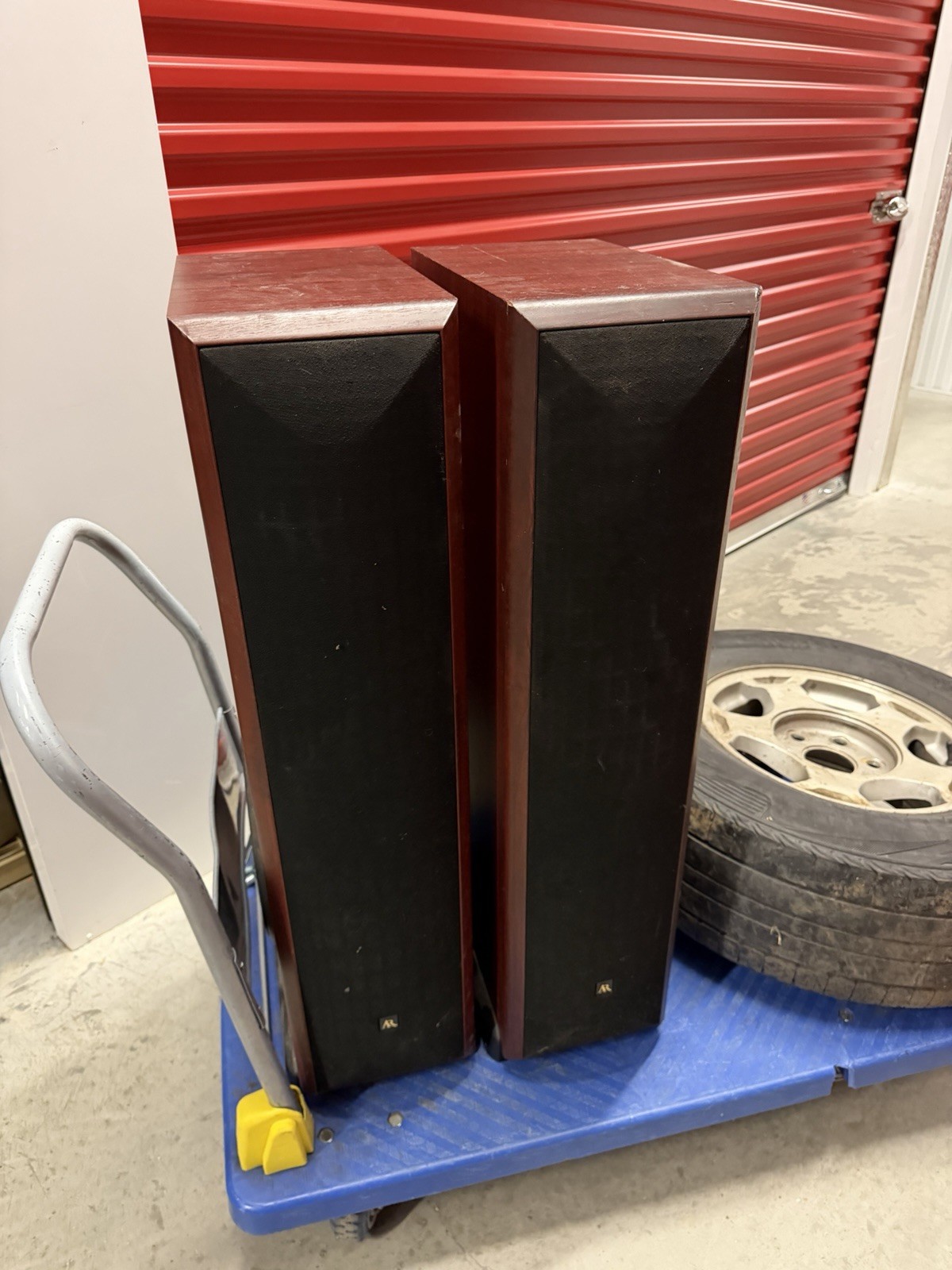

As an eBay Partner, we earn from qualifying purchases. This helps support our independent vintage technology research.