Acoustic Research AR-4x (1966–1973)
They don’t rattle, they don’t distort, and if you close your eyes, you might forget you’re listening to a 55-year-old bookshelf speaker.
Overview
There’s a moment, about ten seconds into “Aja” on a well-restored AR-4x, when the upright bass walks in and your neck hairs lift—not because it’s loud, but because it’s real. The note hangs in the air like it was recorded yesterday, taut and woody, with none of the bloated resonance or flapping you’d expect from a speaker this age. That’s the magic of acoustic suspension done right: no port, no gimmicks, just a sealed box and a woofer suspended in air pressure, behaving with a discipline most modern speakers still can’t match. The AR-4x wasn’t the first to do this, but it was the one that made it accessible. Introduced in 1966 as a refinement of the wildly popular AR-4, it took everything that worked—the tight bass, the clean midrange—and quietly fixed what didn’t, mainly by upgrading the tweeter and adding a high-frequency level control. This wasn’t a flashy move. No chrome, no radical redesign. But for a generation of listeners who cared more about transparency than showmanship, it was enough.
Positioned as the entry point to Acoustic Research’s “classic” line, the AR-4x sat below the AR-5 and AR-6, but above the tiny AR-2ax. It wasn’t the flagship, but it was arguably the sweet spot—big enough to deliver real bass extension, small enough to tuck into a bookshelf or console. At a time when most bookshelf speakers were either tinny or boomy, the AR-4x split the difference with clinical precision. It didn’t try to impress; it tried to disappear. And in a good system, it did. Unlike many of its contemporaries, which leaned on ported designs to fake low-end punch, the AR-4x earned its bass honestly. The 8-inch woofer, paired with a 0.654 cubic foot sealed cabinet, could reach down to 45 Hz with minimal distortion—a feat in the mid-60s. It wasn’t going to shake drywall, but it didn’t need to. What it delivered was accuracy: a bass response that was tight, articulate, and shockingly linear for its size.
The 2.5-inch paper cone tweeter was a significant step up from the AR-4’s original high-frequency driver. While still modest by today’s standards, it offered smoother dispersion and better integration with the woofer, especially in the critical crossover region around 1.2 kHz. That low crossover point is key—it keeps the bulk of the midrange in the woofer’s domain, where cone breakup is less of an issue, and lets the tweeter handle only the top octave. The result is a power response that stays coherent across a wide listening area, avoiding the “beaming” effect that plagued so many two-way designs of the era. The high-frequency level control on the rear panel lets you dial in brightness to taste, a thoughtful touch for rooms with reflective surfaces or aging ears. It’s not a tone knob in the cheap sense; it’s a precision trim, and when set right, it makes the speaker vanish into the music.
Specifications
| Manufacturer | Acoustic Research |
| Production Years | 1966–1973 |
| Original Price | ¥38,000 (1967, Japan); $29,500 (1973, Japan, per unit) |
| Model Type | 2-way, 2-speaker, acoustic suspension, bookshelf |
| Woofer | 20 cm (8 in) cone type |
| Tweeter | 6 cm (2.5 in) cone type |
| Frequency Response | 45 Hz – 20 kHz |
| Impedance | 8 Ω |
| Allowable Input | 15W RMS or more (per channel) |
| Crossover Frequency | 1.2 kHz |
| Cabinet Volume | 0.654 ft³ (18.5 L) |
| Enclosure Type | Acoustic suspension (sealed) |
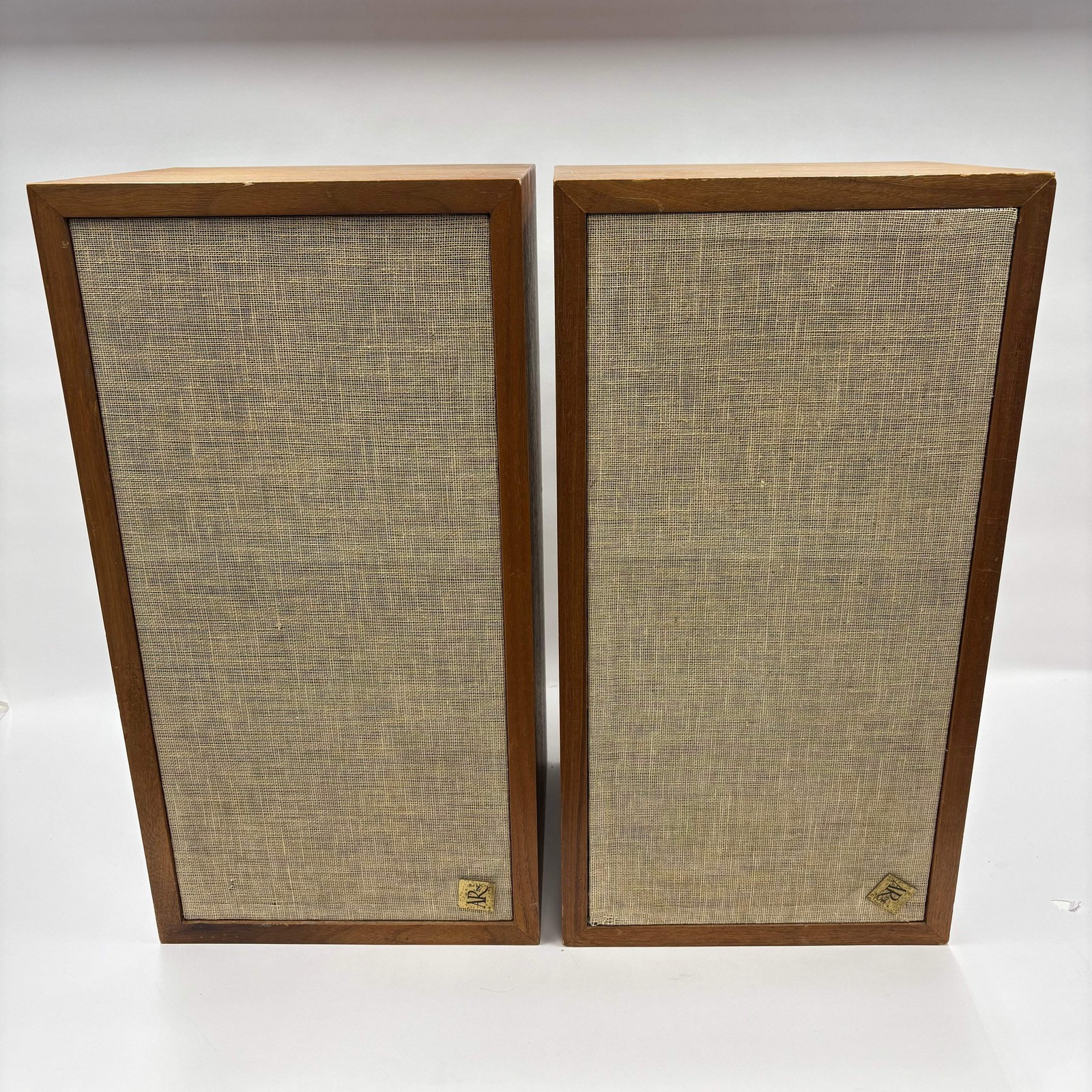
| Dimensions (W×H×D) | 254 × 483 × 229 mm (10 × 19 × 9 in) |
| Weight | 8.4 kg (18.5 lbs) |
| Finish | Walnut oil finish, wood veneer |
| Grille | Fabric cover, removable |
| High-Frequency Control | Adjustable level on rear panel |
| Driver Surrounds | Cloth (woofer), paper (tweeter) |
Key Features
The Sealed Box That Changed Everything
Acoustic suspension wasn’t invented by Acoustic Research, but they perfected it for mass production. The AR-4x’s sealed cabinet eliminates the port noise and tuning limitations of bass-reflex designs, relying instead on the stiffness of trapped air to control cone movement. This means the woofer doesn’t “bottom out” easily, even at low frequencies, and harmonic distortion stays low. It also means the speaker is less sensitive to room placement—no need to pull it away from the wall to “breathe.” The trade-off is efficiency: these speakers are rated around 84 dB/W/m, which isn’t loud by modern standards. They won’t wake the neighbors with a 10-watt tube amp, but they don’t need brute force either. A clean 25–30 watts from a solid-state or tube receiver is enough to fill a medium-sized room with undistorted sound. What they demand is quality, not quantity. Feed them a muddy signal, and they’ll tell you. Feed them something clean, and they’ll sing.
Cloth Surrounds That Last
While many vintage speakers from the 60s and 70s suffer from disintegrated foam surrounds, the AR-4x dodged that bullet entirely. The woofer uses a treated cloth surround, which doesn’t dry out or crumble with age the way foam does. This isn’t just a convenience—it’s a survival trait. Most AR-4x units found today still have functional woofers, even if they’ve never been serviced. That’s rare in vintage audio. The tweeter, being a small paper cone, is more fragile, and its suspension can degrade over decades, but even then, failure is usually electrical (open voice coil) rather than mechanical. Combined with the robust crossover—typically a simple inductor and capacitor setup—this makes the AR-4x one of the more durable vintage bookshelf designs out there. It’s not indestructible, but it’s close.
A Crossover That Gets Out of the Way
The AR-4x’s crossover is minimalist by design: a first-order low-pass for the woofer, a first-order high-pass for the tweeter. No Zobel networks, no complex phase correction. Just enough filtering to keep the drivers in their happy zones. This simplicity means fewer parts to fail, but it also means the drivers have to be well-matched. And they are. The 8-inch woofer rolls off naturally above 1.2 kHz, and the 2.5-inch tweeter starts strong just above that point. The overlap is smooth, and the phase alignment is surprisingly good for a passive two-way. Some owners report replacing the original Chicago Condenser capacitor during restoration—it’s a common point of failure after 50 years—but even stock, the crossover does its job without drawing attention to itself. That’s the hallmark of good engineering: it works so well you don’t notice it.
Historical Context
The AR-4x arrived at a turning point in hi-fi history. The mid-60s saw a surge in demand for high-fidelity sound, but most consumer speakers were still built like furniture—big, ported, and often poorly measured. Acoustic Research, founded by Edgar Villchur and later run by Henry Kloss, stood apart by prioritizing measured performance over marketing. The AR-4, introduced in 1965, was a sensation, praised by Consumer Reports and adopted by studios and audiophiles alike. The AR-4x, released just a year later, wasn’t a reinvention but a refinement—proof that the company was listening to feedback. The upgraded tweeter addressed the one weak spot in the AR-4’s otherwise stellar performance, and the addition of the high-frequency level control gave users more flexibility. At a time when competitors like KLH and Advent were chasing specs with ever-larger drivers and flashier cabinets, Acoustic Research stayed focused on neutrality. The AR-4x wasn’t trying to be exciting. It was trying to be right. And in an era when “hi-fi” often meant “colored,” that was revolutionary.
It also helped that the AR-4x was affordable. While exact U.S. pricing is missing from the research, Japanese market data shows a drop from ¥38,000 in 1967 to ¥29,500 by 1973, suggesting it was positioned as a value leader. Reddit users confirm it was the least expensive of the classic AR line, yet it shared the same acoustic principles as its costlier siblings. This democratization of performance—delivering lab-grade accuracy at a mass-market price—was Acoustic Research’s real legacy. The AR-4x wasn’t just a speaker. It was a statement that good sound didn’t have to cost a fortune.
Collectibility & Value
Today, the AR-4x trades in a narrow but passionate market. Pairs in working condition typically sell between $130 and $200, though unrestored units can be found for as little as $50 at garage sales or thrift stores. That low floor makes them an attractive entry point for vintage audio newcomers, but it also means many are bought as decor or parts donors rather than for sound. Be careful: just because a pair looks clean doesn’t mean it works. The most common failure points are the tweeters and their level controls. The tweeter itself can develop an open voice coil, and the potentiometer on the back is prone to oxidation, causing crackling or complete loss of high frequencies. These are fixable—cleaning the pot or replacing the cap in the crossover—but they’re not trivial for a beginner.
True restoration—replacing capacitors, cleaning pots, re-foaming tweeters if needed—can push the cost up to $300–$400, which sounds steep until you hear them. Holt Hill Audio, a respected vintage dealer, sells fully restored pairs for $399, and they’re worth it. The payoff is a speaker that still competes with modern bookshelf models in clarity and bass control. Cabinet condition varies widely. Original walnut veneer holds up well, but corners can chip, and grilles often show discoloration or minor tears. Replacing the grille cloth is easy and inexpensive, but avoid models with water damage or warped enclosures—those are death sentences for acoustic suspension integrity.
For buyers, the rule is simple: test before you buy. If you can’t audition them, at least check for cone movement and listen for buzzing. A working AR-4x is a bargain. A dead one is a project. And while the cloth surrounds mean you won’t face the $100-per-driver refoam job that plagues so many vintage speakers, don’t assume they’re maintenance-free. These are 50-year-old electronics. Capacitors dry out. Terminals corrode. But when they’re cared for, they last. Find a clean, tested pair, and you’re not just buying nostalgia—you’re buying a speaker that still makes sense in 2026.
eBay Listings



As an eBay Partner, we earn from qualifying purchases. This helps support our independent vintage technology research.
Service Manuals, Schematics & Catalogs
- Catalog — archive.org
- Catalog (1968) — archive.org