Acoustic Research AR-3 (1958–1967)
When a live string quartet vanished into a tape machine and no one could tell the difference, these were the speakers that made it happen.
Overview
Turn the lights down, cue up an anechoic recording of a solo violin, and stand between a pair of AR-3s from the early 1960s. If the foam surrounds haven’t crumbled and the tweeters haven’t gone silent, something uncanny happens: the speakers disappear. Not metaphorically—they physically recede from your perception, replaced by the illusion of a musician three feet in front of you. That wasn’t just marketing fluff; it was the result of a speaker so ruthlessly accurate it once fooled audiences in live-versus-recorded concerts. The AR-3 didn’t just raise the bar for fidelity—it redefined what high fidelity meant.
Introduced in 1958, the AR-3 was the first commercially available loudspeaker to marry the acoustic suspension woofer of the AR-1 with a pair of dome drivers for midrange and treble—revolutionary at a time when most high-end speakers still used horn-loaded tweeters and paper-cone midranges that beamed sound like spotlights. The 12-inch woofer, inherited from the AR-1, delivered bass so tight and controlled it defied the physics of small enclosures, while the 2-inch phenolic dome midrange and 1-3/8-inch dome tweeter offered dispersion so wide and response so smooth that engineers in recording studios began using them as reference monitors. For nearly a decade, the AR-3 was the benchmark against which all others were measured, not because it was flashy or powerful, but because it told the truth—no more, no less.
Within the Acoustic Research lineup, the AR-3 sat at the pinnacle. Below it were the scaled-down AR-2 and the bookshelf-friendly AR-1x, but neither matched its full-range authority. Above it? Nothing—until the AR-3a arrived in 1967 as a subtle refinement rather than a reinvention. The original AR-3 was the statement model, the one Edgar Villchur and Henry Kloss themselves used to prove their acoustic suspension theory could deliver lifelike sound without the bulk of infinite-baffle or transmission-line designs. It was the speaker that convinced skeptics that small, sealed cabinets could outperform floor-standing monsters. And it did so with a humility in design—a plain walnut veneer, minimal branding, no flashy grilles—that belied its seismic impact on audio history.
Specifications
| Manufacturer | Acoustic Research |
| Production Years | 1958–1967 |
| Original Price | $325 per pair (1958) |
| Type | 3-way, 3-driver loudspeaker system |
| Woofer | 1 x 12-inch acoustic suspension cone |
| Midrange | 1 x 2-inch phenolic dome |
| Tweeter | 1 x 1-3/8-inch phenolic dome |
| Crossover Frequencies | 1000 Hz (woofer to mid), 7500 Hz (mid to tweeter) |
| Frequency Response | 40 Hz – 18,000 Hz (±3 dB) |
| Nominal Impedance | 8 ohms |
| Recommended Amplifier Power | 25–50 watts |
| Sensitivity | 86 dB (1W/1m) |
| Enclosure Type | Sealed (acoustic suspension) |
| Dimensions (H×W×D) | 26.5 × 13.5 × 12.5 inches |
| Weight | 58 lbs (26.3 kg) per speaker |
| Grille | Removable fabric-covered foam |
| Connections | Single pair of 5-way binding posts |
| Finish | Walnut veneer with black baffle |
Key Features
The Dome That Changed Everything
Before the AR-3, dome tweeters existed only in laboratories or as part of compression drivers. Acoustic Research took the radical step of using a phenolic resin dome as a direct-radiator—no horn, no waveguide, just a lightweight diaphragm suspended in a magnetic field. The 1-3/8-inch unit wasn’t especially efficient, but its breakup modes were pushed so high that the output remained smooth far beyond 15 kHz. More importantly, its dispersion was nearly omnidirectional, eliminating the “hot spot” effect common in horn tweeters. Listeners could move around the room and still hear a coherent top end. That wide dispersion wasn’t just a technical achievement—it was the secret behind the AR-3’s legendary ability to dissolve into the soundstage during live-versus-recorded demos. The 2-inch midrange dome, mounted just below, extended the principle into the critical vocal range, delivering a neutrality that ribbon and cone drivers of the era struggled to match.
Acoustic Suspension Reinvented Bass
The 12-inch woofer wasn’t the largest on the market, but it didn’t need to be. Villchur’s acoustic suspension design used the air inside the sealed cabinet as a spring, replacing the mechanical compliance of conventional surrounds. The result was bass that started deep—down to 40 Hz—and remained tight even at moderate volumes. Unlike ported designs that could “overhang” or “boom” when pushed, the AR-3’s bass stopped cleanly, mimicking the decay of real instruments. This wasn’t about slam or subsonic extension; it was about timing and accuracy. In an era when most speakers either rolled off early or distorted badly, the AR-3 delivered low end that was both articulate and natural. Engineers at recording studios prized this quality, using AR-3s to monitor mixes without the flabby bass that could mislead decisions.
A Crossover Built for Transparency
The AR-3’s crossover wasn’t complex by modern standards—a second-order low-pass for the woofer, second-order band-pass for the mid, and second-order high-pass for the tweeter—but it was meticulously tuned to preserve phase coherence. Unlike many contemporary designs that slapped in off-the-shelf networks, AR’s engineers measured driver behavior in situ and adjusted component values to minimize interference between drivers. The crossover point at 1 kHz was high enough to keep the woofer out of the upper bass muddiness, while the 7.5 kHz handoff to the tweeter kept the dome operating in its most linear range. Later models like the AR-3a would lower these points for smoother blending, but the original AR-3’s higher crossover contributed to its slightly more forward midrange presence—a character some describe as “engaged” compared to the 3a’s mellower tone.
Historical Context
The AR-3 arrived at a time when high-fidelity audio was still a niche pursuit, dominated by large, inefficient speakers with limited bass and harsh highs. Most manufacturers treated speakers as furniture first and transducers second. Acoustic Research flipped that script. Edgar Villchur, a painter and inventor with no formal engineering training, had spent years experimenting with suspension systems in his garage. When the industry rejected his acoustic suspension concept, he built the AR-1 to prove it worked. The AR-3 was the natural evolution—a full-range system that applied the same principles to the entire frequency spectrum.
Its real-world validation came in the early 1960s, when AR launched a series of over seventy-five live-versus-recorded concerts across the U.S. Using anechoic recordings of the Fine Arts Quartet, played back through AR-3s and Dynaco electronics, audiences were asked to identify when the live musicians stopped playing. In most cases, they couldn’t. That wasn’t just a publicity stunt; it was a seismic moment in audio history, proving that electronic reproduction could, under the right conditions, be indistinguishable from reality. Competitors like KLH, Advent, and Bozak scrambled to respond, but none matched the AR-3’s combination of accuracy and compactness. Even after the AR-3a replaced it in 1967, the original model remained in demand among professionals and audiophiles who preferred its slightly more vivid tonal balance.
Collectibility & Value
Today, a pair of original AR-3s in working condition is a rare find—and an expensive one. While the AR-3a is more commonly seen on the used market, the pre-1967 AR-3 commands a premium from collectors, especially those seeking a historically accurate setup for vintage systems. Pairs in original, unmodified condition with functional drivers can fetch $1,200 to $2,000, while fully restored units with replaced foam, recapped crossovers, and tested drivers often sell for $2,500 or more. Prices spike for museum-grade pairs with documentation or provenance, like those used in AR’s demo tours.
But owning AR-3s isn’t a passive investment—it’s a commitment. The foam surrounds on the woofers and midranges degrade after 50+ years, leading to flaking, loss of compliance, and eventually complete failure. Re-foaming is essential, but it’s not a simple DIY job. The woofers are heavy, and improper installation can misalign the voice coil. The phenolic dome tweeters are even more fragile; their suspension can stiffen with age, causing distortion or complete failure. Some restorers report success with gentle re-lubrication, but replacement units are scarce and expensive. The crossovers, while robust, often need capacitor replacement—electrolytics dry out, and paper-in-oil types can leak or short.
Buying advice? Never purchase a pair without hearing them. Look for clean cabinets—refinished ones lose value—but more importantly, check that the grilles come off without tearing (a sign of brittle foam). Ask if the speakers have been serviced, and request photos of the crossover internals. Beware of “cosmetic only” listings; a speaker that looks pristine but hasn’t been re-foamed will fail within a year of regular use. And remember: these aren’t “set and forget” classics. They demand care, but for those willing to do the work, the reward is a window into the moment high fidelity became truly believable.
eBay Listings

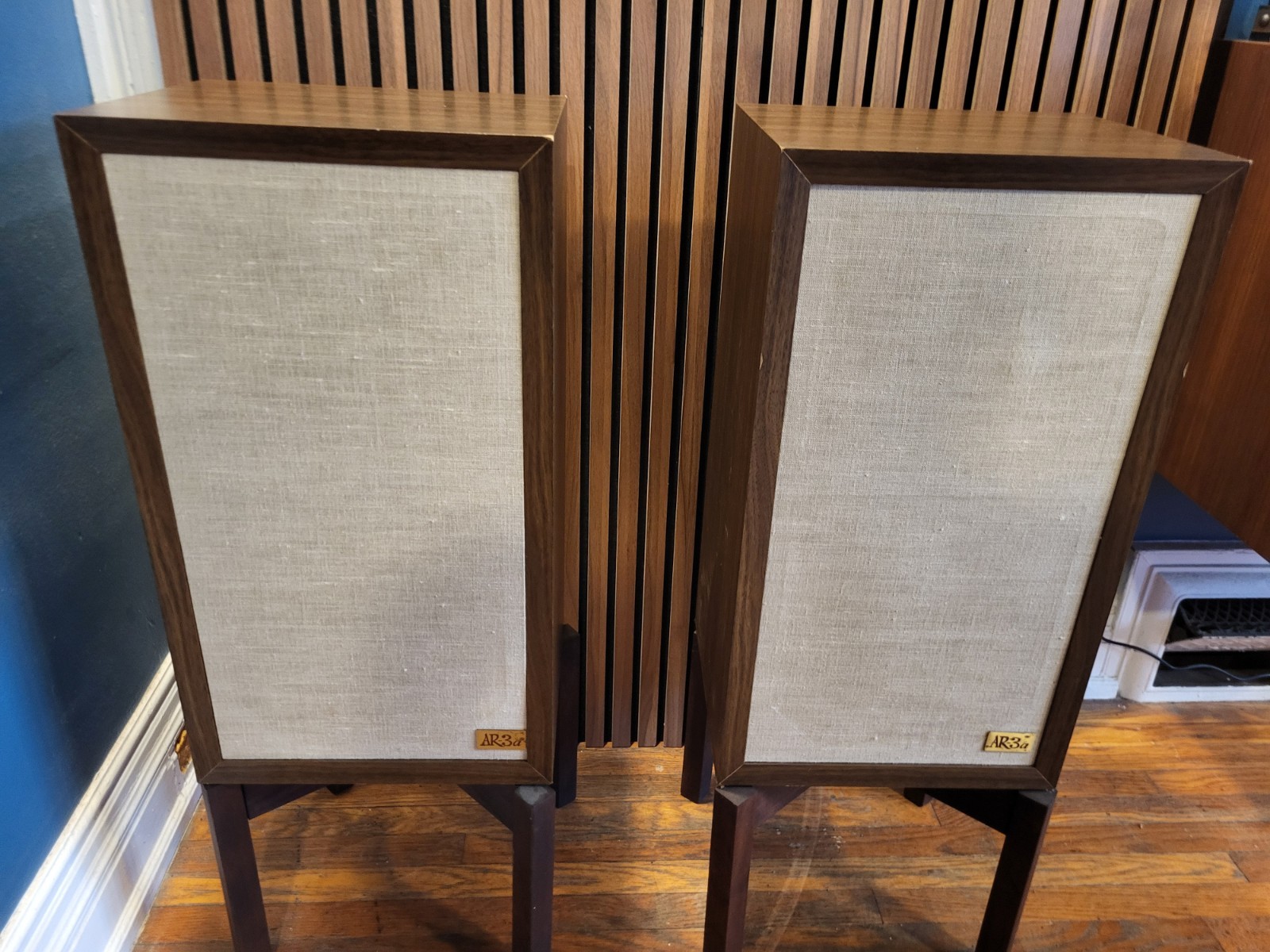

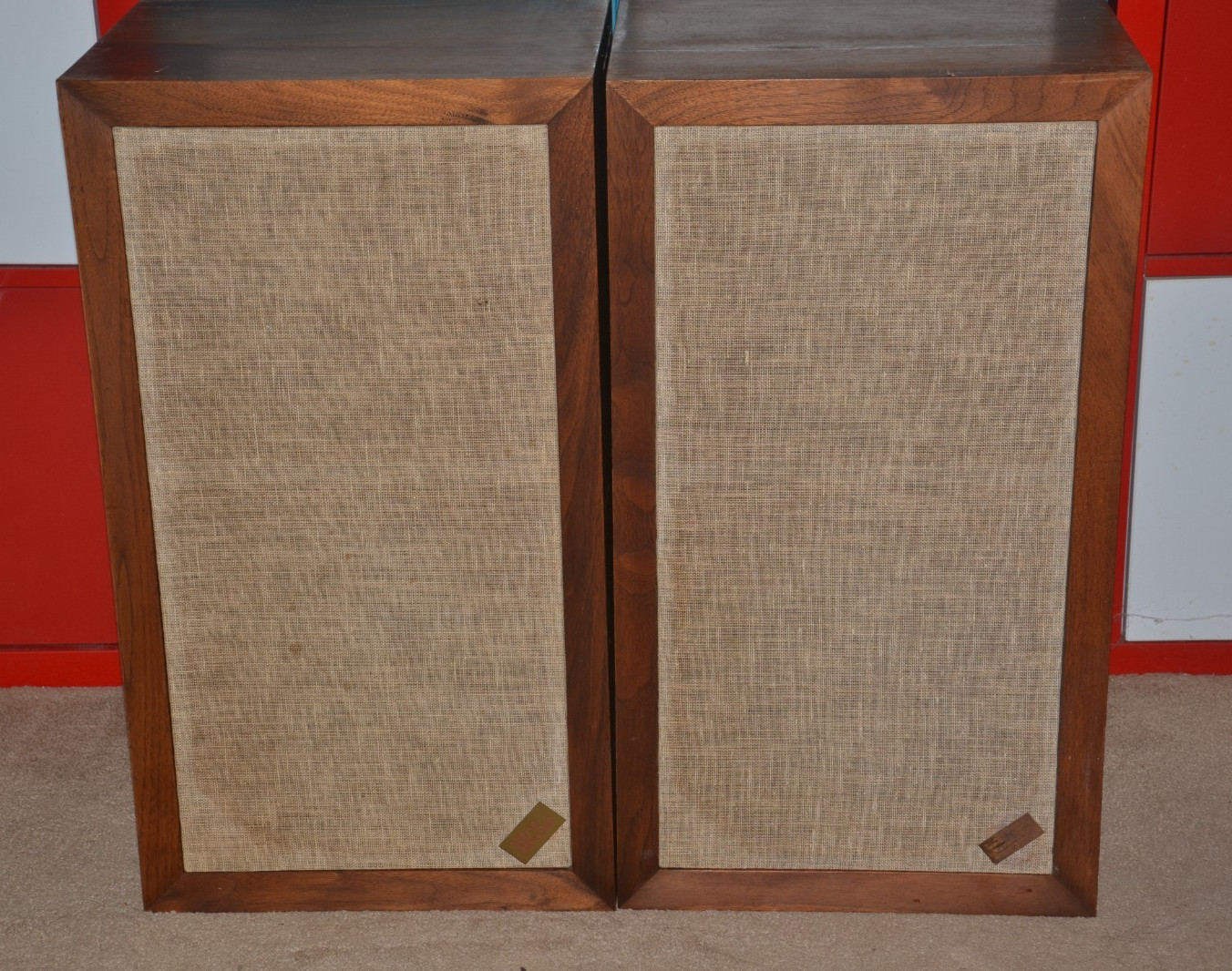
As an eBay Partner, we earn from qualifying purchases. This helps support our independent vintage technology research.