Acoustic Research AR-3a Improved ()
That warm, open midrange you’re chasing? It’s hiding in a walnut-clad cabinet from a British factory you’ve never heard of.
Overview
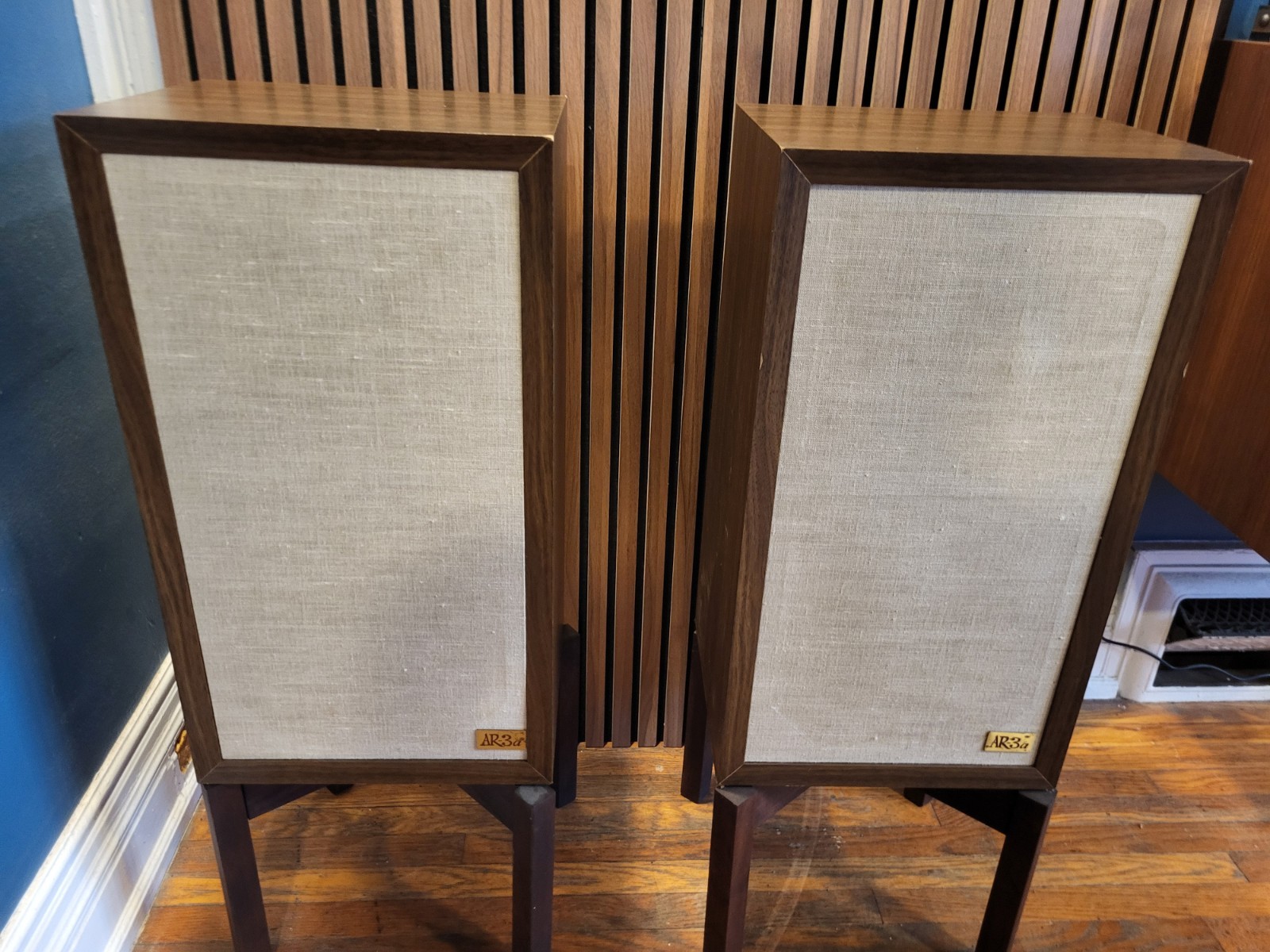
The Acoustic Research AR-3a Improved isn’t just another rehash of a classic—it’s the subtle European cousin of an American legend, quietly refined for listeners who noticed a whisper of coloration where there shouldn’t be. Built as the European-market version of the AR-3a, this dynamic loudspeaker carries the same DNA: three drivers in an infinite-baffle design, wrapped in elegant wood veneer, standing tall at over 60 cm with a presence that’s both stately and unassuming. It belongs to the 1960s design era, a time when AR was perfecting the acoustic-suspension formula that changed hi-fi forever. But the "Improved" badge isn’t marketing fluff—it signifies a real tweak, one aimed squarely at the midrange, where even a fraction of coloration can break the illusion of live sound.
Owners of the standard AR-3a loved its clarity, but some noted a slight thickness through the vocal range. Acoustic Research listened—well, at least the European arm did—and adjusted the crossover specifically to reduce that midrange coloration. That’s the entire difference, and it’s a telling one: when your speaker is already revered, the only way forward is surgical. The AR-3a itself was already a refinement over the AR-3, launched in 1969 with better drivers and a more sophisticated crossover network. It carried over the trusted 12-inch acoustic-suspension woofer from the legendary AR-1, a design so effective it became a template. Up top, the AR-3a introduced smaller dome midrange and tweeter units, reducing their dimensions to improve dispersion and smooth out the high-frequency delivery. The AR-3a Improved inherits all of this, just with that one targeted fix applied.
These aren’t flashy boxes. They don’t shout. But they communicate—effortlessly, honestly. They’re the kind of speaker that makes you forget you’re listening to electronics and wires, pulling you into the space between the musicians. And while they lack modern specs like sensitivity or power handling ratings (which remain unreported in the records), their 4 Ω impedance suggests they want a solid, current-capable amplifier nearby. The terminals accept pin connectors, a detail that might annoy banana-plug loyalists but was standard for the era. Each cabinet weighs in at 21.5 kg—solid, dense, and inert, the way good speakers should feel when you lift them.
Specifications
| Manufacturer | Acoustic Research |
| Dimensions (w x h x d) | 35,6 x 63,6 x 28,9 cm |
| Weight | 21,5 kg |
| Impedance | 4 Ω |
| Number of speakers | 3 |
| Connectors | Terminal for pin connectors |
| Type d'enceinte acoustique | Infinite |
| Presentation | Wood veneer |
Key Features
European Tuning: The “Improved” Difference
The AR-3a Improved isn’t a new model—it’s a recalibrated one. Marketed specifically in Europe, it’s functionally identical to the U.S.-spec AR-3a except for one key change: the crossover has been modified to reduce midrange coloration. That’s the official word, and it’s significant. The original AR-3a, while widely praised, wasn’t sonically perfect—some listeners detected a slight veiling or warmth in the upper bass and lower mids, a byproduct of crossover interactions or driver resonance. Acoustic Research addressed this not with new drivers or a cabinet redesign, but with a precision tweak to the network. That kind of refinement speaks volumes about where AR stood in the late '60s: they weren’t inventing anymore, they were perfecting.
Driver Lineage: Borrowed Brilliance
The AR-3a Improved benefits from two generations of AR innovation. Its 12-inch woofer is directly descended from the AR-1, the speaker that made acoustic suspension a household term. That design—using a sealed box and a carefully controlled suspension system instead of a port—delivered tight, articulate bass without the bloat or chuffing of reflex designs. It required more amplifier power, yes, but the trade-off was accuracy. For the midrange and tweeter, AR moved to smaller dome units, reducing their size compared to earlier models to enhance dispersion. A wider sweet spot means more forgiving placement and a more natural soundstage—critical for listeners who didn’t have dedicated listening rooms. Three drivers in total: one woofer, one midrange, one tweeter, each tasked with a clean slice of the spectrum.
Infinite Baffle: Simplicity with Substance
The AR-3a Improved uses an infinite baffle (sealed box) design, a hallmark of Acoustic Research’s philosophy. Unlike ported cabinets that rely on tuned resonance to extend bass, infinite baffle systems control the driver’s motion entirely through air pressure and suspension. The result is bass that starts a little higher in frequency but rolls off smoothly and remains time-coherent. There’s no “one-note” boom, no delayed port noise—just clean, articulate low end that integrates seamlessly with the mids. It’s a design that demands more from amplifiers, but rewards with transparency. And in a world full of reflex-loaded speakers chasing bass extension on paper, the AR-3a Improved reminds you that control often matters more than depth.
Historical Context
The AR-3a replaced the AR-3 in 1969, marking the next step in Acoustic Research’s evolution of the high-fidelity floorstanding speaker. It wasn’t a revolution, but a refinement—better drivers, a more refined crossover, and a design optimized for real-world listening. The AR-3a itself was described as an improved version of the AR-3, with upgrades across the board. The AR-3a Improved variant followed, tailored for European distribution with its modified crossover. This model sits firmly in the lineage between the AR-3 and its successors, the AR-11 and AR-10pi, which would eventually replace it in 1977. It is, by all accounts, a descendant of both the AR-3 and the original AR-3a, carrying forward their core acoustic-suspension principles while fine-tuning the delivery.
Collectibility & Value
The AR-3a Improved trades in a wide but telling range: listings show prices from as low as €300 to as high as $4,000. More typical are figures between €500 and €900, or equivalent in CAD, AUD, or SEK—CA$800 to CA$950, A$950, SEK 9,500 to 13,000. These fluctuations reflect condition, finish, and completeness. A pair listed at $3,666.20 as “Oiled Walnut” suggests premium restoration or rare finish, while the $4,000 eBay listing may reflect collector demand or inflated expectations. Realistically, well-maintained originals in good cosmetic and sonic condition are likely to fetch between €800 and €1,200, especially if they’ve had foam surrounds replaced.
Speaking of maintenance: while no specific failure modes are documented in the sources, the age of these speakers means foam degradation is inevitable. A universal foam surround kit for AR3a, AR10, AR11, and related models sells for $23.99, indicating that restoration is both expected and accessible. Individual driver replacements are available but costly: a genuine 12-inch AR woofer runs $174, the 5.75-inch dome midrange $120, and the 4.75-inch tweeter $85—prices that reflect scarcity and demand. Potentiometers, used in some AR models for level controls, are also replaceable, with generic versions selling for $50 and specific wirewound units for $145. These parts markets confirm that while the AR-3a Improved isn’t fragile, ownership today assumes a willingness to service and preserve.
eBay Listings



As an eBay Partner, we earn from qualifying purchases. This helps support our independent vintage technology research.