Acoustic Research AR-2a (1958–1967)
A warm, woody voice from the dawn of hi-fi — where sealed-box bass met cross-firing midranges and a tweeter that aged like old paper.
Overview
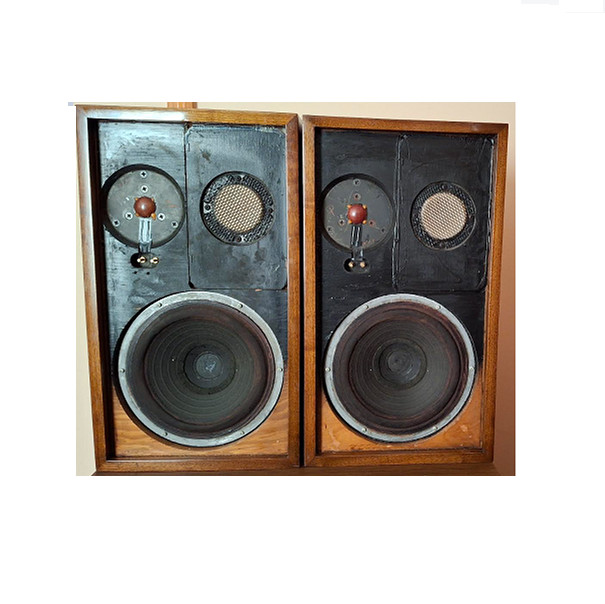
Turn one over in your hands and you’ll feel it: this isn’t just a speaker, it’s a time capsule wrapped in walnut veneer. The AR-2a doesn’t shout about its lineage — it murmurs it through a slightly rolled-off top end and a midrange so smooth it feels like conversation. Born in 1958 as a bridge between the no-frills AR-2 and the groundbreaking AR-3, the AR-2a was Acoustic Research’s attempt to bring dome-tweeter refinement to a more affordable platform without sacrificing the deep, taut bass that made their name. It didn’t get the fanfare of the AR-3, but in living rooms across America, it became the quiet workhorse of high fidelity — the kind of speaker that didn’t draw attention to itself, but made you forget you were listening to electronics at all.
Edgar Villchur’s acoustic suspension design was already proving revolutionary: sealed cabinets with compliant rubber surrounds allowing smaller enclosures to produce deep bass without port noise or boom. The AR-2a used a 10-inch woofer with a cloth surround — a deliberate choice over foam, which would later disintegrate in so many vintage speakers. That woofer reaches down to 42 Hz with authority, and stays flat within ±3 dB until it hits the crossover point. Below that, it still has usable output, dipping to -10 dB at 30 Hz — no small feat for a bookshelf-sized cabinet in the late 1950s. But the real story is up top: Villchur had just patented his direct-radiator dome tweeter, and the AR-2a was among the first to benefit. Gone was the harsh, directional piezo or horn; in its place, a 1.375-inch phenolic dome offering smoother dispersion and less fatigue. It wasn’t as extended as later tweeters, but for 1958, it was a revelation — delicate without being brittle, present without being piercing.
Sandwiched between them are two 5-inch midrange drivers, mounted at opposing angles inside the cabinet — a design AR called “cross-firing.” The idea was to reduce cabinet diffraction and create a more diffuse, room-filling midrange. In practice, it works: vocals emerge with a natural timbre, instruments occupy space without being spotlighted. But it’s not neutral. The AR-2a leans warm, almost genteel — a sound that flatters AM radio, jazz trios, and vocal recordings, but can feel a bit veiled with modern, densely mixed tracks. It’s not a speaker for analytical listening; it’s for long evenings with a glass of something brown, where the music wraps around you like a well-worn sweater.
And that’s the paradox of the AR-2a: it was engineered with scientific rigor, yet its magic lies in its subjectivity. Consumers Union gave the AR-2 a “Check” rating in 1956, and the AR-2a carried that legacy forward. But by the time it was discontinued in 1967, the audio world was shifting toward brighter, more revealing designs. The AR-2a didn’t evolve — it settled. It became the speaker your uncle kept in the den, the one that survived divorce, moves, and bad receivers because it was never flashy enough to discard.
Specifications
| Manufacturer | Acoustic Research |
| Production Years | 1958–1967 |
| Original Price | $119.50 per speaker (1958) |
| Woofer | 10-inch paper cone, cloth surround |
| Midrange | 2x 5-inch paper cone, cross-firing design |
| Tweeter | 1.375-inch phenolic dome |
| Enclosure Type | Acoustic suspension (sealed) |
| Frequency Response | 42 Hz – 20 kHz ±5 dB |
| Impedance | 8 ohms nominal |
| Power Handling | 20 watts minimum recommended |
| Crossover Frequencies | 2000 Hz / 7500 Hz |
| Sensitivity | 86 dB (1W/1m) |
| Dimensions (H×W×D) | 18.5 × 12 × 9.5 inches |
| Weight | 38 pounds per cabinet |
| Grille | Removable cloth-covered frame, stapled |
| Finish | Oiled walnut veneer |
| Connections | Single pair of binding posts |
| Warranty | 5 years, non-transferable, void if cabinet opened |
Key Features
The Cloth-Surround Woofer That Outlived Foam
While later AR models like the AR-3a and AR-4x would fall victim to crumbling foam surrounds, the AR-2a dodged that bullet entirely. Its 10-inch woofer uses a butyl-rubber-impregnated cloth surround — durable, flexible, and remarkably resistant to aging. Decades later, many original woofers still perform within spec, provided they haven’t been abused or exposed to extreme humidity. That durability isn’t just a maintenance win; it shapes the sound. Cloth surrounds offer a slightly softer attack than modern rubber, giving kick drums a rounded thump rather than a sharp snap. It’s less “accurate” by modern standards, but more forgiving of poor recordings — a virtue in an era of mono LPs and AM radio.
Cross-Firing Midrange: Diffusion Over Precision
Mounting two 5-inch midrange drivers at opposing angles inside the cabinet was AR’s clever solution to baffle-edge diffraction. Instead of both facing forward and interacting with the cabinet edges, they fire inward and reflect off the interior walls, creating a more diffuse sound wave. The result is a midrange that doesn’t “beam” — it spreads. Voices aren’t pinned to a point in space, but float in a broader soundstage. This works beautifully for solo instruments and vocals, but can blur detail in complex passages. It’s not a speaker for dissecting a string quartet; it’s for feeling the warmth of a saxophone in a smoky club. Some owners later replaced the dual mids with a single forward-firing unit (as in the AR-2ax), citing improved clarity — but they lost that signature diffusion in the process.
Phenolic Dome Tweeter: The First Step Toward Air
Villchur’s dome tweeter was a breakthrough, and the AR-2a was one of the first models to feature it. Made from a rigid phenolic resin, it’s less airy than modern silk or beryllium domes, with a gentle roll-off above 15 kHz. But it’s remarkably free of the harshness that plagued contemporary horn and cone tweeters. The trade-off is dispersion: while it’s wide for its time, it doesn’t quite match the 180-degree spread of later designs. Still, for 1958, it was a leap forward — listeners finally had a tweeter they could listen to for hours without fatigue. That said, the phenolic dome can become brittle with age, and replacements are rare. If the diaphragm is cracked or the voice coil damaged, sourcing a donor or custom rebuild is often the only option.
Historical Context
The AR-2a arrived at a pivotal moment. In 1958, high fidelity was no longer a niche hobby — it was entering middle-class homes. The AR-1 had proven the acoustic suspension concept, the AR-2 had brought it down in price, and the AR-3 had introduced the dome tweeter and midrange. The AR-2a was the synthesis: take the AR-2’s 10-inch woofer and cross-firing mids, graft on the AR-3’s tweeter, and deliver it at a price point ($119.50 per speaker) that undercut the AR-3 while offering more refinement than the AR-2. It wasn’t the flagship, but it was the sweet spot — the model that balanced innovation, performance, and affordability.
Competitors like KLH (founded by AR co-founder Henry Kloss) were licensing Villchur’s acoustic suspension tech, and brands like Advent and Fisher were entering the market with ported designs that offered more bass extension but less control. The AR-2a stood apart with its sealed-box precision and scientific design ethos. It wasn’t trying to impress at a trade show — it was built to measure well in a lab and sound natural in a room. That philosophy resonated with engineers, audiophiles, and reviewers. When Consumers Union gave AR speakers top marks, it wasn’t just a sales boost — it was validation that objective performance could coexist with subjective enjoyment.
By the mid-1960s, however, tastes were changing. The AR-2ax (introduced in 1967) replaced the cross-firing mids with a single forward-firing unit, signaling AR’s shift toward more conventional layouts. The AR-2a, in retrospect, was the last of a brief experiment — a transitional design that captured a specific moment when acoustic innovation met mid-century industrial design.
Collectibility & Value
The AR-2a trades in a narrow but passionate market. Unrestored pairs in working condition typically sell for $300–$500, while fully recapped and serviced units with refinished cabinets can fetch $700–$900. True mint examples — rare, given their age — occasionally break $1,200, especially if they include original grilles, badges, and warranty cards. But condition is everything. These speakers are 60 years old, and three components fail with alarming regularity: the crossover capacitors, the midrange level potentiometer, and the tweeter.
Crossover capacitors are the first to go. Original paper-and-oil types dry out and short, often taking the tweeter with them. A proper recap — using modern polypropylene or film caps matched to original values — is essential and costs $150–$250 per pair. More insidious is the midrange level control, a small potentiometer mounted inside the cabinet. Over time, dissimilar metals corrode, turning it into an open circuit. When that happens, the midrange drops out entirely, leaving only bass and a faint, distorted treble. Replacing it requires removing the woofer and opening the sealed cabinet — a move that voided the original warranty and still risks breaking the air seal. Many owners bypass the pot entirely, wiring the midrange at full level and adjusting balance at the amplifier.
The tweeter itself is fragile. If the phenolic dome is cracked or the voice coil rubs, replacement is difficult. NOS units are scarce, and modern substitutes don’t quite match the tonality. Some owners retrofit electrostatic or ribbon tweeters, but that alters the character fundamentally.
Before buying, check:
- Grille cloth for tears (original frames are stapled and hard to remove without damage)
- Cabinet for warping or water damage (the thin veneer is prone to lifting)
- Sound at low volume (listen for distortion in mids and tweeter)
- Back panel for re-capping evidence (a clean, modern crossover is a good sign)
Restoration is possible, but not cheap. Factor in $300–$500 for full servicing. These aren’t “plug-and-play” vintage speakers — they’re projects for enthusiasts who appreciate their historical role and warm, forgiving sound.
eBay Listings



As an eBay Partner, we earn from qualifying purchases. This helps support our independent vintage technology research.