Acoustic Research AR-8BX (mid-1980s)
A sealed two-way that never tried to be the flagship, and quietly out-resolved most of what sat next to it on the shelf.
Overview
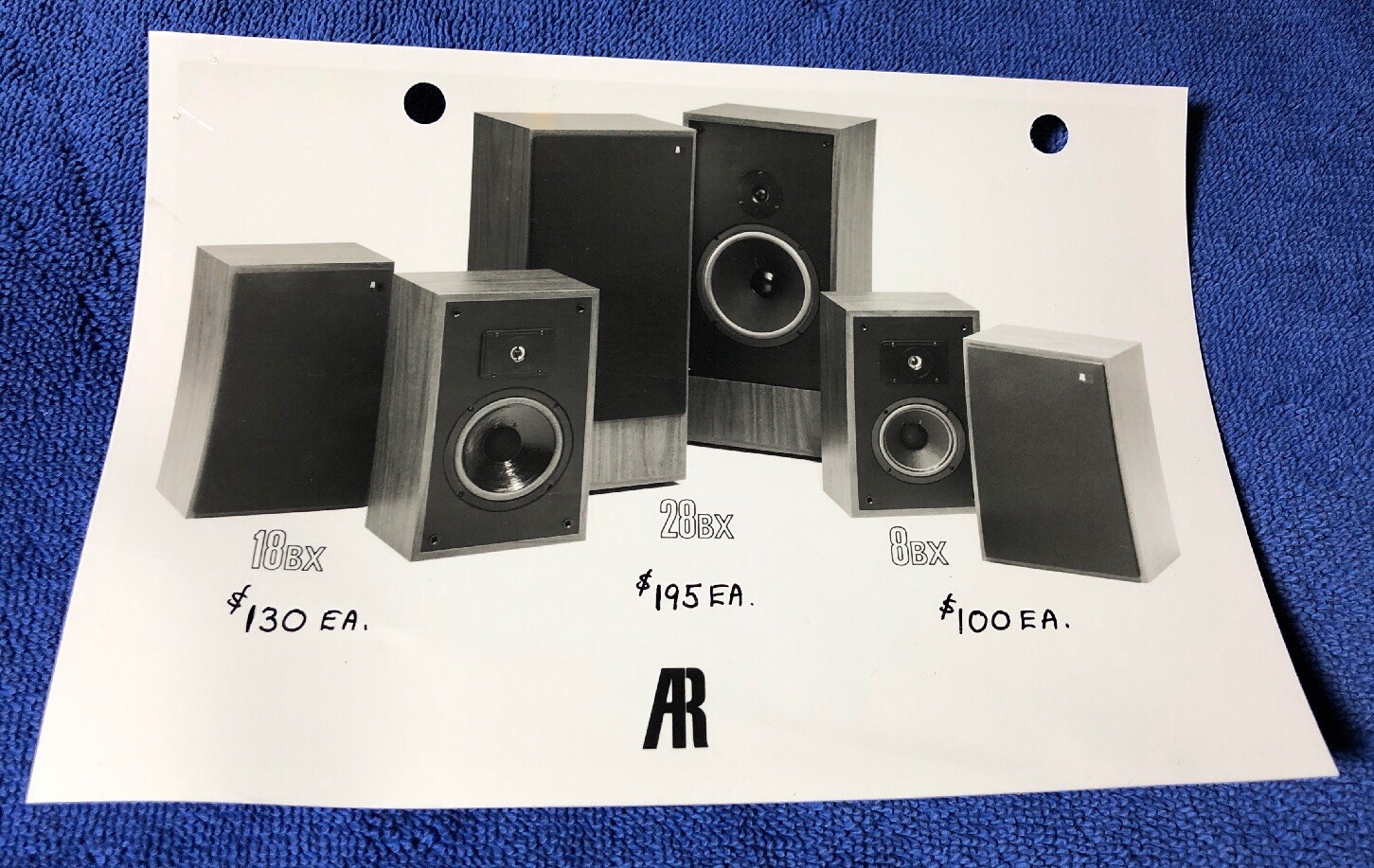
At 394 by 244 by 189 mm, the AR-8BX is a small box. It's a bookshelf speaker in the literal sense: sealed, built around a 6.5-inch carbon-loaded polypropylene woofer working into a 9.8-litre acoustic suspension cabinet, with a 25 mm low-mass, liquid-cooled dome tweeter handling everything above the crossover. Two drivers, two ways. Acoustic Research made no attempt to dress it up as anything grander.
It was meant for listeners who wanted more refinement than the entry models offered. Within the BX lineup, the 8BX was neither the flagship, which was the AR-18BX or AR-33BX, nor the budget model, which was the AR-6BX. It sat in the middle. The acoustic suspension loading comes down from the sealed-box principle Edgar Villchur pioneered at AR decades earlier. No port, no passive radiator, no tuning tricks. The air trapped in the cabinet is the spring, and the trade is efficiency for precision. Owners report the payoff is bass that starts and stops cleanly rather than hanging around after the note.
Feed it with something honest, a NAD 3020 or a vintage Sansui receiver, and the 8BX is articulate and balanced. It isn't built for booming bass or flashy imaging tricks. It's built so you notice the breath before the singer's first note, or the decay of a piano key in an otherwise silent passage. Pair it with a bright solid-state amp and the sound can turn clinical. Match it with a warm tube amp or a well-balanced integrated like a Marantz 2270 and the balance becomes much more involving. When properly restored, these speakers have a coherence that feels almost modern. They were never about slamming dynamics or room-filling volume.
Key Features
Sealed Acoustic Suspension Cabinet
The 8BX's enclosure is acoustic suspension - sealed, with no port to vent the woofer's backwave. That eliminates port noise and the tuning limitations of bass-reflex loading, and trades efficiency for precision. The 6.5-inch carbon-loaded polypropylene cone is modest in size, but it's well matched to the 9.8-litre internal volume, and that relationship is what keeps a small sealed woofer from going flabby. Undersized drivers in oversized boxes produce the loose, one-note bass that gave small speakers a bad name in the 1980s. AR kept the box and the driver in proportion.
25 mm Liquid-Cooled Dome Tweeter
The tweeter is a 25 mm low-mass dome, liquid-cooled and likely ferrofluid-damped. Ferrofluid damping in this era wasn't a marketing gimmick. It improved power handling, reduced distortion, and smoothed the high-frequency response. A healthy example stays remarkably neutral, with cymbals that shimmer without sizzle and strings that breathe without bite, avoiding the glassy harshness that afflicts so many aging vintage tweeters. The catch is the fluid itself. A dried ferrofluid cell can lead to tweeter failure or a brittle, fatiguing sound, and re-fluiding or replacing the tweeter is a known restoration path that is anything but trivial. Owners report that sourcing original-spec replacements is difficult, and many resort to high-quality Audax or Peerless units as substitutes. Purists argue those swaps lose a bit of the original character. Service technicians observe that early 8BX tweeters had better build quality than later production runs, so serial number and build date matter when you're shopping.
Minimalist Passive Crossover
The crossover network is deliberately simple: few components, high-quality parts for the era, and careful tuning to maintain phase coherence between the two drivers. Every extra capacitor or inductor in a passive network introduces another opportunity for distortion and coloration, so AR kept the path short. That gives the "unfiltered" quality AR fans tend to chase, and it means the 8BX reveals the character of whatever amplifier is driving it more clearly than a complex multi-way system would. That's a strength if you like your upstream gear, and a liability if you don't.
Recommended Amplifier Power: 10–75 W
AR rated the 8BX for amplifiers between 10 and 75 watts. That's a wide window, and it says the speaker isn't unusually hungry or unusually fussy. It just wants a clean signal. The 10-watt floor is low enough that a small integrated or a modest receiver will drive it to reasonable levels in a nearfield setup. The 75-watt ceiling reflects what the drivers and crossover can absorb without complaint. What the rating doesn't capture is the 8BX's habit of exposing amplifier character. A harsh amp at the bottom of that range will sound harsher through these than through a more forgiving speaker.
Compact Bookshelf Footprint
At 394 x 244 x 189 mm, the 8BX is shelf-sized, built for the rise of compact systems and small enough to sit on a bookshelf. The walnut veneer holds up well over the decades, though edge wear and finish scratches are common on working examples. Replacement grilles are available, but original grilles with the AR logo are preferred by collectors.
Historical Context
By the mid-1980s, the market was crowded with new high-end designs. High-Fidelity (April 1985, p.51) noted a wave of systems ranging from budget two-ways up to $1,500-per-pair flagships. The AR-8BX emerged during a transitional period for Acoustic Research. The company's golden era, the one defined by the AR-3 and AR-4, was already behind it, and the brand had been acquired by Teledyne back in the 1960s, shifting focus from boutique innovation toward broader consumer appeal. By the 1980s AR was competing in a crowded mid-fi market dominated by brands like JBL, Polk, and Sony, all pushing ported designs and flashy aesthetics. AR stuck with sealed cabinets and measured response.
The BX series - 8BX, 18BX, 33BX - was AR's attempt to modernize its legacy without abandoning its principles, and the "BX" reportedly stood for "balanced experience." The 8BX didn't reach the cult status of the AR-3a, but it earned quiet respect among listeners who valued accuracy over spectacle. One seller listing dates a pair to 1988, though that may be the year of that particular pair rather than the model's production run. Exact start and end years aren't documented in the sources that survive.
Collectibility & Value
The 8BX trades well below its more famous siblings. A pair in good original condition, with intact foam and functioning tweeters, typically sells for $100-$180 on the secondary market. Fully restored units that have been re-foamed, re-capped, and tested can fetch $200-$250, especially when sold with original grilles and hardware. Market listings have been spotted as low as $8 and as high as $166.55, so condition drives the price. Owners on collector forums have been known to ask outright what a pair is even worth, so there's no firm consensus on the model.
The foam surrounds on the woofer are the first thing to go. They degrade over time, producing flapping, distortion, or complete failure, and re-foaming is a common and well-documented process. Kits run roughly $40-$60 per speaker, and compatible foam kits are listed for the 8BX alongside the 8BXI and 8LS. The tweeter is the real wildcard. If the ferrofluid has dried, the dome may still work but it's living on borrowed time, and finding original-spec replacements is difficult. Used ones are a gamble. The ubiquitous 1-inch mylar dome, like those from Audax, is a popular substitute, but it changes the tonal balance and often makes the speaker brighter.
The buying checklist is short. Verify the woofers move freely without rubbing. Listen for rattles or distortion at low volumes. Check the tweeters for clarity, with no fizz and no dropouts. Avoid units advertised as "vintage charm" without functional testing, and don't pay a premium for original boxes. Replacement parts do surface. 6.5-inch replacement woofers listed as compatible with the AR8B and AR8BX have sold for around $29, and original glossy grilles for the 18BX, 28BX, and 8BX have gone for under $20.
eBay Listings

As an eBay Partner, we earn from qualifying purchases. This helps support our independent vintage technology research.