Acoustic Research AR-5 (1970–1975)
The midrange is smooth, detailed and natural. That is why people still hunt these down.
Overview
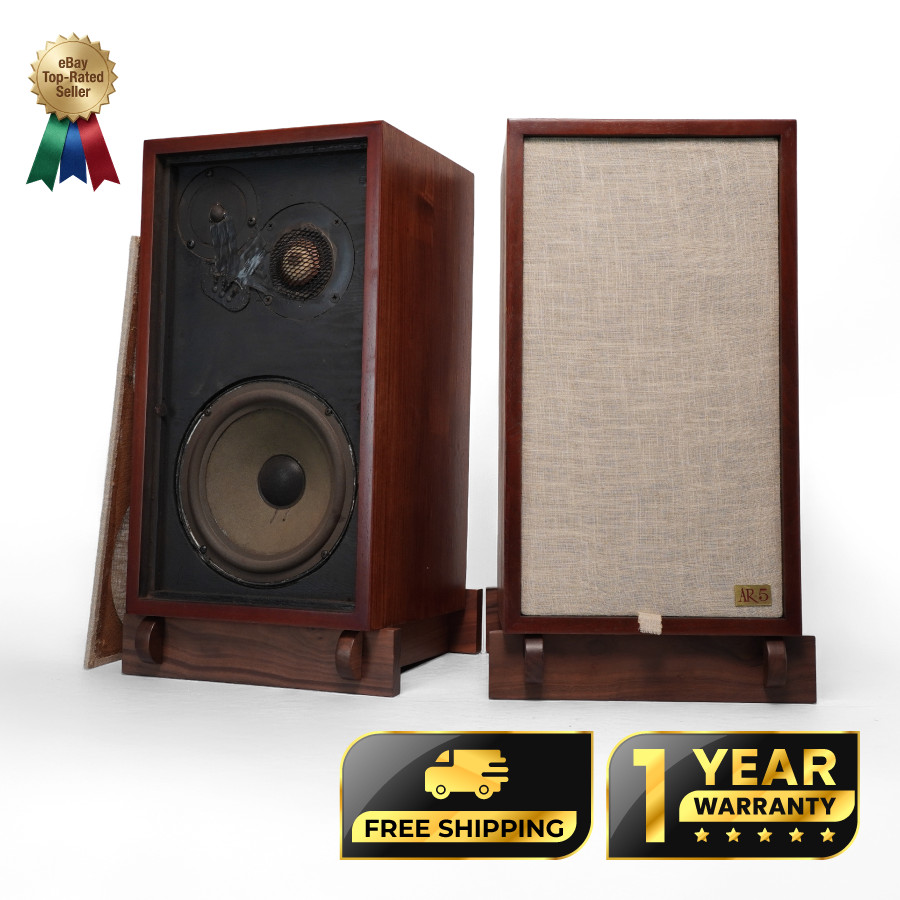
This is a walnut-clad AR-5 from the 1970s. It wasn't the flagship, and it wasn't the entry-level bargain. It was the middle model of Acoustic Research's acoustic suspension family, built for listeners who wanted serious performance without the price tag of an AR-3a. It starts with a 10-inch woofer sealed in its acoustic suspension chamber. The bass is taut and articulate, without the boominess of so many ported designs of the era. Higher up are a 1.5-inch hemispherical dome midrange and a 0.75-inch dome tweeter. Together they give vocals a very lifelike presence. There's no harshness and no fatigue, just clear midband.
Compared to the AR-3a, the AR-5 gives up some ultimate refinement and bass extension. In exchange it has a more compact footprint and a significantly lower original price. That made it a favorite among college grads, young professionals, and apartment dwellers who still wanted high fidelity. It wasn't built to fill a concert hall. It was built to make a bedroom or den feel like a private listening room. The AR-3a was the statement piece and the AR-5 was the workhorse. It does especially well with jazz, folk, and vocal-centric recordings.
It has compromises. The smaller cabinet limits deep bass output, so it won't shake walls like a modern subwoofer-driven system. It needs a careful amplifier match. Underpowered receivers leave it sounding thin, and overly bright solid-state amps can expose a slight edge in the upper mids if the crossover components have drifted over time. Pair it with a warm tube amp or a well-matched integrated from the same era and the balance comes right. It takes patience and proper setup.
Specifications
| Manufacturer | Acoustic Research |
| Production Years | 1970–1975 |
| Original Price | $245 per pair (1970) |
| Speaker Type | 3-way acoustic suspension |
| Woofer | 10" acoustic suspension |
| Midrange | 1.5" hemispherical dome |
| Tweeter | 0.75" hemispherical dome |
| Input Impedance | 8 ohms |
| Recommended Power | 20 watts minimum |
| Frequency Response | 45 Hz – 18 kHz |
| Crossover Frequencies | 500 Hz, 3.5 kHz |
| Sensitivity | 86 dB (1W/1m) |
| Dimensions (H×W×D) | 21.5" × 12.5" × 10.5" |
| Weight | 42 lbs per speaker |
| Enclosure Material | Walnut veneer over MDF |
| Grille | Fabric-covered foam with wooden frame |
| Terminals | Single binding posts (5-way) |
| Finish Options | Walnut (standard) |
Key Features
Acoustic Suspension That Actually Works
Long before ported cabinets became the norm, AR bet everything on sealed-box acoustic suspension. The 10-inch woofer is loaded into a precisely tuned air spring, which gets rid of the chuffing and phase issues of bass reflex designs. The bass is clean, controlled, and fast for its size. It won't rattle floorboards at 30 Hz, but from 50 Hz up it blends smoothly with the midrange. Kick drums have snap, not bloat. Acoustic bass lines stay articulate even in complex passages. With no port to misbehave, the bass stays consistent at any volume, with no sudden dips or peaks as you turn it up.
A Dome-Driven Midrange Revelation
Many manufacturers were still using cone midranges in the early '70s. AR went all-in on dome drivers for the AR-5. The 1.5-inch hemispherical dome midrange is the soul of this speaker. It's not as hyper-detailed as later ribbon or AMT designs, but it has a liquidity that few dome drivers have matched since. Voices sound very present, with just enough warmth to avoid sterility. Think Joni Mitchell on *Blue* or Bill Withers on *Live at Carnegie Hall*. The transition to the tweeter is smooth, thanks to a carefully engineered crossover that avoids the "suckout" some three-ways suffer between drivers.
Engineered for Real Rooms
At just over two feet tall, the AR-5 was designed to fit into real homes, not demo suites. The cabinet is compact for the time and allows flexible placement, though it still benefits from some distance from the wall to let the bass breathe. The single binding posts suggest AR expected most buyers to use modest receivers of the era, not monster separates. The 8-ohm impedance makes it a forgiving load, though it's not particularly efficient. Don't expect room-filling volume from anything under 20 watts. In a medium-sized room with a decent amp, the soundstage is wider and deeper than its size suggests. Imaging is precise without being artificially etched, and the dispersion is even enough that you don't need to sit in a "sweet spot."
Historical Context
The AR-5 arrived in 1970, right as Acoustic Research was at the peak of its influence. The company, founded by Edgar Villchur and Henry Kloss, had already revolutionized speaker design with the AR-1 and cemented its reputation with the AR-3. By the late '60s, AR speakers were everywhere, from dorm rooms to high-end audio salons. The AR-5 was part of a deliberate strategy to expand the lineup downward without giving up acoustic suspension. It sat below the AR-3a and AR-4, but above the smaller bookshelf AR-4x. Competitors like KLH (founded by Kloss himself), Advent, and Bose were all chasing AR's success, but few matched its combination of scientific rigor and musicality.
At the time, most budget speakers relied on ported designs or cheap cones to fake bass response. AR refused to compromise, even in a mid-tier model. The AR-5 became a staple in stereo systems across America, praised in magazines like *Stereo Review* for its natural tonality and lack of coloration. It wasn't flashy, but it was trustworthy. In an era when "hi-fi" often meant exaggerated highs and boomy bass, the AR-5 sounded like real instruments in a real space.
Collectibility & Value
Today, the AR-5 trades in the $150 to $400 range per pair, depending heavily on condition. Unlike the AR-3a, which has become a collectible, the AR-5 is still treated as a working speaker. That's good news for buyers, since you're more likely to find a pair that's been maintained and recapped than one sitting in a closet for 40 years. Still, age takes its toll. Foam surrounds on the woofer and midrange are the first to go, often crumbling by now. Refoaming is common and relatively affordable, but poor workmanship can ruin the balance. Always check for flaking foam or a "rattling" bass driver before buying.
The crossover is just as important. Electrolytic capacitors dry out over time, and original pots can get noisy. Owners report that cleaning controls and replacing old caps often turns a dull, lifeless pair into something vibrant. If the crossover hasn't been serviced, budget $100 - $150 for a proper recap. Original grilles are often missing or damaged. Replacements exist, but the correct fabric and frame style matter for both looks and sound diffusion.
The walnut veneer holds up well, but watch for water rings, scratches, or replaced baffles. Refinished cabinets can look nice but may affect resale. A fully restored AR-5 with new foam, recapped crossover, and clean terminals can command $500 or more.
eBay Listings



As an eBay Partner, we earn from qualifying purchases. This helps support our independent vintage technology research.