Accuphase T-100 (1973–1982)
The first tuner to make you forget you’re listening to radio waves at all
Overview
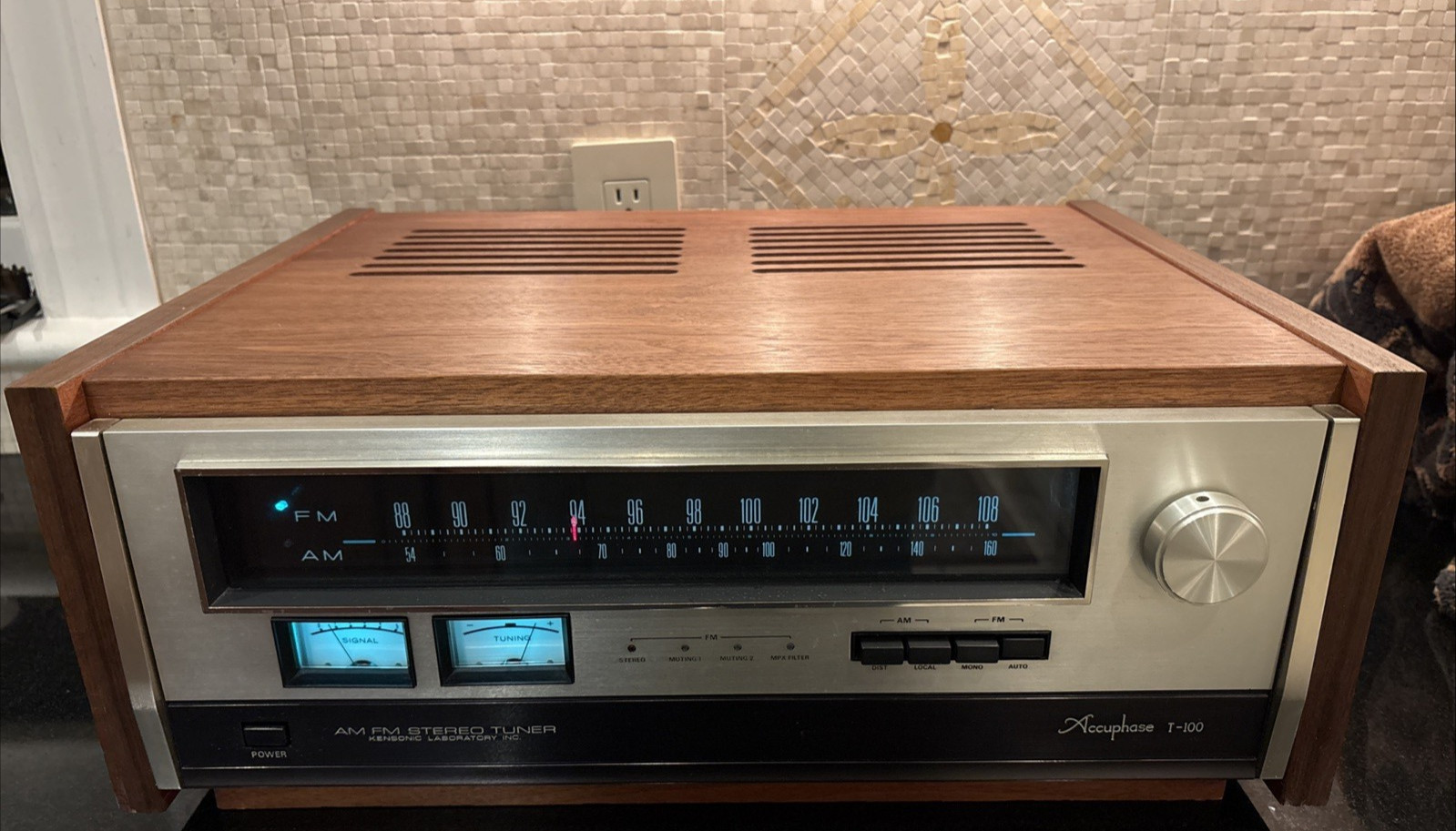
Turn the dial on an Accuphase T-100 after midnight, when the FM band opens up and distant signals drift in from across the country, and you’ll hear something most tuners can’t deliver: silence between the stations. Not just quiet—true, deep, vacuum-like absence of noise—so when a station does appear, it materializes with startling clarity, like a spotlight hitting a stage. That silence isn’t accidental. It’s the result of obsessive engineering: a 5-gang frequency-linear tuning capacitor, dual shielded double-tuned RF stages, and a front end built not to compete with other tuners of the 1970s, but to erase the limitations of broadcast reception itself. The T-100 wasn’t designed to be good for its era. It was built to be the last tuner you’d ever need.
Introduced in 1973 as part of Accuphase’s debut lineup—alongside the P-300 power amp and C-200 preamp—the T-100 arrived when Japanese high-end audio was still proving itself against Western giants like Marantz and McIntosh. But this wasn’t just another pretty face in a brushed aluminum chassis. The T-100 was a statement piece from engineers who had cut their teeth at Kenwood and left with a chip on their shoulder and a vision for what a tuner should be. Where others treated AM as an afterthought, the T-100 gave it serious circuitry: a flat-topped IF filter, a dedicated “haystack” filter for the tuning indicator, and a noise-reduction approach that actually worked without muddying the audio. It wasn’t rare to find AM broadcasts playing with 10 kHz bandwidth and no trace of the whistles or heterodynes that plague most tuners of the era.
And then there’s the FM section—widely regarded as one of the best analog FM front ends ever mass-produced. With a 5-gang RF stage (one more than the FM-only T-101), it achieved a level of selectivity and sensitivity that allowed it to dig weak signals out of the noise while rejecting adjacent-channel interference with surgical precision. Unlike later digital tuners that locked onto stations in 200 kHz steps, the T-100 let you glide smoothly across the dial, hunting for the sweet spot where a distant station peaks in clarity. There’s a tactile satisfaction in that analog tuning—a slow twist of the knob, watching the multipath meter flicker, adjusting the stereo noise filter just enough to clean up the edges without killing the highs. It’s a ritual, not a function.
Owners report that a well-aligned T-100, fed with a decent outdoor antenna, can outperform many modern receivers in real-world reception. It doesn’t just pick up more stations—it makes them sound like they’re coming from a CD. The stereo imaging is rock-stable, the bass tight, and the high frequencies extended without being harsh. One reviewer famously claimed he could hear the difference between vinyl and CD source material at the broadcast level—pops and surface noise from LPs, silence from digital—which speaks less to the limitations of FM and more to the T-100’s transparency.
But let’s be clear: this isn’t a tuner for the faint of heart or the casually curious. It’s heavy (over 20 pounds), power-hungry by modern standards, and demands attention. It warms up with a faint drift in tuning during the first 20 minutes—normal, expected, and easily managed if you know to wait. And while the build quality is legendary, time has not been kind to all its components. More on that later.
Specifications
| Manufacturer | Accuphase Laboratory, Inc. |
| Production Years | 1973–1982 |
| Original Price | $750 (USA) |
| Band | FM, AM |
| Tuning System | Analog, 5-gang FM tuning capacitor |
| FM Frequency Range | 87.5–108 MHz |
| AM Frequency Range | 530–1600 kHz |
| IF Frequency (FM) | 10.7 MHz |
| IF Frequency (AM) | 450 kHz |
| FM Sensitivity (26 dB SNR) | 1.2 µV |
| AM Sensitivity (26 dB SNR) | 20 µV |
| FM Selectivity (±400 kHz) | 70 dB |
| FM Signal-to-Noise Ratio | 70 dB (DIN) |
| FM Stereo Separation | 40 dB at 1 kHz |
| AM Signal-to-Noise Ratio | 50 dB |
| AM Selectivity (±9 kHz) | 40 dB |
| Audio Output (FM) | 150 mV (RCA, stereo) |
| Output Impedance | 600 ohms |
| Input Impedance (Antenna) | 75 ohms (FM), 300 ohms (AM, via terminals) |
| Power Supply | AC 100/117/220/240V, 50/60 Hz |
| Power Consumption | 26W |
| Weight | 9.8 kg (21.6 lbs) |
| Dimensions (W×H×D) | 483 × 146 × 378 mm (19 × 5.75 × 14.9 in) |
| Special Features | Two-step muting, stereo noise filter, independent AM/FM level controls, multipath indicator, dial lamp control, dual-gate MOSFET RF/mixer stages |
Key Features
The 5-Gang Front End That Changed the Game
Most high-end tuners of the 1970s used 4-gang tuning capacitors—one section for each stage of the RF and oscillator circuits. The T-100 went further, incorporating a fifth gang to improve tracking and linearity across the entire FM band. This wasn’t just overkill; it meant the tuner could maintain near-perfect alignment between the RF amplifier, mixer, and local oscillator, reducing image interference and improving signal capture in weak-signal areas. The result? Stations that other tuners struggle to pull in clearly appear stable and full-bodied on the T-100. It’s the difference between hearing a station “through” the tuner and feeling like it’s being handed to you, unfiltered and uncorrupted.
Analog Purity with Zero Compromise
While some competitors were beginning to experiment with digital readouts and synthesized tuning by the late 1970s, the T-100 stayed stubbornly, beautifully analog. No microprocessors, no digital noise, no tuning steps. Just a smooth, continuous dial and a needle meter that responds in real time. The stereo decoder is a single IC—unusual for a tuner that’s otherwise all discrete transistors—but even that was chosen for transparency. The rest of the signal path, from RF amplifier to audio output, uses discrete components throughout, avoiding the coloration that can come from integrated circuits in critical stages. The audio output stage, in particular, is built to audiophile standards, with careful attention to impedance matching and low distortion.
A Sophisticated AM Section That Actually Matters
Most AM/FM tuners of the era treated AM as a checkbox feature—functional, but dull and noisy. The T-100 treats AM like a serious broadcast medium. Its IF stage includes a flat-topped filter for consistent bandwidth and a separate “haystack” filter for the tuning indicator, preventing interference with the audio path. The result is AM reception with extended highs, solid bass, and a signal-to-noise ratio that rivals dedicated communications receivers. Talk radio, news, and even AM music stations come through with surprising fidelity. And because it includes a stereo noise filter and independent level controls, you can tailor the sound to your antenna setup and listening preferences.
Historical Context
The T-100 arrived at a pivotal moment. In the early 1970s, FM stereo broadcasting was still expanding, and high-fidelity home audio was transitioning from tube-based systems to solid-state designs. Japanese manufacturers were gaining credibility, but many still built down to a price. Accuphase did the opposite. Founded by former Kenwood engineers, the company’s philosophy was “build up to the spec,” and the T-100 was its first proof of concept. It wasn’t just competing with tuners from Sony or Pioneer—it was aiming at the same tier as McIntosh MR78 and Marantz 10B, units that cost significantly more.
At $750, the T-100 was expensive—equivalent to over $5,000 today—but it justified its price with performance that matched or exceeded far costlier units. It was distributed in the U.S. by TEAC, which helped establish its presence in high-end dealerships. While the later T-105 and T-108 models would introduce digital tuning and microprocessor control, the T-100 remained a pure analog design, a philosophy that still resonates with purists. Its closest competitors were the Harman-Kardon F-500, the Scott 4310, and the Fisher 800C—but where those often required modification to reach their full potential, the T-100 was exceptional straight from the factory.
It’s worth noting that the T-100 and T-101 were contemporaries, not sequential models. The T-101, introduced in 1974, was FM-only and slightly less expensive, but despite having one fewer tuning gang, it was often marketed as a more “focused” alternative. In practice, many experienced listeners found the T-100’s FM section superior due to its extra gang and more robust power supply. The inclusion of a high-performance AM section only widened the gap for those who valued broadcast versatility.
Collectibility & Value
Today, the Accuphase T-100 trades between $300 and $600 on the secondary market, depending on condition, alignment, and provenance. Units with clean dials, responsive knobs, and verified signal performance at the high end of the FM band command premiums. Cosmetically flawless examples with original packaging and manuals are rare and can exceed $700, especially if they’ve been professionally aligned.
But here’s the catch: not all T-100s on the market are what they seem. Many have never been aligned in decades, and some have degraded capacitors in the power supply or IF stages. The electrolytic capacitors, in particular, are prone to drying out after 40+ years, which can lead to hum, reduced sensitivity, or complete failure. Service technicians observe that a full recap of the power supply and signal path is often necessary to restore peak performance. The dual-gate MOSFETs in the RF stage are generally reliable, but if the tuner has been exposed to voltage spikes or moisture, they can fail silently, killing sensitivity without obvious symptoms.
When buying, test the following:
- Does the tuning feel smooth, or is there grit or looseness in the knob?
- Does the multipath meter respond to antenna movement?
- Is there audible hiss or hum on weak stations?
- Does AM reception have full bandwidth, or is it muffled?
- Are the front-panel lights and muting switch functional?
A T-100 that passes these checks is likely in good shape. But if it hasn’t been aligned in years, expect to budget $150–$300 for a professional alignment and recapping. Done right, the tuner will perform as it did in 1975. Done poorly, or not at all, and it’s just a heavy paperweight with a nice face.
Despite its age, the T-100 remains relevant. In an era of crowded FM bands and digital interference, its high selectivity and clean front end allow it to outperform many modern receivers. It won’t connect to your smartphone or stream Spotify, but if you care about broadcast fidelity—if you still believe radio can be high-end audio—then the T-100 isn’t just collectible. It’s essential.
eBay Listings



As an eBay Partner, we earn from qualifying purchases. This helps support our independent vintage technology research.