Accuphase PRO-20 (1994)
At 46.8 kg, this studio-built amplifier delivers 300W per channel with gold-plated signal paths and a 1,000 VA toroidal transformer. It was built for precision, not show.
Overview
The Accuphase PRO-20 is a stereo power amplifier made by Accuphase Laboratory, Inc. and released in January 1994. It was designed for studios, so the priorities are clean power, low distortion and stability under continuous operation. Unlike the consumer models, it was built for professional monitoring, where accuracy and reliability count for more than looks. A rear-panel switch gives it a monophonic bridge mode, so it can work as a balanced monaural amplifier when needed. The original price was ¥780,000. That put it in a high-end niche of the Accuphase lineup, aimed at studios and critical listening facilities rather than the domestic market.
Key Features
300W Output into 2Ω with 10-Parallel Push-Pull MOS-FETs
In stereo mode the PRO-20 delivers 300W per channel into 2Ω, 200W into 4Ω, and 100W into 8Ω. Those specs show it stays stable with difficult, low-impedance loads. In bridged monophonic mode it puts out 600W into 4Ω or 400W into 8Ω, enough to drive high-efficiency studio monitors or subwoofers. The output stage uses 20 MOS-FETs per channel in a 10-parallel push-pull configuration, each rated for 120W of allowable loss power. Under typical 8Ω loads, the power load per transistor pair is only about 5W. That keeps thermal stress down and helps longevity.
Hybrid IC-Modularized Balanced Differential Input Stage
The front end is Accuphase's balanced differential pure complementary push-pull circuit, modularized in a hybrid IC. This improves temperature stability and noise performance and keeps the channels closely matched. FET buffers on both input phases give high input impedance and low output impedance. According to available documentation, the modular design adds to the amplifier's long-term reliability, which matters in studios where equipment runs for long stretches.
Gold-Plated Signal Paths and Oxygen-Free Copper Bus Boards
Gold plating covers all the critical signal paths. The printed circuit boards in the signal path are gold-plated to reduce skin resistance, which is meant to preserve high-frequency detail. The oxygen-free copper bus boards that connect the output terminals are gold-plated too, which cuts oxidation and contact resistance over time. None of this is cosmetic. It is a systematic effort to remove possible sources of signal degradation in a professional setting.
1,000 VA Toroidal Transformer with Dual 56,000 μF Capacitors
Power comes from a 1,000 VA toroidal transformer paired with dual 56,000 μF filter capacitors. This keeps the voltage supply stable during dynamic transients, which helps maintain clarity in complex passages or dense mixes. The power supply accepts AC110V/117V/220V/240V at 50Hz or 60Hz, so the unit works in studios worldwide without modification.
Passive Cooling via Die-Cast Aluminum Heat Sink
Despite the high output, the PRO-20 is cooled passively. A large aluminum die-cast heat sink dissipates the heat with no fan, so there is no mechanical noise to interfere with recording or monitoring. With no moving parts, reliability also benefits. Owners note that adequate ventilation around the unit is essential, especially during sustained high-output operation.
Balanced and Unbalanced Input Options with High Input Impedance
Inputs are RCA (unbalanced) and XLR (balanced), which covers a wide range of studio and high-end consumer sources. Balanced input impedance is 40kΩ and unbalanced is 20kΩ, high enough to avoid loading most preamplifiers. Input sensitivity is 0.80 V for full stereo output into 8Ω and 1.59 V in bridged mono mode, in line with standard professional line levels. Gain is fixed at 28.0 dB in both configurations.
Historical Context
Accuphase developed the PRO-20 specifically as a studio amplifier. Many of the brand's contemporaneous models were tailored for audiophiles, but the PRO-20 put stability, headroom and neutrality ahead of sonic character. Forum discussions from the early 2000s suggest it was considered a professional counterpart to the A-50V, with one user describing the PRO-20 (U) as the "pro version" of that model. Accuphase never officially confirmed this lineage. The January 1994 release puts it in the final wave of analog-centric, discrete-component amplifiers before digital signal processing began to reshape studio gear.
Collectibility & Value
The PRO-20 is a rare find on the secondary market, and recent listings indicate strong collector interest. One unit was offered on eBay for $4,100 in tested working condition, and another appeared on Carousell Singapore at S$4,200. Those figures suggest stable, if niche, demand among vintage audio enthusiasts and studio gear collectors. No widespread reliability issues or common failure modes have been documented, though with no active cooling, thermal management should be considered in modern setups. Spare parts and service support are limited, since the model was never widely distributed outside Japan.
eBay Listings


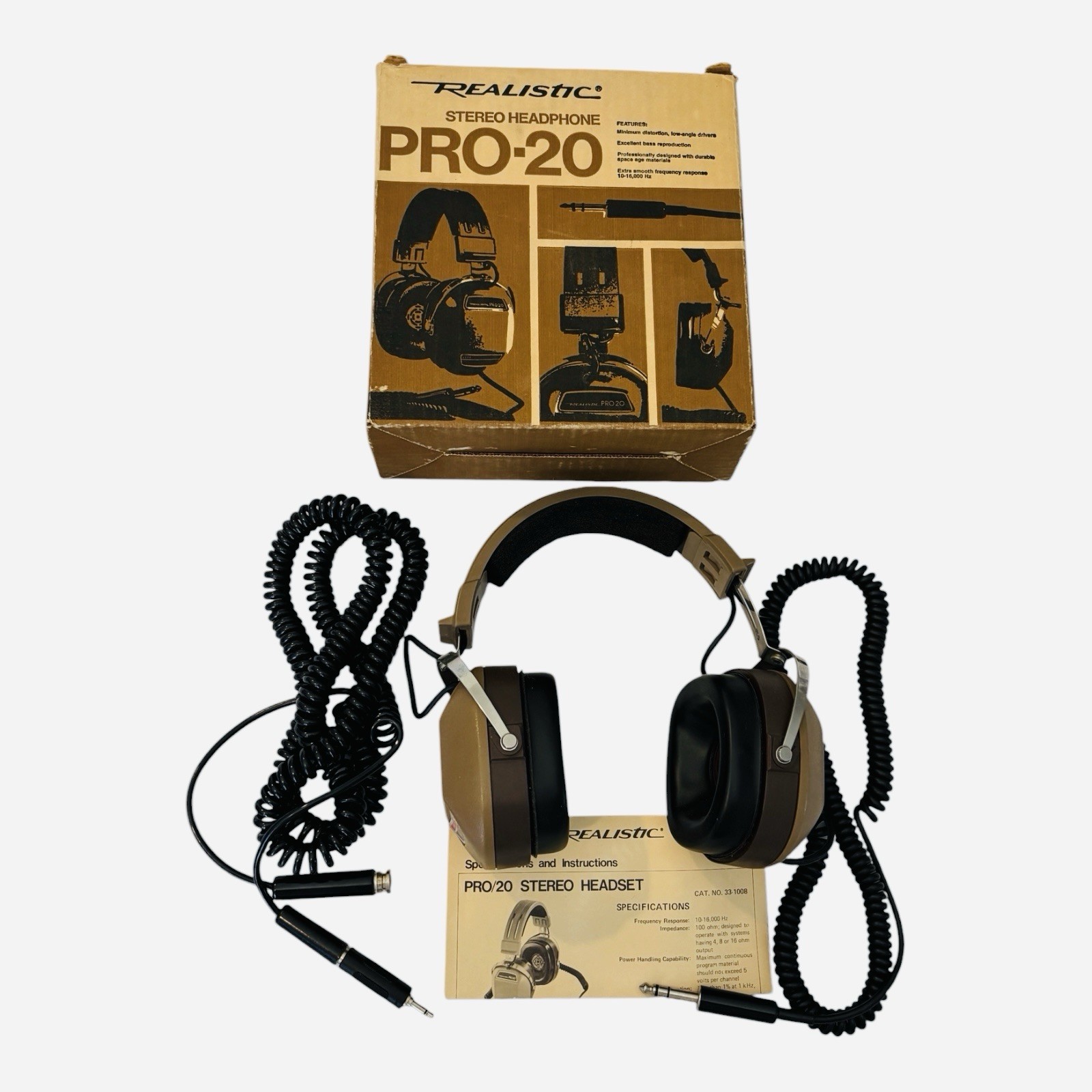
As an eBay Partner, we earn from qualifying purchases. This helps support our independent vintage technology research.
Service Manuals, Schematics & Catalogs
- Catalog (1992) — archive.org