Accuphase E-550 (2009)
One twist of the volume knob and you’re not just adjusting level—you’re feeling the precision of 65,536 discrete steps in a piece of engineering that hums with Class A grace.
Overview
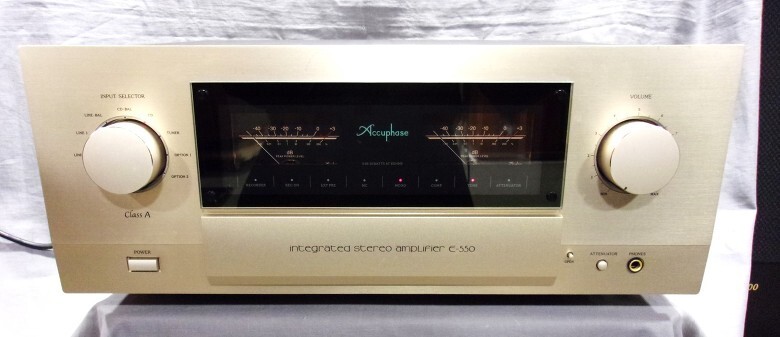
The Accuphase E-550 isn’t just an integrated amplifier—it’s a statement. Built like a vault and voiced like a concert hall, this 23.9 kg beast from Accuphase Laboratory, Inc. arrived in 2009 as the company’s top-of-the-line Class A integrated amplifier, succeeding the E-530 and carrying forward a legacy of obsessive build quality and sonic refinement. It doesn’t shout, but when it speaks, you listen. And you keep listening, because the sound—lush, muscular, detailed—has a way of making you forget you’re listening to electronics at all.
What sets the E-550 apart isn’t just its power, though its ability to deliver 150 watts per channel into a punishing 1 ohm load is nothing short of astonishing for a Class A design. It’s the way it does it: with composure, with silence, with a sense of effortlessness that reviewers have described as “frighteningly high” sound levels produced without compression or strain. One owner reported driving GamuT L5 speakers in a large room to near 90dB with “solid, unwavering composure”—and that was just the beginning.
But the real magic starts at the volume control. Accuphase’s AAVA (Analog Vari-Amplifier) system replaces the traditional potentiometer with a logic-controlled relay network offering 65,536 attenuation steps. It’s not a digital volume control; it’s an analog one built with such precision that reviewers note it “feels exactly the same as with a conventional control,” yet delivers a “rare, remarkable sense of assurance and satisfaction.” That’s not marketing fluff—that’s the sound of someone who’s turned the knob and felt something shift in the air.
And yes, it runs hot. It’s Class A, after all. Owners report it needs about an hour to reach optimal operating temperature, but once it’s warm, it stays locked in—no drift, no sag. The power supply, anchored by a large toroidal transformer and high filtering capacity, feeds two fully discrete, symmetrical amplifier sections using Power MOS-FETs in triple parallel push-pull configuration. The current feedback design and MCS+ (Multiple Circuit Summing+) topology aren’t just buzzwords—they’re the reason the E-550 delivers such tight control and seemingly unlimited current, even into difficult speaker loads.
It’s also built to last. The chassis is over-engineered in the best way: heavy-duty heat sinks, high-carbon cast-iron feet to dampen vibrations, and those signature gold-anodized aluminum front panels that look as good today as they did in 2009. The RCA and XLR inputs come with individual protective caps, the speaker terminals are oversized binding posts, and the signal path is kept as short and clean as possible thanks to logic-control relays. Even the option to bypass the preamp section via the EXT PRE button means you can use the E-550 as a standalone power amp—future-proofing in an era when separates were still king.
Specifications
| Manufacturer | Accuphase Laboratory, Inc. |
| Production years | Introduced in 2009 |
| Amplifier Class | A |
| Number of Channels | 2 |
| Continuous Average Output Power (both Channels driven, 20-20,000Hz) | 30 watts per channel into 8 ohm |
| Continuous Average Output Power (both Channels driven, 20-20,000Hz) | 60 watts per channel into 4 ohm |
| Continuous Average Output Power (both Channels driven, 20-20,000Hz) | 120 watts per channel into 2 ohm |
| Continuous Average Output Power (both Channels driven, 20-20,000Hz) | 150 watts per channel into 1 ohm |
| Total Harmonic Distortion (both channels driven 20-20,000Hz) | 0.02% (4-16 ohm load) |
| Total Harmonic Distortion (both channels driven 20-20,000Hz) | 0.05% (2-ohm load) |
| Intermodulation Distortion | 0.01% |
| Frequency Response (Power Input) | 20-20000Hz +0, -0.02 dB |
| Frequency Response (High Level Input) | 20-20,000 Hz +0, -0.2 dB |
| Damping Factor | 140 (with 8 ohm load, 50 Hz) |
| Input Sensitivity; Input Impedance (High Level Input) | 77.7 mV (for 1 W output); 20 KOhm |
| Input Sensitivity; Input Impedance (Balanced Input) | 77.7 mV (for 1 W output); 40 KOhm |
| Input Sensitivity; Input Impedance (Power Input) | 0.617 V; 20 KOhm |
| Output Voltage; Output Impedance (Pre-Out) | 0.617 V; 50 Ohm (at rated continuous average output) |
| Gain (High Level Input- Pre Output) | 18 dB |
| Gain (Power Input- Output) | 28 dB |
| Tone Controls Bass | 300Hz +/- 10 dB |
| Tone Controls Treble | 3 kHz +/-10dB |
| Loudness Compensation | +6 dB (100 Hz) |
| Attenuator | -20dB |
| Signal to Noise Ratio (High Level Input) | 103 dB (A-weighted) |
| Signal to Noise Ratio (Balanced Input) | 103 dB (A-weighted) |
| Signal to Noise Ratio (Power Input) | 120 dB (A-weighted) |
| Load Impedance | 2-16 Ohms |
| Power Requirements | AC 120/230V 50/60 Hz as indicated on back panel |
| Dimensions (W x H x D) | 465 mm x 196 mm x 427 mm |
| Weight | 23.9 kg (Net) |
| Inputs | 5 line inputs (RCA), 1 balanced input (XLR), 1 processor loop, 1 tape loop |
| Outputs | 2 sets of speaker outputs, 1 pre-out (RCA) |
| Volume control settings | 65,536 possibilities |
Key Features
The AAVA Volume Control: Analog Precision, Digital Steps
At the heart of the E-550’s user experience is the AAVA (Accuphase Analog Vari-Amplifier) volume control—a system so refined it blurs the line between analog purity and digital precision. Instead of a potentiometer, which can wear out and introduce noise, AAVA uses a network of logic-controlled relays to switch between resistors, offering 65,536 discrete attenuation levels. The result? No channel imbalance, no degradation over time, and a smooth, silent adjustment that feels completely natural. Reviewers have noted that it “feels exactly the same as with a conventional control,” yet delivers a level of fidelity that makes you wonder how you ever tolerated anything else.
Class A Power with Muscle to Spare
The E-550 runs in pure Class A, meaning both sides of the output stage are always conducting—wasteful in terms of power, but glorious in terms of sound. The amplifier section uses Power MOS-FETs in a triple parallel push-pull configuration, driven by a current feedback design and Accuphase’s proprietary MCS+ topology. This isn’t just about power—it’s about control. With a damping factor of 140 into 8 ohms, the E-550 grips speakers like a vice, delivering “effortless power” and “refined detail” even with low-impedance loads. And while rated at 30 watts into 8 ohms, reviewers have questioned Accuphase’s conservative ratings, suspecting the real output potential is even higher.
Built Like a Tank, Tuned Like a Violin
Every aspect of the E-550’s construction speaks to a philosophy of over-engineering. The symmetrical layout, fully discrete circuitry, and heavy-duty heat sinks aren’t just for show—they’re functional elements that contribute to the amplifier’s stability and longevity. The large toroidal transformer and high-capacity filtering ensure a rock-solid power supply, while the microprocessor-controlled protection system guards against shorts, overloads, and thermal runaway. Even the feet are engineered: made of high-carbon cast iron to isolate the chassis from vibrations. And those gold-anodized binding posts? They’re not just pretty—they’re functional, capable of handling thick speaker cables with ease.
Flexible, Expandable, and Thoughtfully Laid Out
The E-550 isn’t just a standalone amplifier—it’s a hub. With five RCA line inputs, one XLR balanced input, a processor loop, and a tape loop, it’s built for integration into a high-end system. The pre-out allows you to use it as a preamp with an external power amp, and the EXT PRE button makes that switch seamless. Option board slots let you add a DAC-20 or AD-20 for digital input or analog record playback, keeping the E-550 relevant in a changing world. And the tone controls—often a weak point in high-end gear—are implemented cleanly, with no audible distortion reported during operation.
Collectibility & Value
The Accuphase E-550 launched with an RRP of $9,995 or £5,500, positioning it firmly in the ultra-high-end integrated amplifier market. While original pricing is confirmed, production end year remains unverified—only a range of 2005–2009 appears in some sources, though 2009 is cited as the introduction year in authoritative spec databases. Used prices vary: a listing on Choice Hifi shows a current market price of £3,250, while Audio Forums notes that in 2009, used examples were selling for approximately £4,000–£4,500, depending on included option cards. A 2026 listing on HifiShark.com shows an asking price of €2,300 for an E-550 with DAC-20 and AD-20 option boards, suggesting that fully loaded units retain value well.
Despite its robust build, common failures or maintenance issues are not documented in the available sources. The existence of a service manual implies repairability, but no widespread reliability concerns have been reported. Given its reputation for “among the best ever made” build quality, the E-550 is considered a long-term keeper—especially for those who appreciate Class A warmth, AAVA precision, and the kind of engineering that doesn’t cut corners.
eBay Listings


As an eBay Partner, we earn from qualifying purchases. This helps support our independent vintage technology research.
Service Manuals, Schematics & Catalogs
- Service Manual — audiocircuit
- Catalog — archive.org
- Catalog (1991) — archive.org
- Catalog (1992) — archive.org