Accuphase E-305 (1987)
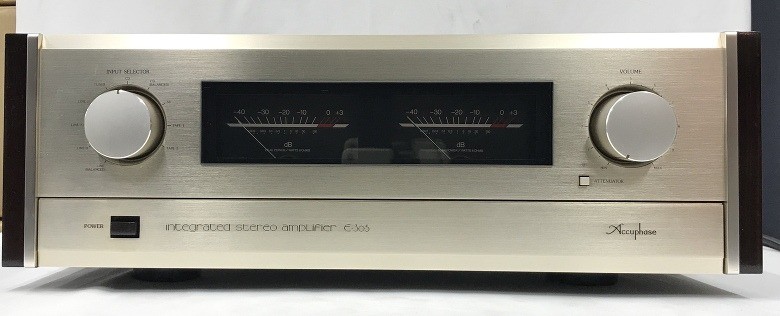
At 20.5kg, it sits heavy on the shelf. It's an integrated that behaves like separates.
Overview
The Accuphase E-305 is an integrated stereo pre-main amplifier built by Accuphase Laboratory, Inc. and released in December 1987 at ¥270,000. That price bought a full-scale three-amp configuration: a dedicated equalizer amplifier for analog discs, a high-gain preamplifier, and a power amplifier, each engineered as if it were its own component. The idea is simple and hard to execute. The total gain of an integrated amplifier exceeds 100 dB, and at those levels the stages start talking to each other. Accuphase used separate transformer windings for the phono, preamp, and power sections, and regulated the preamp with a full-scale constant voltage circuit. The line stage behaves like a standalone unit in its own chassis.
The power amplifier delivers 130W per channel into 8 ohms and 180W into 4 ohms, with a load rating spanning 2 to 16 ohms. Distortion is quoted at 0.02% THD across the full 20Hz-20kHz band in dual-channel operation, and IM distortion at 0.01%. Damping factor is 100 into an 8-ohm load at 50Hz. That combination of honest power and firm control suits complex or low-impedance speakers.
Today the E-305 is available only on the used market. It is a separates-grade vintage powerhouse, and it acts like one on the bench: 20.5kg in a 475 x 170 (including legs) x 375mm chassis, rated at 490W consumption at 8-ohm rated output.
Key Features
Three-Parallel Push-Pull Output Stage with 780W Collector Loss
The output stage runs a triple-parallel push-pull topology built around six bipolar transistors, each rated for a collector loss (Pc) of 130W. That sums to 780W of total collector loss capacity. It is far more than the rated output requires, and it's the reason the amp can deliver 180W into 4 ohms and stay composed into 2-ohm loads. MOS FETs handle the front stage driving those output devices, which keeps output impedance low and drive voltage high. The design goal, as Accuphase framed it, was low-load drive: enough current to feed speakers that make lesser amplifiers sweat.
Direct-Coupled Signal Path with Per-Stage DC Servos
Every unit amplifier in the E-305 is connected directly, starting from the analog disc input. There are no coupling capacitors in the signal path, so no phase shift and no bandwidth truncation. Direct coupling invites DC drift, which could put a woofer at risk. Accuphase stabilized each unit amplifier with its own DC servo circuit, which corrects offset without putting anything into the audio path. The signal runs unbroken from cartridge to speaker terminal.
Cascode Input Stage and Single-Chip Dual-Transistor Second Stage
The input stage is a cascode arrangement paired with a constant-current load, which yields wide bandwidth and high linearity. The second-stage differential amplifier uses a single-chip dual transistor as a complementary service circuit. That choice helps noise floor and thermal stability.
Dedicated Power Supplies and Regulated Preamp Section
The preamplifier and power amplifier have separate transformer windings, so supply interference can't bleed between stages. The preamp section is stabilized by a full-scale constant voltage circuit, the kind of regulation you'd expect from a standalone preamp rather than an integrated. The phono stage has to amplify microvolt-level MC signals, so it gets its own quiet supply.
MM/MC Phono Stage with Switchable Gain
The equalizer amplifier switches between MC and MM according to required gain. A low-noise, high-gm FET feeds a three-parallel cascode and bootstrap differential circuit, a topology chosen to keep S/N clean at low MC output levels. Sensitivity is 0.128mV into 100 ohms for MC and 4.3mV into 47k ohms for MM. Gain runs 29 dB from MM to tape record output and 60 dB from MC to tape record output. There's one caveat, and reviewers at the time noted it: the line stage's S/N is stronger than the phono stage's. If vinyl is your only source, an outboard phono stage is worth considering.
Relay-Based Input Switching with Silver-Palladium Contacts
Input selection is handled by sealed relays with cross-bar twin silver-palladium gold-plated contacts, controlled electronically by a logic circuit. There are eight input terminals and two balanced inputs. The relay approach avoids the contact resistance, oxidation, and channel imbalance that plague conventional switches and potentiometers over decades of use. That's a real concern for anyone buying a thirty-five-year-old amplifier.
Independent Recording Selector and Tape Copy Switch
The built-in recording selector is independent of the input selector, so you can record an FM broadcast while listening to a CD. A separate copy switch allows independent dubbing between two tape recorders. Separate pre-out and main-in terminals let the E-305 be split into a standalone preamp or power amp. On an integrated amplifier of this era, that much routing flexibility was unusual.
Additive Active Filter Tone Controls
The tone controls use an additive active filter method borrowed from graphic equalizer design: the flat signal passes straight through, and the correction is added only as needed. Bass turnover sits at 300 Hz with ±10 dB at 50 Hz; treble turnover at 3 kHz with ±10 dB at 20 kHz. A loudness compensator adds +6 dB at 100 Hz at -30dB volume, and a subsonic filter rolls off at 17 Hz at 12 dB/octave to tame warp and rumble. The front panel uses a gold-style scratch hairline finish with natural persimmon sideboards, and the secondary controls hide behind a tilting flap.
Logarithmic Peak Power Meter
The front-panel meter is a logarithmic compression peak level display, reading output directly on a dB scale into an 8-ohm load. It's a practical instrument, useful for spotting clipping before you hear it.
Historical Context
Accuphase released the E-305 in December 1987 as a refined successor to earlier integrated models like the E-202. The company's MOSFET lineage runs back further: Accuphase states it developed the E-303 in 1978 as the world's first integrated stereo amplifier using power MOSFETs. By the E-305, the improvements were in power supply design, Class A circuit refinement, and the move to direct-coupled DC servo topology. It was pitched at the "new audio era," where buyers wanted the convenience of one box without giving up separates-grade fidelity. The E-series as a whole ran from roughly 1982 to 1993, with the E-305 sitting in the upper-middle of the range. Period directories listed it alongside the Luxman L 560, and Audio (October 1988, p.172) catalogued integrated amplifiers of the era.
Collectibility & Value
The E-305 trades only on the used market, and prices reflect its reputation. Recent eBay listings have run $2,487 to $2,625 for units in good condition, with a serviced example listed higher. A Polish listing from September 2024 asked PLN 15,200. Original documentation survives: there's a 13-page service manual available, and an original English-language information folder circulates among collectors. At least one documented partial overhaul and repair has been written up by a French restorer, though no specific failure points are catalogued in the available literature. Watch for clones: a healthy clone and DIY board market has grown around the E-305, with varying success, so verify provenance carefully rather than trusting a familiar faceplate.
eBay Listings


As an eBay Partner, we earn from qualifying purchases. This helps support our independent vintage technology research.