Accuphase DP-77 (2002–2005)
That first SACD playback through its dual-mono DACs still gives me chills—like hearing a symphony hall exhale.
Overview
The Accuphase DP-77 isn’t just a CD/SACD player—it’s a statement. Released during the golden window of high-resolution physical media, it arrived when audiophiles were finally getting what they’d dreamed of: 1-bit DSD playback in the home, with engineering that didn’t cut corners. Built between 2002 and 2005, the DP-77 was positioned as the second-tier flagship in Accuphase’s integrated disc player lineup, just below the legendary DP-85 and the DP-100/DC-101 stack. That’s no minor distinction—this was a machine designed for those who wanted near-top-tier performance without stepping into six-figure territory.
What sets the DP-77 apart, even today, is its internal philosophy: though it fits transport and SACD processor in one chassis, they’re functionally isolated. You can bypass the internal transport entirely and use the DAC section as a standalone converter, thanks to dedicated digital inputs and outputs. That modularity was rare in integrated players and speaks to Accuphase’s commitment to future-proofing. It’s not just a player—it’s a system in disguise.
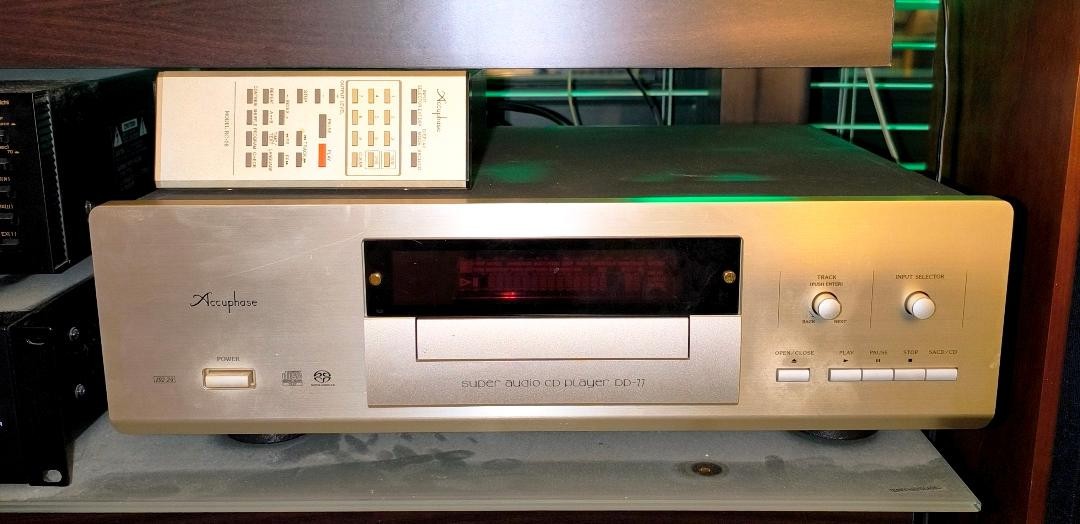
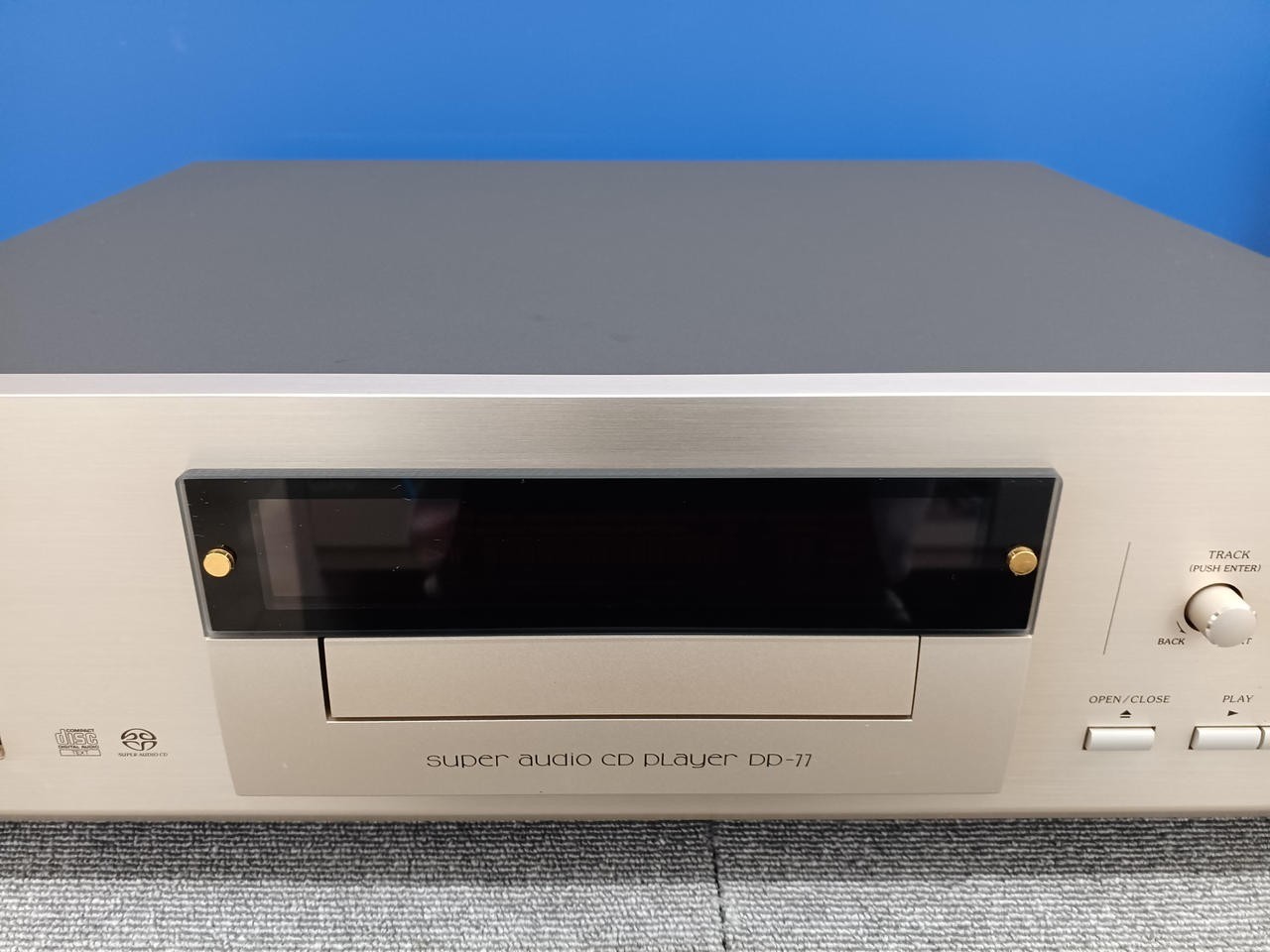
And let’s talk about that champagne front panel. It’s not flashy, but it’s unmistakable—elegant, understated, with the weight and presence of something built to last decades. Which it was. Weighing in at either 17.7 kg or 22.0 kg depending on the source (the discrepancy remains unresolved), it feels like a vault. The build quality, the board layout, the separate assemblies for DSP, DAC, and I/O—all scream obsessive attention to signal path integrity. This wasn’t mass-produced; it was engineered.
Specifications
| Manufacturer | Accuphase Laboratory, Inc. |
| Product type | Super Audio CD Player, integrated SACD/CD player |
| Production years | 2002–2005 |
| Disc format | CD, SACD |
| Digital converter | 24-bit MDS plus |
| Digital processor | Ready for 2.8224 MHz/1 bit and 192 kHz/24-bit source formats |
| Mechanism | Single lens/twin pickup high-speed access mechanism |
| Frequency response | 2 Hz to 20 kHz (SACD), 2 Hz to 20 kHz (CD) |
| Signal to Noise Ratio | 120 dB (SACD), 120 dB (CD) |
| Dynamic range | 110 dB (SACD), 100 dB (CD) |
| Total harmonic distortion | 0.0008% (SACD), 0.0015% (CD) |
| Channel separation | 110 dB (SACD), 110 dB (CD) |
| Line output | 2.5V (unbalanced), 2.5V (balanced) |
| Output level | 2.0 V (fixed), 0 to 2.0 V (variable) |
| Output impedance | 100 ohms (balanced), 50 ohms (unbalanced) |
| Digital outputs | coaxial, optical |
| HS-Link capability | via option board |
| Power Consumption | 28 watts |
| Net weight | 22.0 kg |
| Power type and voltage | Alternating Current supply (AC) / 220 Volt |
| Remote control | yes (RC-28) |
| Color | champagner Front |
Key Features
Dual-Section Architecture
The DP-77’s most compelling feature is its split personality. While it appears as a single integrated unit, the transport and SACD processor are electrically and physically segregated. This means owners can feed external digital sources into the DP-77’s exceptional DAC section—effectively using it as a standalone converter. For purists who wanted to pair a high-end transport with a reference-grade DAC but didn’t want two boxes, this was a rare and elegant solution.
Modular Expansion via Option Boards
Future flexibility was baked in. The DP-77 includes option board slots that allow users to expand digital I/O—adding more optical or coaxial inputs, or enabling HS-Link connectivity. HS-Link, Accuphase’s proprietary high-speed digital interface, lets the DP-77 integrate seamlessly with compatible preamps and processors, preserving bit-perfect DSD transmission. That kind of foresight in 2002 was ahead of its time.
High-Speed Twin Pickup Mechanism
The single lens/twin pickup mechanism isn’t just a marketing term—it’s a real engineering solution to disc stability and read accuracy. By using dual pickups on a single lens system, the DP-77 achieves faster access times and improved tracking, especially on warped or imperfect discs. It’s one of the reasons owners report such consistent, jitter-free playback even with older or scratched media.
24-bit MDS Plus D/A Conversion
At the heart of the DP-77 is Accuphase’s proprietary 24-bit MDS Plus (Multi Delta-Sigma) D/A converter. Designed to handle both 1-bit DSD (2.8224 MHz) and 24-bit/192 kHz PCM, it was built to extract every nuance from SACDs and high-res CDs alike. The specs back it up: 0.0008% THD on SACD playback is absurdly low, and the 120 dB signal-to-noise ratio ensures a dead-black background. This isn’t just clean—it’s silent, like turning off the world.
Historical Context
In 2002, the SACD format was still fighting for legitimacy. Competing with DVD-Audio and the looming digital shift, high-end manufacturers had to prove that physical media could deliver a future-proof, audiophile-grade experience. Accuphase didn’t just participate—they led. The DP-77 was their second-best integrated SACD player at the time, sitting just below the DP-85 and the DP-100/DC-101 stack. That placement wasn’t arbitrary: it offered 90% of the flagship’s performance at a more accessible price, making it a strategic offering for serious collectors who wanted Accuphase’s signature sound without the ultimate cost.
Collectibility & Value
The DP-77 entered the market at $8,000 USD—a serious investment even by today’s standards. Now, it trades in the €3,190 to €3,200 range, with recent listings from early 2025 and 2026 confirming stable demand among high-end analog enthusiasts. That’s not cheap, but it’s also not inflated—this is a machine that holds value because it still performs. The availability of service manuals (priced at $16.99 for download or $46.98 with AirMail USB) suggests repairability is viable, though no common failure modes are documented. Given its complex internal layout—seven distinct board assemblies and precision mechanics—owners should expect professional servicing for major issues. Still, the fact that repair guides exist at all is a win for long-term ownership.
eBay Listings

As an eBay Partner, we earn from qualifying purchases. This helps support our independent vintage technology research.